




The cardinality of a set A is 4 and that of set B is 3, then what is the cardinality of the set $A\vartriangle B$.
A. 1
B. 5
C. 7
D. Cannot be determined
Answer
 Verified
624k+ views
Hint: The set theory will be used to solve this problem. The cardinality of a set is defined as the number of elements in the set. For example, a set A ={1, 2, 3} has a cardinality of 3. Also, $A\vartriangle B$ represents a set which contains elements which are NOT common in A and B. We will try to find the number of elements in this set to find the answer.
Complete step-by-step answer:
We have been given a set A with cardinality 4, and a set B with a cardinality of 3. The cardinality of a set is equal to the number of elements in that set, so we can write that-
n(A) = 4
n(B) = 3
We need to find the cardinality of the set $A\vartriangle B$. This set contains the elements present in A but not in B and those which are present in B but not in A. In other words, it contains all the elements which are NOT common in A and B. It can be represented using Venn diagram as-
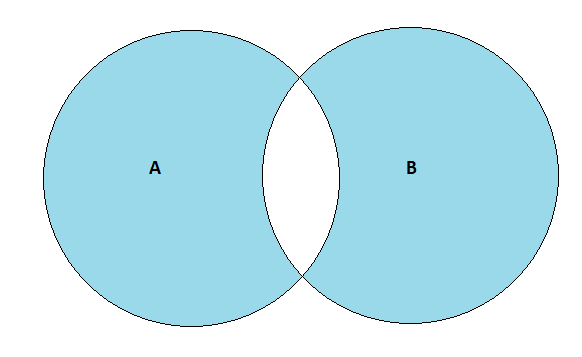
The shaded region represents $A\vartriangle B$. Mathematically, the formula to calculate the cardinality of $A\vartriangle B$ is-
$n\left( {A\vartriangle B} \right) = n\left( {A \cup B} \right) - n\left( {A \cap B} \right)$ which is the difference of union of A and B and the intersection of A and B. But we do not know the number of elements common in A and B, so it is not possible to find the cardinality of $A\vartriangle B$. Hence, the correct option should be D.
Note: The students should always remember that $A\vartriangle B$, contains the elements that are not common in A and B. They often misinterpret this definition and assume that this is a set of the elements that are common in A and B. Also, whenever they encounter a problem in set theory, they should always draw a suitable Venn diagram to better understand the problem.
Complete step-by-step answer:
We have been given a set A with cardinality 4, and a set B with a cardinality of 3. The cardinality of a set is equal to the number of elements in that set, so we can write that-
n(A) = 4
n(B) = 3
We need to find the cardinality of the set $A\vartriangle B$. This set contains the elements present in A but not in B and those which are present in B but not in A. In other words, it contains all the elements which are NOT common in A and B. It can be represented using Venn diagram as-
The shaded region represents $A\vartriangle B$. Mathematically, the formula to calculate the cardinality of $A\vartriangle B$ is-
$n\left( {A\vartriangle B} \right) = n\left( {A \cup B} \right) - n\left( {A \cap B} \right)$ which is the difference of union of A and B and the intersection of A and B. But we do not know the number of elements common in A and B, so it is not possible to find the cardinality of $A\vartriangle B$. Hence, the correct option should be D.
Note: The students should always remember that $A\vartriangle B$, contains the elements that are not common in A and B. They often misinterpret this definition and assume that this is a set of the elements that are common in A and B. Also, whenever they encounter a problem in set theory, they should always draw a suitable Venn diagram to better understand the problem.
Recently Updated Pages
Three beakers labelled as A B and C each containing 25 mL of water were taken A small amount of NaOH anhydrous CuSO4 and NaCl were added to the beakers A B and C respectively It was observed that there was an increase in the temperature of the solutions contained in beakers A and B whereas in case of beaker C the temperature of the solution falls Which one of the following statements isarecorrect i In beakers A and B exothermic process has occurred ii In beakers A and B endothermic process has occurred iii In beaker C exothermic process has occurred iv In beaker C endothermic process has occurred

Master Class 11 Social Science: Engaging Questions & Answers for Success
Master Class 11 Physics: Engaging Questions & Answers for Success
Master Class 11 Maths: Engaging Questions & Answers for Success
Master Class 11 Economics: Engaging Questions & Answers for Success
Master Class 11 Computer Science: Engaging Questions & Answers for Success
Three beakers labelled as A B and C each containing 25 mL of water were taken A small amount of NaOH anhydrous CuSO4 and NaCl were added to the beakers A B and C respectively It was observed that there was an increase in the temperature of the solutions contained in beakers A and B whereas in case of beaker C the temperature of the solution falls Which one of the following statements isarecorrect i In beakers A and B exothermic process has occurred ii In beakers A and B endothermic process has occurred iii In beaker C exothermic process has occurred iv In beaker C endothermic process has occurred
Master Class 11 Social Science: Engaging Questions & Answers for Success
Master Class 11 Physics: Engaging Questions & Answers for Success
Trending doubts
One Metric ton is equal to kg A 10000 B 1000 C 100 class 11 physics CBSE
There are 720 permutations of the digits 1 2 3 4 5 class 11 maths CBSE
State and prove Bernoullis theorem class 11 physics CBSE
Draw a diagram of a plant cell and label at least eight class 11 biology CBSE
Difference Between Prokaryotic Cells and Eukaryotic Cells
Discuss the various forms of bacteria class 11 biology CBSE