




The capacity between the point A and B in the adjoining circuit will be
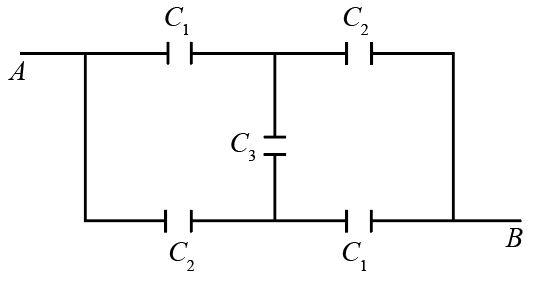
A. $\dfrac{{2{C_1}{C_2} + {C_3}\left( {{C_1} + {C_2}} \right)}}{{{C_1} + {C_2} + 2{C_3}}}$
B.$\dfrac{{{C_1}{C_2} + {C_2}{C_3} + {C_3}{C_1}}}{{{C_1} + {C_2} + {C_3}}}$
C.$\dfrac{{{C_1}\left( {{C_2} + {C_3}} \right) + {C_2}\left( {{C_1} + {C_3}} \right)}}{{{C_1} + {C_2} + 3{C_3}}}$
D.\[\dfrac{{{C_1}{C_2}{C_3}}}{{{C_1}{C_2} + {C_2}{C_3} + {C_3}{C_1}}}\]
Answer
 Verified
617.7k+ views
Hint: In this question, we will assume the total charge flowing in the circuit. We assume that a part of this charge will flow through a capacitor, and another part of this total charge will pass through another capacitor. The total charge in the circuit can be expressed as the product of voltage and the equivalent capacitance. This equivalent capacitance has the capacitance, which is equal to the sum of capacitance in the different capacitors. Then we will apply junction law, which says that the sum of all the incoming voltage at the terminal must be equal to the outgoing voltage. After solving the equation for the charges in capacitors, we will compare the equations formed, and then we will find the desired capacitance from terminal A and B.
Complete step by step answer:
The following is the schematic diagram of the circuit.
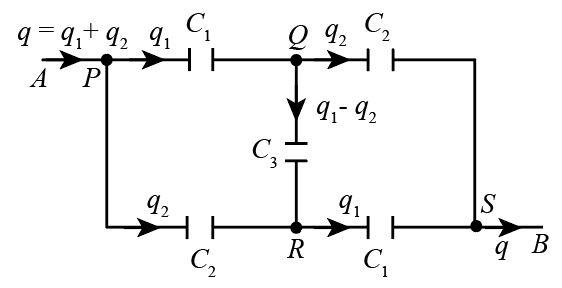
We will assume $q$ charge is flowing from the terminal $A$. Further ${q_1}$ part of charge $q$ will flow through capacitor ${C_1}$ and ${q_2}$ part of charge $q$ will flow through capacitor ${C_2}$. From terminal $Q$, ${q_1} - {q_2}$ will flow through ${C_3}$. Because of the symmetry$A$ ${q_1}$ charge will flow through another capacitor ${C_1}$ and ${q_2}$ charge will flow through another capacitor ${C_2}$. Assume voltage at terminal $P$ ,$Q$ ,$R$ and $S$ as ${V_P}$ ,${V_Q}$ ,${V_R}$ and ${V_s}$ respectively.
The total charge in the circuit can be expressed as:
$q = {C_{eq}}{V_P}$……(i)
Where, ${C_{eq}}$ is the equivalent capacitance in the circuit.
At terminal $Q$ , we will apply the junction law which can be expressed as:
$ {q_1} = {q_2} + {q_1} - {q_2}\\$
$ \implies \left( {{V_P} - {V_Q}} \right){C_1} = \left( {{V_Q} - 0} \right){C_2} + \left( {{V_Q} - {V_P} + {V_Q}} \right){C_3}\\ $
$\implies {V_P}{C_1} + {V_P}{C_2} = {V_Q}\left( {{C_1} + {C_2} + 2{C_3}} \right)\\$
$\implies {V_Q} = \dfrac{{{V_P}\left( {{C_1} + {C_3}} \right)}}{{{C_1} + {C_2} + 2{C_3}}}$..……(ii)
Now, we will find the charge ${q_1}$ in the circuit which can be expressed as:
${q_1} = \left( {{V_P} - {V_Q}} \right){C_1}$
In the above expression we will substitute the value of ${V_Q}$ from equation (ii), we get,
$ {q_1} = \left( {{V_P} - \dfrac{{{V_P}\left( {{C_1} + {C_3}} \right)}}{{{C_1} + {C_2} + 2{C_3}}}} \right){C_1}\\$
$\implies {q_1} = {C_1}{V_P}\left( {\dfrac{{{C_1} + {C_2} + 2{C_3} - {C_1} - {C_3}}}{{{C_1} + {C_2} + 2{C_3}}}} \right)\\$
$\implies {q_1} = {C_1}{V_P}\left( {\dfrac{{{C_2} + {C_3}}}{{{C_1} + {C_2} + 2{C_3}}}} \right)
……(iii) $
Similarly, we will find the charge ${q_2}$ in the circuit which can be expressed as:
${q_2} = {V_Q}{C_2}$
In the above expression we will substitute the value of ${V_Q}$ from equation (ii).
\[{q_2} = \dfrac{{{V_P}\left( {{C_1} + {C_3}} \right)}}{{{C_1} + {C_2} + 2{C_3}}}{C_2}\] ……(iv)
Now, we will find the total charge $q$ by adding ${q_1}$ and${q_2}$ from equation (iii) and (iv)
$ q = {q_1} + {q_2}\\$
$ \implies q = {C_1}{V_P}\left( {\dfrac{{{C_2} + {C_3}}}{{{C_1} + {C_2} + 2{C_3}}}} \right) + {C_2}{V_P}\dfrac{{\left( {{C_1} + {C_3}} \right)}}{{{C_1} + {C_2} + 2{C_3}}}\\$
$ \implies q = {V_P}\dfrac{{{C_1}{C_2} + {C_1}{C_3} + {C_1}{C_2} + {C_2}{C_3}}}{{{C_1} + {C_2} + 2{C_3}}}\\ $
$\implies q = {V_P}\dfrac{{2{C_1}{C_2} + {C_3}\left( {{C_1} + {C_2}} \right)}}{{{C_1} + {C_2} + 2{C_3}}}$ ……(v)
But from equation (i) we know that $q = {C_{eq}}{V_P}$. On comparing equation (i) and (v) we get,
$q = {V_P}\dfrac{{2{C_1}{C_2} + {C_3}\left( {{C_1} + {C_2}} \right)}}{{{C_1} + {C_2} + 2{C_3}}} = {C_{eq}}{V_P}$
From the above comparison we have the value,
${C_{eq}} = \dfrac{{2{C_1}{C_2} + {C_3}\left( {{C_1} + {C_2}} \right)}}{{{C_1} + {C_2} + 2{C_3}}}$
So, the correct answer is “Option A”.
Note:
The charge that is flowing through the different capacitors is a part of total charge. We need to find the expression for the charges through different capacitors. We will always keep in mind that the capacitance offered by the capacitors separately will produce the same effect as equivalent capacitance.
Complete step by step answer:
The following is the schematic diagram of the circuit.
We will assume $q$ charge is flowing from the terminal $A$. Further ${q_1}$ part of charge $q$ will flow through capacitor ${C_1}$ and ${q_2}$ part of charge $q$ will flow through capacitor ${C_2}$. From terminal $Q$, ${q_1} - {q_2}$ will flow through ${C_3}$. Because of the symmetry$A$ ${q_1}$ charge will flow through another capacitor ${C_1}$ and ${q_2}$ charge will flow through another capacitor ${C_2}$. Assume voltage at terminal $P$ ,$Q$ ,$R$ and $S$ as ${V_P}$ ,${V_Q}$ ,${V_R}$ and ${V_s}$ respectively.
The total charge in the circuit can be expressed as:
$q = {C_{eq}}{V_P}$……(i)
Where, ${C_{eq}}$ is the equivalent capacitance in the circuit.
At terminal $Q$ , we will apply the junction law which can be expressed as:
$ {q_1} = {q_2} + {q_1} - {q_2}\\$
$ \implies \left( {{V_P} - {V_Q}} \right){C_1} = \left( {{V_Q} - 0} \right){C_2} + \left( {{V_Q} - {V_P} + {V_Q}} \right){C_3}\\ $
$\implies {V_P}{C_1} + {V_P}{C_2} = {V_Q}\left( {{C_1} + {C_2} + 2{C_3}} \right)\\$
$\implies {V_Q} = \dfrac{{{V_P}\left( {{C_1} + {C_3}} \right)}}{{{C_1} + {C_2} + 2{C_3}}}$..……(ii)
Now, we will find the charge ${q_1}$ in the circuit which can be expressed as:
${q_1} = \left( {{V_P} - {V_Q}} \right){C_1}$
In the above expression we will substitute the value of ${V_Q}$ from equation (ii), we get,
$ {q_1} = \left( {{V_P} - \dfrac{{{V_P}\left( {{C_1} + {C_3}} \right)}}{{{C_1} + {C_2} + 2{C_3}}}} \right){C_1}\\$
$\implies {q_1} = {C_1}{V_P}\left( {\dfrac{{{C_1} + {C_2} + 2{C_3} - {C_1} - {C_3}}}{{{C_1} + {C_2} + 2{C_3}}}} \right)\\$
$\implies {q_1} = {C_1}{V_P}\left( {\dfrac{{{C_2} + {C_3}}}{{{C_1} + {C_2} + 2{C_3}}}} \right)
……(iii) $
Similarly, we will find the charge ${q_2}$ in the circuit which can be expressed as:
${q_2} = {V_Q}{C_2}$
In the above expression we will substitute the value of ${V_Q}$ from equation (ii).
\[{q_2} = \dfrac{{{V_P}\left( {{C_1} + {C_3}} \right)}}{{{C_1} + {C_2} + 2{C_3}}}{C_2}\] ……(iv)
Now, we will find the total charge $q$ by adding ${q_1}$ and${q_2}$ from equation (iii) and (iv)
$ q = {q_1} + {q_2}\\$
$ \implies q = {C_1}{V_P}\left( {\dfrac{{{C_2} + {C_3}}}{{{C_1} + {C_2} + 2{C_3}}}} \right) + {C_2}{V_P}\dfrac{{\left( {{C_1} + {C_3}} \right)}}{{{C_1} + {C_2} + 2{C_3}}}\\$
$ \implies q = {V_P}\dfrac{{{C_1}{C_2} + {C_1}{C_3} + {C_1}{C_2} + {C_2}{C_3}}}{{{C_1} + {C_2} + 2{C_3}}}\\ $
$\implies q = {V_P}\dfrac{{2{C_1}{C_2} + {C_3}\left( {{C_1} + {C_2}} \right)}}{{{C_1} + {C_2} + 2{C_3}}}$ ……(v)
But from equation (i) we know that $q = {C_{eq}}{V_P}$. On comparing equation (i) and (v) we get,
$q = {V_P}\dfrac{{2{C_1}{C_2} + {C_3}\left( {{C_1} + {C_2}} \right)}}{{{C_1} + {C_2} + 2{C_3}}} = {C_{eq}}{V_P}$
From the above comparison we have the value,
${C_{eq}} = \dfrac{{2{C_1}{C_2} + {C_3}\left( {{C_1} + {C_2}} \right)}}{{{C_1} + {C_2} + 2{C_3}}}$
So, the correct answer is “Option A”.
Note:
The charge that is flowing through the different capacitors is a part of total charge. We need to find the expression for the charges through different capacitors. We will always keep in mind that the capacitance offered by the capacitors separately will produce the same effect as equivalent capacitance.
Recently Updated Pages
Master Class 12 Business Studies: Engaging Questions & Answers for Success

Master Class 12 Biology: Engaging Questions & Answers for Success
Master Class 12 Chemistry: Engaging Questions & Answers for Success
Class 12 Question and Answer - Your Ultimate Solutions Guide
Master Class 11 English: Engaging Questions & Answers for Success
Master Class 11 Social Science: Engaging Questions & Answers for Success
Trending doubts
Which are the Top 10 Largest Countries of the World?
Draw a labelled sketch of the human eye class 12 physics CBSE
Differentiate between homogeneous and heterogeneous class 12 chemistry CBSE
Why is the cell called the structural and functional class 12 biology CBSE
Draw ray diagrams each showing i myopic eye and ii class 12 physics CBSE
Which is the correct genotypic ratio of mendel dihybrid class 12 biology CBSE