




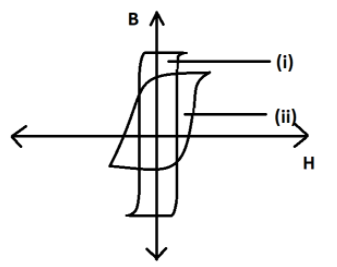
The B-H curve shown in the fig. associated with
A). (i) diamagnetic and (ii) paramagnetic substance
B). (i) paramagnetic and (ii) ferromagnetic substance
C). (i) soft iron and (ii) steel respectively
D). (i) steel and (ii) soft iron respectively
Answer
 Verified
631.5k+ views
Hint: The diagram shown in the figure represents the behaviour of a material taken through a cycle of magnetization. We need to study the property of retentivity and coercivity from the hysteresis loop that are given on the Y and X axis respectively.
Complete step by step answer:
The figure shows the hysteresis loop that represents the Magnetic field induction (B) on the Y-axis and magnetizing force (H) on the X-axis.
The value of magnetic field induction left in the specimen when the magnetising force is reduced to zero is called Retentivity of the material and it is seen on the Y-axis. To reduce the retentivity to zero we need to apply a magnetizing force in the opposite direction. This value of magnetising force is called the coercivity of the material and it is on the X- axis.
The retentivity of soft iron is greater than the retentivity of steel as it gets more strongly magnetised than steel. Also, soft iron loses its magnetism more rapidly than steel so its coercivity is less than that of steel. Accordingly, it can be seen from the figure that (i) represents soft iron and (ii) is steel.
Hence, the correct answer is option C. (i) soft iron and (ii) steel respectively.
Note: The students must remember that the area of B-H curve represents hysteresis loss. Note that hysteresis loss in case of soft iron is much less than the hysteresis loss due to steel. Steel and Iron are both ferromagnetic materials so options A , B are not correct.
Complete step by step answer:
The figure shows the hysteresis loop that represents the Magnetic field induction (B) on the Y-axis and magnetizing force (H) on the X-axis.
The value of magnetic field induction left in the specimen when the magnetising force is reduced to zero is called Retentivity of the material and it is seen on the Y-axis. To reduce the retentivity to zero we need to apply a magnetizing force in the opposite direction. This value of magnetising force is called the coercivity of the material and it is on the X- axis.
The retentivity of soft iron is greater than the retentivity of steel as it gets more strongly magnetised than steel. Also, soft iron loses its magnetism more rapidly than steel so its coercivity is less than that of steel. Accordingly, it can be seen from the figure that (i) represents soft iron and (ii) is steel.
Hence, the correct answer is option C. (i) soft iron and (ii) steel respectively.
Note: The students must remember that the area of B-H curve represents hysteresis loss. Note that hysteresis loss in case of soft iron is much less than the hysteresis loss due to steel. Steel and Iron are both ferromagnetic materials so options A , B are not correct.
Recently Updated Pages
Master Class 12 Economics: Engaging Questions & Answers for Success

Master Class 12 English: Engaging Questions & Answers for Success
Master Class 12 Social Science: Engaging Questions & Answers for Success
Master Class 12 Maths: Engaging Questions & Answers for Success
Master Class 12 Physics: Engaging Questions & Answers for Success
Master Class 12 Business Studies: Engaging Questions & Answers for Success
Trending doubts
Which are the Top 10 Largest Countries of the World?
Draw a labelled sketch of the human eye class 12 physics CBSE
Differentiate between homogeneous and heterogeneous class 12 chemistry CBSE
Why is the cell called the structural and functional class 12 biology CBSE
Draw ray diagrams each showing i myopic eye and ii class 12 physics CBSE
Which is the correct genotypic ratio of mendel dihybrid class 12 biology CBSE