




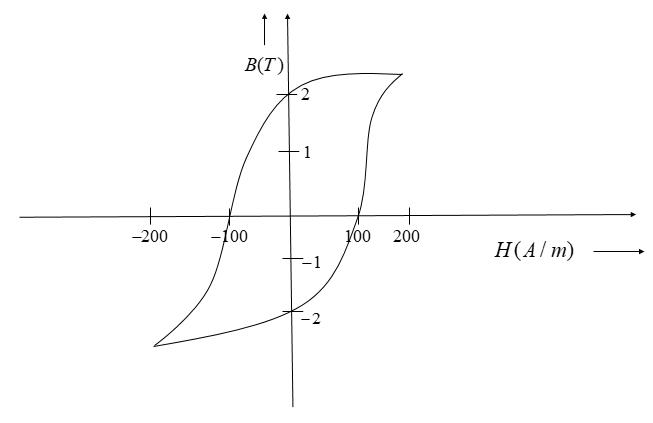
The $B-H$ curve for a ferromagnet is shown in the figure. The ferromagnet is placed inside a long solenoid with $1000 turns/cm$. The current that should be passed in the solenoid to demagnetize a ferromagnet completely is:
a) $2mA$
b) $1mA$
c) $3mA$
d) None of these
Answer
 Verified
585.3k+ views
Hint: B-H curve shows that a given material doesn’t not follow the same path during magnetization and demagnetization. This creates a difference in the current, which is responsible for reduction of magnetization of the material. The current, at which the current demagnetizes, no longer remains zero but has a negative value. We will use this concept along with the basic formula to find the answer.
Formula used: $Hl=NI$
Complete step by step answer:
The B-H curve represents the magnetization and demagnetization characteristics of a ferromagnetic material. It shows the amount of current required for a particular magnetization to be achieved. It also shows that for a given ferromagnetic material, the path traced during magnetization and demagnetization are not the same.
We know that the magnetic intensity has a unique relation with the current passing through the conducting wire along with the number turns. This relation is as follows:
$Hl=NI$
Where, $H$ is the magnetic field intensity, $l$ is the length of conductor, $N$ is the number of turns, $I$ is the current through the conductor.
We can modify the above equation as:
$H=\dfrac{N}{l}I$ ------(i)
Here, it can be clearly seen that for the complete demagnetization of the ferromagnetic material, the y-axis component must be zero, i.e., $B=0$. Clearly, at this point the value of $H$ is $100A/m$.
Putting this value of $H$ in equation (i), we get:
$\dfrac{100A}{m}=\dfrac{1000turns}{{{10}^{-2}}m}I$
$I=1mA$
So, the correct answer is “Option B”.
Note: Don’t panic when length is not mentioned in such questions. Generally, the length is already present in other parameters often disguised. For example, here length was present in the $N$ given in question as $turns/m$. Hence, because of this, we did not require the absolute length to solve the question.
Formula used: $Hl=NI$
Complete step by step answer:
The B-H curve represents the magnetization and demagnetization characteristics of a ferromagnetic material. It shows the amount of current required for a particular magnetization to be achieved. It also shows that for a given ferromagnetic material, the path traced during magnetization and demagnetization are not the same.
We know that the magnetic intensity has a unique relation with the current passing through the conducting wire along with the number turns. This relation is as follows:
$Hl=NI$
Where, $H$ is the magnetic field intensity, $l$ is the length of conductor, $N$ is the number of turns, $I$ is the current through the conductor.
We can modify the above equation as:
$H=\dfrac{N}{l}I$ ------(i)
Here, it can be clearly seen that for the complete demagnetization of the ferromagnetic material, the y-axis component must be zero, i.e., $B=0$. Clearly, at this point the value of $H$ is $100A/m$.
Putting this value of $H$ in equation (i), we get:
$\dfrac{100A}{m}=\dfrac{1000turns}{{{10}^{-2}}m}I$
$I=1mA$
So, the correct answer is “Option B”.
Note: Don’t panic when length is not mentioned in such questions. Generally, the length is already present in other parameters often disguised. For example, here length was present in the $N$ given in question as $turns/m$. Hence, because of this, we did not require the absolute length to solve the question.
Recently Updated Pages
Master Class 12 Economics: Engaging Questions & Answers for Success

Master Class 12 Physics: Engaging Questions & Answers for Success
Master Class 12 English: Engaging Questions & Answers for Success
Master Class 12 Social Science: Engaging Questions & Answers for Success
Master Class 12 Maths: Engaging Questions & Answers for Success
Master Class 12 Business Studies: Engaging Questions & Answers for Success
Trending doubts
Which are the Top 10 Largest Countries of the World?
What are the major means of transport Explain each class 12 social science CBSE
Draw a labelled sketch of the human eye class 12 physics CBSE
Why cannot DNA pass through cell membranes class 12 biology CBSE
Differentiate between insitu conservation and exsitu class 12 biology CBSE
Draw a neat and well labeled diagram of TS of ovary class 12 biology CBSE