




The area of the triangle formed by the lines $x=0,y=0$ and $\dfrac{x}{a}+\dfrac{y}{b}=1$ is:
1. $ab$
2. $\dfrac{ab}{2}$
3. $2ab$
4. $\dfrac{ab}{3}$
Answer
 Verified
541.8k+ views
Hint: For solving this for the straight line diagram, first of all, we should assume two lines that form the pair of equations, find the relation by multiplying the equations of these lines and comparing them with the given equations. Then using the equation of these straight lines, we can find the three points of the triangle. Now since we know the vertices of the triangle, we can calculate it’s area by using the formula, Area = $\dfrac{1}{2}\left| \begin{matrix}
{{x}_{1}} & {{y}_{1}} & 1 \\
{{x}_{2}} & {{y}_{2}} & 1 \\
{{x}_{3}} & {{y}_{3}} & 1 \\
\end{matrix} \right|$ .
Complete step-by-step solution:
According to the question it is asked to us to find the area of the triangle formed by the given lines, $x=0,y=0$ and $\dfrac{x}{a}+\dfrac{y}{b}=1$. Here we can see that the lines are given to us as $x=0,y=0$ and it is clear that both of these lines are x-axis and y-axis respectively. And both of these meet at (0, 0) and the third line which is given is $\dfrac{x}{a}+\dfrac{y}{b}=1$.
Here the $x$ intercept is $a$, and the $y$ intercept is given as $b$. So, the coordinates of the triangle are $\left( 0,0 \right),\left( a,0 \right),\left( 0,b \right)$. So, the triangle here is a right angle triangle.
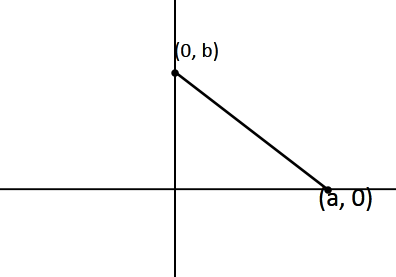
And the base of this triangle = $a$
And the height of this triangle = $b$
Since, area of triangle = $\dfrac{1}{2}\times base\times height$,
$\begin{align}
& =\dfrac{1}{2}\times a\times b \\
& =\dfrac{ab}{2} \\
\end{align}$
Hence the correct answer is option 2.
Note: For the random point triangle, we must note that the figure is just schematic and not to scale. While calculating the area, we must not forget about the modulus sign. This problem involves a lot of calculations, so we must write each step carefully and avoid mistakes.
{{x}_{1}} & {{y}_{1}} & 1 \\
{{x}_{2}} & {{y}_{2}} & 1 \\
{{x}_{3}} & {{y}_{3}} & 1 \\
\end{matrix} \right|$ .
Complete step-by-step solution:
According to the question it is asked to us to find the area of the triangle formed by the given lines, $x=0,y=0$ and $\dfrac{x}{a}+\dfrac{y}{b}=1$. Here we can see that the lines are given to us as $x=0,y=0$ and it is clear that both of these lines are x-axis and y-axis respectively. And both of these meet at (0, 0) and the third line which is given is $\dfrac{x}{a}+\dfrac{y}{b}=1$.
Here the $x$ intercept is $a$, and the $y$ intercept is given as $b$. So, the coordinates of the triangle are $\left( 0,0 \right),\left( a,0 \right),\left( 0,b \right)$. So, the triangle here is a right angle triangle.
And the base of this triangle = $a$
And the height of this triangle = $b$
Since, area of triangle = $\dfrac{1}{2}\times base\times height$,
$\begin{align}
& =\dfrac{1}{2}\times a\times b \\
& =\dfrac{ab}{2} \\
\end{align}$
Hence the correct answer is option 2.
Note: For the random point triangle, we must note that the figure is just schematic and not to scale. While calculating the area, we must not forget about the modulus sign. This problem involves a lot of calculations, so we must write each step carefully and avoid mistakes.
Recently Updated Pages
Master Class 12 Economics: Engaging Questions & Answers for Success

Master Class 12 English: Engaging Questions & Answers for Success
Master Class 12 Social Science: Engaging Questions & Answers for Success
Master Class 12 Maths: Engaging Questions & Answers for Success
Master Class 12 Physics: Engaging Questions & Answers for Success
Master Class 12 Business Studies: Engaging Questions & Answers for Success
Trending doubts
Which are the Top 10 Largest Countries of the World?
Draw a labelled sketch of the human eye class 12 physics CBSE
Differentiate between homogeneous and heterogeneous class 12 chemistry CBSE
Why is the cell called the structural and functional class 12 biology CBSE
Draw ray diagrams each showing i myopic eye and ii class 12 physics CBSE
Which is the correct genotypic ratio of mendel dihybrid class 12 biology CBSE