




The area of a square park is $ \left( {400 \pm 4} \right){m^2} $ . What is the length of one side of the park?
A. $ (20 \pm 2)m $
B. $ \sqrt {404} m $
C. $ (20 \pm 0.1)m $
D. $ (20 \pm \sqrt 2 )m $
Answer
 Verified
543.3k+ views
Hint: The area of the square park is already given so using the formula of area of the square we will first find the length of one side of the park and then the length of maximum difference in the length of the square park using the tolerance formula.
Area of square = $ A = {l^2} $
Therefore, the tolerance formula is
$ \dfrac{{\Delta A}}{A} = 2\dfrac{{\Delta l}}{l} $
Complete step-by-step answer:
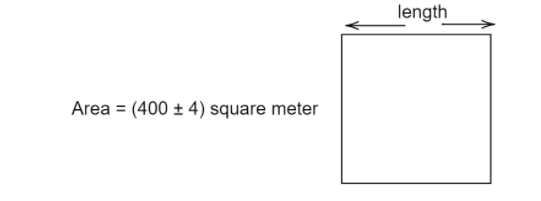
First, we will find the length of one side of the square park
Area of square park = $ 400{m^2} $
Area of square = $ A = {l^2} $
$ \therefore 400{m^2} = {l^2} $
Taking square root on both sides,
$ \sqrt {400{m^2}} = \sqrt {{l^2}} $
$ 20m = l $
Therefore, the length of one side of the square park is $ 20m $ .
The maximum difference in the area of square park is given as
$ \Delta A = 4{m^2} $
We know,
$ A = {l^2} $
Therefore,
$ \dfrac{{\Delta A}}{A} = 2\dfrac{{\Delta l}}{l} $
Substituting the values in the formula we get,
$ \dfrac{4}{{400}} = 2 \times \dfrac{{\Delta l}}{{20}} $
Now solving for $ \Delta l $ we get,
$ \therefore \Delta l = \dfrac{{4 \times 20}}{{400 \times 2}} $
$ \therefore \Delta l = \dfrac{2}{{20}} = \dfrac{1}{{10}} = 0.1m $
The maximum difference in length of one side of a square park is $ 0.1m $
So, the total length of the one side of a square park becomes $ (20 \pm 0.1)m $ .
The correct answer is option $ (C) $ . $ (20 \pm 0.1)m $ .
So, the correct answer is “Option C”.
Note: A square is a regular quadrilateral, this means that it has 4 identical sides and 4 identical angles (ninety-degree angles, or one hundred-gradian angles or proper angles). it could also be described as a rectangle in which adjoining sides have the same length. A square with vertices ABCD could be denoted $ \square ABCD $ .
Area of square = $ A = {l^2} $
Therefore, the tolerance formula is
$ \dfrac{{\Delta A}}{A} = 2\dfrac{{\Delta l}}{l} $
Complete step-by-step answer:
First, we will find the length of one side of the square park
Area of square park = $ 400{m^2} $
Area of square = $ A = {l^2} $
$ \therefore 400{m^2} = {l^2} $
Taking square root on both sides,
$ \sqrt {400{m^2}} = \sqrt {{l^2}} $
$ 20m = l $
Therefore, the length of one side of the square park is $ 20m $ .
The maximum difference in the area of square park is given as
$ \Delta A = 4{m^2} $
We know,
$ A = {l^2} $
Therefore,
$ \dfrac{{\Delta A}}{A} = 2\dfrac{{\Delta l}}{l} $
Substituting the values in the formula we get,
$ \dfrac{4}{{400}} = 2 \times \dfrac{{\Delta l}}{{20}} $
Now solving for $ \Delta l $ we get,
$ \therefore \Delta l = \dfrac{{4 \times 20}}{{400 \times 2}} $
$ \therefore \Delta l = \dfrac{2}{{20}} = \dfrac{1}{{10}} = 0.1m $
The maximum difference in length of one side of a square park is $ 0.1m $
So, the total length of the one side of a square park becomes $ (20 \pm 0.1)m $ .
The correct answer is option $ (C) $ . $ (20 \pm 0.1)m $ .
So, the correct answer is “Option C”.
Note: A square is a regular quadrilateral, this means that it has 4 identical sides and 4 identical angles (ninety-degree angles, or one hundred-gradian angles or proper angles). it could also be described as a rectangle in which adjoining sides have the same length. A square with vertices ABCD could be denoted $ \square ABCD $ .
Recently Updated Pages
Master Class 12 Business Studies: Engaging Questions & Answers for Success

Master Class 12 Chemistry: Engaging Questions & Answers for Success
Master Class 12 Biology: Engaging Questions & Answers for Success
Class 12 Question and Answer - Your Ultimate Solutions Guide
Master Class 11 English: Engaging Questions & Answers for Success
Master Class 11 Social Science: Engaging Questions & Answers for Success
Trending doubts
Which are the Top 10 Largest Countries of the World?
Draw a labelled sketch of the human eye class 12 physics CBSE
Differentiate between homogeneous and heterogeneous class 12 chemistry CBSE
Differentiate between Pyramid of energy and pyramid class 12 biology CBSE
Why is the cell called the structural and functional class 12 biology CBSE
Draw the diagram of the pyramid of energy Explain In class 12 biology CBSE