




The area (in square units) bounded by the parabola \[y={{x}^{2}}-1,\] the tangent at the point (2, 3) to it and the y-axis is:
\[\left( a \right)\dfrac{14}{3}\]
\[\left( b \right)\dfrac{56}{3}\]
\[\left( c \right)\dfrac{8}{3}\]
\[\left( d \right)\dfrac{32}{3}\]
Answer
 Verified
577.5k+ views
Hint: First, we will draw the graph of \[y={{x}^{2}}-1\] and find the equation of the tangent at (2, 3) using the differentiation. Then plot the points where these curves meet the x and y-axis. Now, apply the formula \[\int\limits_{a}^{b}{f\left( y \right)}dy-\int\limits_{c}^{d}{g\left( y \right)dy,}\] where f(y) is the equation of the tangent, ‘a’ and ‘b’ are the limits up to which the area is found, whereas g(y) is the equation of the parabola in terms of y and ‘c’ and ‘d’ are the limits up to which the area is found.
Complete step by step answer:
Here, we are provided with a parabola \[y={{x}^{2}}-1.\] Now, we have to find a tangent at the point (2, 3).
\[\Rightarrow y={{x}^{2}}-1\]
On differentiating, we get,
\[\Rightarrow \dfrac{dy}{dx}=2x-0\]
\[\Rightarrow \dfrac{dy}{dx}=2x\]
At point (2, 3), we have,
\[\Rightarrow \dfrac{dy}{dx}=2\times 2=4\]
Therefore, the slope of tangent = 4.
Let us assume the equation of the tangent as y = mx + c, where m is the slope and c is the intercept on the y-axis. On substituting the value of slope (m) = 4, we get,
\[y=4x+c.....\left( i \right)\]
Since this line passes through the point (2, 3), therefore it satisfies the point (2, 3). So, substituting (2, 3) in equation (i), we get,
\[\Rightarrow 3=8+c\]
\[\Rightarrow c=-5\]
So, the equation of tangent becomes
\[\Rightarrow y=4x-5\]
Now, let us plot the graph for these curves. We have,
\[\left( 1 \right)y={{x}^{2}}-1\]
At y = 0, \[x=\pm 1\]
At x = 0, y = – 1
\[\left( 2 \right)y=4x-5\]
At y = 0, \[x=\dfrac{5}{4}\]
At x = 0, y = – 5
So, the graph can be plotted as
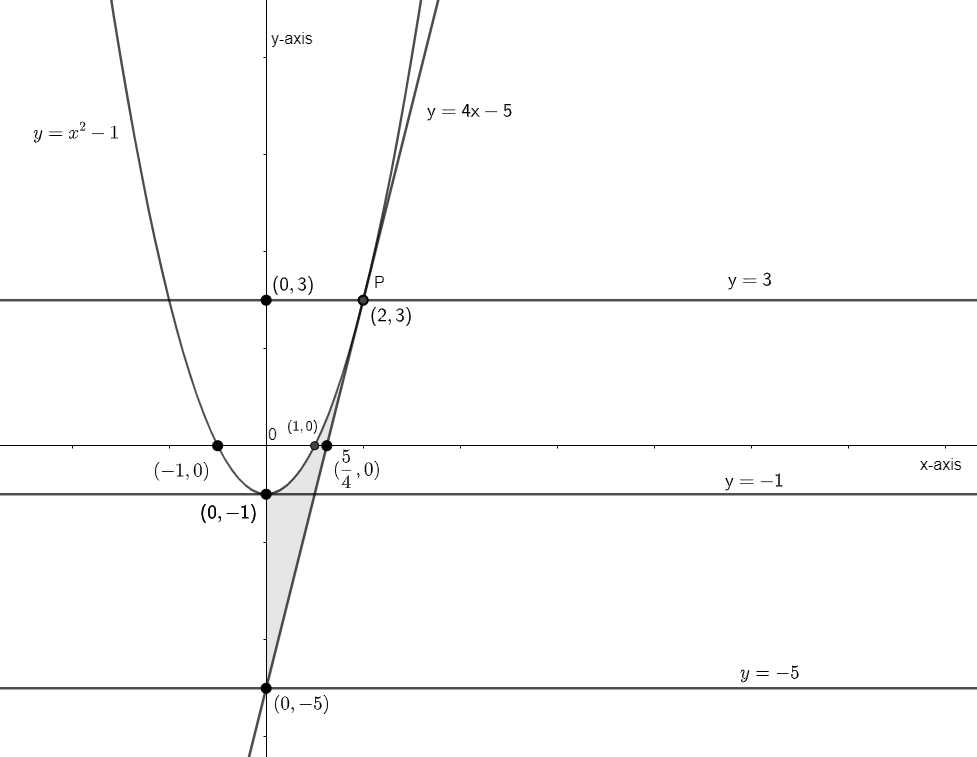
Clearly, we can see that the area required is the shaded part shown above.
\[\Rightarrow \text{Area}=\int\limits_{a}^{b}{f\left( y \right)dy}-\int\limits_{c}^{d}{g\left( y \right)dy}\]
Here, f(y) is the equation of the tangent in terms of y. So, we get,
\[f\left( y \right)=\dfrac{1}{4}\left( y+5 \right)\]
And g(y) is the equation of the parabola in terms of y. So, we get,
\[g\left( y \right)=\sqrt{y+1}\]
Here ‘a’ and ‘b’ are the limits between which the area of f(y) is calculated, i.e. (a, b) = (– 5, 3).
And ‘c’ and ‘d’ are the limits between which the area of g(y) is calculated, i.e. (c, d) = (– 1, 3).
\[\Rightarrow \text{Area}=\int\limits_{-5}^{3}{\dfrac{1}{4}\left( y+5 \right)dy}-\int\limits_{-1}^{3}{\sqrt{y+1}dy}\]
\[\Rightarrow \text{Area}=\dfrac{1}{4}\left[ \dfrac{{{y}^{2}}}{2}+5y \right]_{-5}^{3}-\dfrac{2}{3}\left[ {{\left( y+1 \right)}^{\dfrac{3}{2}}} \right]_{-1}^{3}\]
\[\Rightarrow \text{Area}=\dfrac{1}{4}\left[ \left( \dfrac{9}{2}+15 \right)-\left( \dfrac{25}{2}-25 \right) \right]-\dfrac{2}{3}\left[ {{4}^{\dfrac{3}{2}}}-0 \right]\]
\[\Rightarrow \text{Area}=\dfrac{1}{4}\left[ 32 \right]-\dfrac{2}{3}\times 8\]
\[\Rightarrow \text{Area}=\dfrac{8}{3}\]
So, the correct answer is “Option C”.
Note: One may note that plotting the graph is very important because then only we can visualize the points which are taken as limits. The important points should be marked in the graph. Also, note that we have used the formula for area, i.e. \[\text{Area}=\int{f\left( y \right)dy}\] because we have to calculate the area bounded by the y-axis. If we were to find the area bounded by the x-axis then we would have used the formula \[\int{f\left( x \right)dx}.\]
Complete step by step answer:
Here, we are provided with a parabola \[y={{x}^{2}}-1.\] Now, we have to find a tangent at the point (2, 3).
\[\Rightarrow y={{x}^{2}}-1\]
On differentiating, we get,
\[\Rightarrow \dfrac{dy}{dx}=2x-0\]
\[\Rightarrow \dfrac{dy}{dx}=2x\]
At point (2, 3), we have,
\[\Rightarrow \dfrac{dy}{dx}=2\times 2=4\]
Therefore, the slope of tangent = 4.
Let us assume the equation of the tangent as y = mx + c, where m is the slope and c is the intercept on the y-axis. On substituting the value of slope (m) = 4, we get,
\[y=4x+c.....\left( i \right)\]
Since this line passes through the point (2, 3), therefore it satisfies the point (2, 3). So, substituting (2, 3) in equation (i), we get,
\[\Rightarrow 3=8+c\]
\[\Rightarrow c=-5\]
So, the equation of tangent becomes
\[\Rightarrow y=4x-5\]
Now, let us plot the graph for these curves. We have,
\[\left( 1 \right)y={{x}^{2}}-1\]
At y = 0, \[x=\pm 1\]
At x = 0, y = – 1
\[\left( 2 \right)y=4x-5\]
At y = 0, \[x=\dfrac{5}{4}\]
At x = 0, y = – 5
So, the graph can be plotted as
Clearly, we can see that the area required is the shaded part shown above.
\[\Rightarrow \text{Area}=\int\limits_{a}^{b}{f\left( y \right)dy}-\int\limits_{c}^{d}{g\left( y \right)dy}\]
Here, f(y) is the equation of the tangent in terms of y. So, we get,
\[f\left( y \right)=\dfrac{1}{4}\left( y+5 \right)\]
And g(y) is the equation of the parabola in terms of y. So, we get,
\[g\left( y \right)=\sqrt{y+1}\]
Here ‘a’ and ‘b’ are the limits between which the area of f(y) is calculated, i.e. (a, b) = (– 5, 3).
And ‘c’ and ‘d’ are the limits between which the area of g(y) is calculated, i.e. (c, d) = (– 1, 3).
\[\Rightarrow \text{Area}=\int\limits_{-5}^{3}{\dfrac{1}{4}\left( y+5 \right)dy}-\int\limits_{-1}^{3}{\sqrt{y+1}dy}\]
\[\Rightarrow \text{Area}=\dfrac{1}{4}\left[ \dfrac{{{y}^{2}}}{2}+5y \right]_{-5}^{3}-\dfrac{2}{3}\left[ {{\left( y+1 \right)}^{\dfrac{3}{2}}} \right]_{-1}^{3}\]
\[\Rightarrow \text{Area}=\dfrac{1}{4}\left[ \left( \dfrac{9}{2}+15 \right)-\left( \dfrac{25}{2}-25 \right) \right]-\dfrac{2}{3}\left[ {{4}^{\dfrac{3}{2}}}-0 \right]\]
\[\Rightarrow \text{Area}=\dfrac{1}{4}\left[ 32 \right]-\dfrac{2}{3}\times 8\]
\[\Rightarrow \text{Area}=\dfrac{8}{3}\]
So, the correct answer is “Option C”.
Note: One may note that plotting the graph is very important because then only we can visualize the points which are taken as limits. The important points should be marked in the graph. Also, note that we have used the formula for area, i.e. \[\text{Area}=\int{f\left( y \right)dy}\] because we have to calculate the area bounded by the y-axis. If we were to find the area bounded by the x-axis then we would have used the formula \[\int{f\left( x \right)dx}.\]
Recently Updated Pages
Master Class 12 Economics: Engaging Questions & Answers for Success

Master Class 12 Physics: Engaging Questions & Answers for Success
Master Class 12 English: Engaging Questions & Answers for Success
Master Class 12 Social Science: Engaging Questions & Answers for Success
Master Class 12 Maths: Engaging Questions & Answers for Success
Master Class 12 Business Studies: Engaging Questions & Answers for Success
Trending doubts
Which are the Top 10 Largest Countries of the World?
What are the major means of transport Explain each class 12 social science CBSE
Draw a labelled sketch of the human eye class 12 physics CBSE
Why cannot DNA pass through cell membranes class 12 biology CBSE
Differentiate between insitu conservation and exsitu class 12 biology CBSE
Draw a neat and well labeled diagram of TS of ovary class 12 biology CBSE