




The area enclosed by the curve \[y={{\sin }^{3}}x\], x-axis between \[x=0\] to \[x=\dfrac{\pi }{2}\] is:
A. \[1\]
B. \[{}^{1}/{}_{3}\]
C. \[{}^{2}/{}_{3}\]
D. \[{}^{3}/{}_{2}\]
Answer
 Verified
653.4k+ views
Hint: Relate the graph of \[\sin x\] and \[{{\sin }^{3}}x\] by the range of \[\sin x\], i.e. [-1, 1]. Draw a neat diagram to get the area of the bounded part from the given curves. Area bounded by lines, x = a, x = b, and y = f(x) will be \[=\int\limits_{a}^{b}{f(x)dx}\] where (b > a).
Complete step by step answer:
Here, we need to determine the area bounded by \[y={{\sin }^{3}}x\], x-axis and between x = 0 and \[x=\dfrac{\pi }{2}\]. So first of all we need to represent the area in the diagram by drawing graph of \[y={{\sin }^{3}}x\], \[x=0\], \[x=\dfrac{\pi }{2}\].
So we can draw the diagram as:-
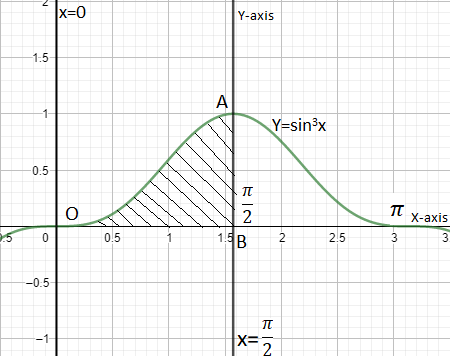
Now we can observe from the above diagram and get that the area of the shaded region is the required area of the problem. Here, the graph of \[{{\sin }^{3}}x\] will be just like sinx, as the range of sinx is [-1, 1].
Hence, the range of \[{{\sin }^{3}}x\] will be [-1, 1] as well. So we can get the area of the shaded region by integrating \[y={{\sin }^{3}}x\] from x = 0 to \[\dfrac{\pi }{2}\].
Hence, area can be calculated as,
Area of the shaded region \[=\int\limits_{0}^{{}^{\pi }/{}_{2}}{{{\sin }^{3}}xdx}....(1)\]
Now we know the identity of sin3x is given as,
\[\sin 3x=3\sin x-4{{\sin }^{3}}x.....(2)\]
So we can calculate the value of \[{{\sin }^{3}}x\] from the above equation and hence put it to the equation (1) to get a simple form of integral.
Hence, value of \[{{\sin }^{3}}x\] can be given as,
\[\begin{align}
& sin3x=3 sinx-4{{\sin }^{3}}x \\
& 4{{\sin }^{3}}x=3\sin x-\sin 3x \\
& {{\sin }^{3}}x=\dfrac{3\sin x-\sin 3x}{4}......(3) \\
\end{align}\]
Hence putting value of \[{{\sin }^{3}}x\] to the equation (1), we get,
Area of shaded region \[=\int\limits_{0}^{{}^{\pi }/{}_{2}}{\dfrac{3\sin x-\sin 3x}{4}}dx\]
\[\begin{align}
& =\dfrac{1}{4}\int\limits_{0}^{{}^{\pi }/{}_{2}}{\left( 3\sin x-\sin 3x \right)dx} \\
& =\dfrac{1}{4}\left( 3\int\limits_{0}^{{}^{\pi }/{}_{2}}{\sin xdx-}\int\limits_{0}^{{}^{\pi }/{}_{2}}{\sin 3x}dx \right) \\
\end{align}\]
As we know, \[\int{\sin x dx=-\cos x}\], we get,
Area of the shaded region,
\[\begin{align}
& =\dfrac{1}{4}\left( 3\left( -\operatorname{cosx} \right)_{0}^{{}^{\pi }/{}_{2}}-\left( \dfrac{-\cos 3x}{3} \right)_{0}^{{}^{\pi }/{}_{2}} \right) \\
& =\dfrac{1}{4}\left( 3\left( -\cos \dfrac{\pi }{2}+\cos 0 \right)-\left( \dfrac{-\cos \dfrac{3\pi }{2}}{3}+\dfrac{\cos 0}{3} \right) \right) \\
& =\dfrac{1}{4}\left( 3-\dfrac{1}{3} \right)=\dfrac{8}{3}\times \dfrac{1}{4}=\dfrac{2}{3}uni{{t}^{2}} \\
\end{align}\]
Hence the area of the bounded area is \[\dfrac{2}{3}uni{{t}^{2}}\].
So option C is the correct answer.
Note:
Curve \[xy=1\] is a rectangular hyperbola because the expression \[xy=1\] or \[x=\dfrac{1}{y}\] has an inverse relation in x and y. So if x increases, then y will decrease and vice-versa. That’s why the curves in all 4 quadrants have an inverse relation. One may easily understand the curve of \[xy=1\] by this approach.
Diagrams play an important role for this type of question.
Another approach for getting area of bounded region from the diagram would be given as,
Area of shaded region = area of triangle OTC – area of TAB
where, we need to calculate area of TAB by difference of area of DATC and area of DABC. So it can be another approach.
Complete step by step answer:
Here, we need to determine the area bounded by \[y={{\sin }^{3}}x\], x-axis and between x = 0 and \[x=\dfrac{\pi }{2}\]. So first of all we need to represent the area in the diagram by drawing graph of \[y={{\sin }^{3}}x\], \[x=0\], \[x=\dfrac{\pi }{2}\].
So we can draw the diagram as:-
Now we can observe from the above diagram and get that the area of the shaded region is the required area of the problem. Here, the graph of \[{{\sin }^{3}}x\] will be just like sinx, as the range of sinx is [-1, 1].
Hence, the range of \[{{\sin }^{3}}x\] will be [-1, 1] as well. So we can get the area of the shaded region by integrating \[y={{\sin }^{3}}x\] from x = 0 to \[\dfrac{\pi }{2}\].
Hence, area can be calculated as,
Area of the shaded region \[=\int\limits_{0}^{{}^{\pi }/{}_{2}}{{{\sin }^{3}}xdx}....(1)\]
Now we know the identity of sin3x is given as,
\[\sin 3x=3\sin x-4{{\sin }^{3}}x.....(2)\]
So we can calculate the value of \[{{\sin }^{3}}x\] from the above equation and hence put it to the equation (1) to get a simple form of integral.
Hence, value of \[{{\sin }^{3}}x\] can be given as,
\[\begin{align}
& sin3x=3 sinx-4{{\sin }^{3}}x \\
& 4{{\sin }^{3}}x=3\sin x-\sin 3x \\
& {{\sin }^{3}}x=\dfrac{3\sin x-\sin 3x}{4}......(3) \\
\end{align}\]
Hence putting value of \[{{\sin }^{3}}x\] to the equation (1), we get,
Area of shaded region \[=\int\limits_{0}^{{}^{\pi }/{}_{2}}{\dfrac{3\sin x-\sin 3x}{4}}dx\]
\[\begin{align}
& =\dfrac{1}{4}\int\limits_{0}^{{}^{\pi }/{}_{2}}{\left( 3\sin x-\sin 3x \right)dx} \\
& =\dfrac{1}{4}\left( 3\int\limits_{0}^{{}^{\pi }/{}_{2}}{\sin xdx-}\int\limits_{0}^{{}^{\pi }/{}_{2}}{\sin 3x}dx \right) \\
\end{align}\]
As we know, \[\int{\sin x dx=-\cos x}\], we get,
Area of the shaded region,
\[\begin{align}
& =\dfrac{1}{4}\left( 3\left( -\operatorname{cosx} \right)_{0}^{{}^{\pi }/{}_{2}}-\left( \dfrac{-\cos 3x}{3} \right)_{0}^{{}^{\pi }/{}_{2}} \right) \\
& =\dfrac{1}{4}\left( 3\left( -\cos \dfrac{\pi }{2}+\cos 0 \right)-\left( \dfrac{-\cos \dfrac{3\pi }{2}}{3}+\dfrac{\cos 0}{3} \right) \right) \\
& =\dfrac{1}{4}\left( 3-\dfrac{1}{3} \right)=\dfrac{8}{3}\times \dfrac{1}{4}=\dfrac{2}{3}uni{{t}^{2}} \\
\end{align}\]
Hence the area of the bounded area is \[\dfrac{2}{3}uni{{t}^{2}}\].
So option C is the correct answer.
Note:
Curve \[xy=1\] is a rectangular hyperbola because the expression \[xy=1\] or \[x=\dfrac{1}{y}\] has an inverse relation in x and y. So if x increases, then y will decrease and vice-versa. That’s why the curves in all 4 quadrants have an inverse relation. One may easily understand the curve of \[xy=1\] by this approach.
Diagrams play an important role for this type of question.
Another approach for getting area of bounded region from the diagram would be given as,
Area of shaded region = area of triangle OTC – area of TAB
where, we need to calculate area of TAB by difference of area of DATC and area of DABC. So it can be another approach.
Recently Updated Pages
Explain the structure of megasporangium class 12 biology CBSE

Why is chloroform kept in dark coloured bottles class 12 chemistry CBSE
Derive the balancing condition of a Wheatstone bri class 12 physics CBSE
Draw VI characteristics of a pn junction diode Explain class 12 physics CBSE
Is it possible to carry pride in ones language too class 12 english CBSE
In a population at Hardy Weinberg equilibrium the allele class 12 biology CBSE
Trending doubts
Draw a labelled sketch of the human eye class 12 physics CBSE
Which are the Top 10 Largest Countries of the World?
Draw ray diagrams each showing i myopic eye and ii class 12 physics CBSE
Which is the correct genotypic ratio of mendel dihybrid class 12 biology CBSE
Differentiate between homogeneous and heterogeneous class 12 chemistry CBSE
Which animal never drinks water in its entire life class 12 biology CBSE