




The anther contains
(a) Sepals
(b) Ovules
(c) Carpels
(d) Pollen grains
Answer
 Verified
621.6k+ views
Hint: These are male reproductive cells of seed-bearing plants transported by wind, water, insects, etc. These are present in the anther and burst open when mature to participate in pollination.
Complete answer:
Flowers are the reproductive part of a plant. It contains both male and female reproductive parts. Pollen grains are male reproductive cells present on anther. Pollen is a powdery substance consisting of pollen grains which are male microgametophytes of seed plants, which produce male gametes. Pollen grains are minute bodies of various shapes and structures.
Additional Information:
- Pollen grains consist of three distinct parts. The central cytoplasmic part is the source of nuclei responsible for fertilization. The other parts constituting the wall of the grain are an inner layer, the intine, and an outer layer, the exine.
-The stamen are male reproductive organs of a flower. It has two parts: anther and stalk or filament.
- Anther produces pollen grains, which are microscopic structures. The opening of another causes the release of pollen, which are then carried by winds or insects or birds to different plants for pollination.
-The male reproductive part is collectively termed as androecium.
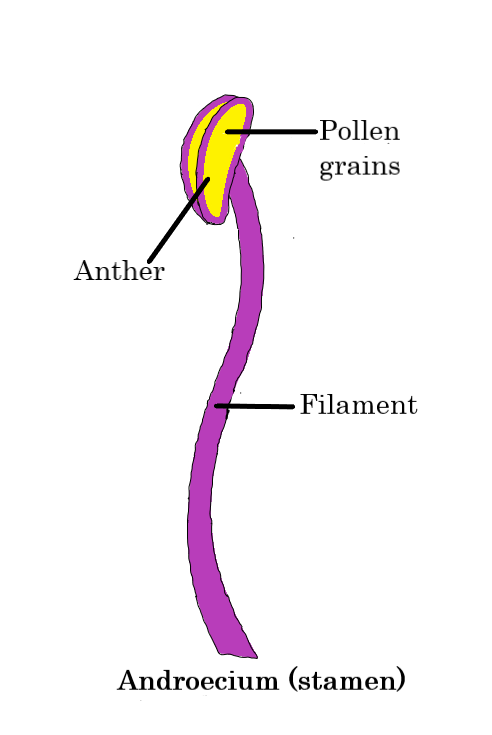
So, the correct answer is,’ pollen grains’.
Note: -The size of pollen grains ranges from 15 to 200 μm. The plant known to have the longest pollen grain till now is Zostera, with pollen grains up to 2500 µm long.
-Petal is modified leaves that surround the reproductive parts of flowers. They are bright in color and shaped accordingly to attract the pollinators.
-Nasal allergy caused by pollen is known as pollinosis. Generally, allergy-causing pollen belongs to anemophilous plants.
-Pollen of grass causes hay fever. It is also responsible for asthma in some people.
Complete answer:
Flowers are the reproductive part of a plant. It contains both male and female reproductive parts. Pollen grains are male reproductive cells present on anther. Pollen is a powdery substance consisting of pollen grains which are male microgametophytes of seed plants, which produce male gametes. Pollen grains are minute bodies of various shapes and structures.
Additional Information:
- Pollen grains consist of three distinct parts. The central cytoplasmic part is the source of nuclei responsible for fertilization. The other parts constituting the wall of the grain are an inner layer, the intine, and an outer layer, the exine.
-The stamen are male reproductive organs of a flower. It has two parts: anther and stalk or filament.
- Anther produces pollen grains, which are microscopic structures. The opening of another causes the release of pollen, which are then carried by winds or insects or birds to different plants for pollination.
-The male reproductive part is collectively termed as androecium.
So, the correct answer is,’ pollen grains’.
Note: -The size of pollen grains ranges from 15 to 200 μm. The plant known to have the longest pollen grain till now is Zostera, with pollen grains up to 2500 µm long.
-Petal is modified leaves that surround the reproductive parts of flowers. They are bright in color and shaped accordingly to attract the pollinators.
-Nasal allergy caused by pollen is known as pollinosis. Generally, allergy-causing pollen belongs to anemophilous plants.
-Pollen of grass causes hay fever. It is also responsible for asthma in some people.
Recently Updated Pages
Master Class 12 Economics: Engaging Questions & Answers for Success

Master Class 12 English: Engaging Questions & Answers for Success
Master Class 12 Social Science: Engaging Questions & Answers for Success
Master Class 12 Maths: Engaging Questions & Answers for Success
Master Class 12 Physics: Engaging Questions & Answers for Success
Master Class 9 General Knowledge: Engaging Questions & Answers for Success
Trending doubts
Which are the Top 10 Largest Countries of the World?
Draw a labelled sketch of the human eye class 12 physics CBSE
Differentiate between homogeneous and heterogeneous class 12 chemistry CBSE
Why is the cell called the structural and functional class 12 biology CBSE
Draw ray diagrams each showing i myopic eye and ii class 12 physics CBSE
Which is the correct genotypic ratio of mendel dihybrid class 12 biology CBSE