




The angle of the prism is \[{60^0}\] and the incident ray makes an angle of \[{45^0}\] with the normal. Calculate the minimum angle of deviation.
Answer
 Verified
516.6k+ views
Hint: Magnetic flux density others referred to as magnetic induction assists us to determine the number of magnetic lines of force that pass through a unit area of a given material. The unit of flux density is Tesla which can be represented as T. We can also mention flux density by using the unit, Gauss. The relation between Tesla and Gauss is that one Tesla corresponds to\[10,000\]Gauss. The magnetic field is a vector quantity. This implies that the magnetic field has both magnitude and direction.
Complete step-by-step solution:
Let’s draw the prism tracing the incident and the emergent ray.
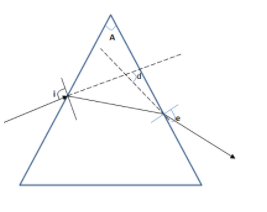
In this diagram
i- Denotes angle of incidence
e- Denotes angle of emergence
A- Angle of prism
d- Indicates deviation
The given values are:
i=\[{45^0}\]
A=\[{60^0}\]
We have to find the angle of minimum deviation
For minimum deviation, we can apply the concept, angle of incidence and= angle of emergence e
Therefore by Using the equation d=i+e-A
We get,
$
d = i + e - A = i + i - 60 = 2i - 60 = (2*45) - 60 \\
\\
$
$d = {90^0} - {60^0} = {30^0}$
Therefore we have got the angle of minimum deviation to be${30^0}$.
Note:When light is incident on a glass prism a phenomenon called refraction takes place. Since the light is travelling from air to the glass, the light ray will bend towards the normal. And when the ray of light exits the prism, since its travelling from glass to air, the light ray will bend away from the normal. One thing to note is that the angle of incidence is not always equal to the angle of emergence. Only in the case of minimum deviation will the angle of incidence be equal to the angle of emergence.
Complete step-by-step solution:
Let’s draw the prism tracing the incident and the emergent ray.
In this diagram
i- Denotes angle of incidence
e- Denotes angle of emergence
A- Angle of prism
d- Indicates deviation
The given values are:
i=\[{45^0}\]
A=\[{60^0}\]
We have to find the angle of minimum deviation
For minimum deviation, we can apply the concept, angle of incidence and= angle of emergence e
Therefore by Using the equation d=i+e-A
We get,
$
d = i + e - A = i + i - 60 = 2i - 60 = (2*45) - 60 \\
\\
$
$d = {90^0} - {60^0} = {30^0}$
Therefore we have got the angle of minimum deviation to be${30^0}$.
Note:When light is incident on a glass prism a phenomenon called refraction takes place. Since the light is travelling from air to the glass, the light ray will bend towards the normal. And when the ray of light exits the prism, since its travelling from glass to air, the light ray will bend away from the normal. One thing to note is that the angle of incidence is not always equal to the angle of emergence. Only in the case of minimum deviation will the angle of incidence be equal to the angle of emergence.
Recently Updated Pages
Master Class 12 Economics: Engaging Questions & Answers for Success

Master Class 12 Physics: Engaging Questions & Answers for Success
Master Class 12 English: Engaging Questions & Answers for Success
Master Class 12 Social Science: Engaging Questions & Answers for Success
Master Class 12 Maths: Engaging Questions & Answers for Success
Master Class 12 Business Studies: Engaging Questions & Answers for Success
Trending doubts
Which are the Top 10 Largest Countries of the World?
What are the major means of transport Explain each class 12 social science CBSE
Draw a labelled sketch of the human eye class 12 physics CBSE
Why cannot DNA pass through cell membranes class 12 biology CBSE
Differentiate between insitu conservation and exsitu class 12 biology CBSE
Draw a neat and well labeled diagram of TS of ovary class 12 biology CBSE