




The angle of elevation of a tower at a point is ${45^ \circ }$.After going 40m towards the foot of the tower,the angle of elevation of the tower is ${60^ \circ }$.Find the height of the tower.
Answer
 Verified
603k+ views
Hint: Using the given data ,sketch the diagram with AC as the tower and B is the point from where the angle of elevation is measured initially. From this , $\tan {45^ \circ } = \dfrac{{AC}}{{AB}}$
And calculating further we get $40 + x = h$ and we are said that the point moves 40m further and the angle of elevation there is ${60^ \circ }$ and once again calculating $\tan {60^ \circ } = \dfrac{h}{x}$we get $\sqrt 3 x = h$ and simplifying further we get the height of the tower.
Complete step-by-step answer:
Step 1: Lets sketch the diagram with the given details
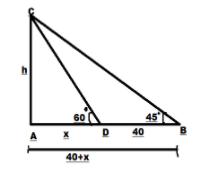
Step 2:Here ,in this diagram, AC is the tower and B is the point from where the angle of elevation is measured initially. Therefore the angle of elevation at B is ${45^ \circ }$.
Step 3:It is given that ,when we move 40m towards the tower ,then the angle of elevation is
${60^ \circ }$.Therefore the angle of elevation at D is ${60^ \circ }$ and DB=40 and $AD = x$. From this we get that AB=40+x.
Step 3:Now, from the diagram
$ \Rightarrow \tan {45^ \circ } = \dfrac{{AC}}{{AB}}$
Here , we know that $\tan {45^ \circ } = 1$
$ \Rightarrow 1 = \dfrac{h}{{40 + x}}$
$ \Rightarrow 40 + x = h$……………….(1)
Step 4: Now, let's do the same step with ${60^ \circ }$
$
\Rightarrow \tan 60 = \dfrac{h}{x} \\
\Rightarrow \sqrt 3 = \dfrac{h}{x} \\
$
$ \Rightarrow \sqrt 3 x = h$………………..(2)
Step 5:Now let's equate the equations (1) and (2) as the right hand side of both the equations are the same.
$
\Rightarrow 40 + x = \sqrt 3 x \\
\Rightarrow 40 = \sqrt 3 x - x \\
$
Now ,let's take x common in the right hand side
$ \Rightarrow 40 = x(\sqrt 3 - 1)$
We know that the value of $\sqrt 3 = 1.732$.So substitute it in the equation above
$
\Rightarrow 40 = x(1.732 - 1) \\
\Rightarrow 40 = x(0.732) \\
\Rightarrow \dfrac{{40}}{{0.732}} = x \\
\Rightarrow x = 54.64 \\
$
Step 6:Now using the value of x in equation (2)
$
\Rightarrow \sqrt 3 *(54.64) = h \\
\\
$
As $\sqrt 3 = 1.732$
$
\Rightarrow 1.732*54.64 = h \\
\Rightarrow 94.64 = h \\
$
Therefore the height of the tower is 94.6 m
Note: In these kinds of sums ,the diagram is very important and you may lose marks even if your answer is correct and the diagram is missing.
We need to be careful in marking the angles at the right places.
Many tend to make a mistake by taking AB as 40m.So you need to read the question more carefully.
And calculating further we get $40 + x = h$ and we are said that the point moves 40m further and the angle of elevation there is ${60^ \circ }$ and once again calculating $\tan {60^ \circ } = \dfrac{h}{x}$we get $\sqrt 3 x = h$ and simplifying further we get the height of the tower.
Complete step-by-step answer:
Step 1: Lets sketch the diagram with the given details
Step 2:Here ,in this diagram, AC is the tower and B is the point from where the angle of elevation is measured initially. Therefore the angle of elevation at B is ${45^ \circ }$.
Step 3:It is given that ,when we move 40m towards the tower ,then the angle of elevation is
${60^ \circ }$.Therefore the angle of elevation at D is ${60^ \circ }$ and DB=40 and $AD = x$. From this we get that AB=40+x.
Step 3:Now, from the diagram
$ \Rightarrow \tan {45^ \circ } = \dfrac{{AC}}{{AB}}$
Here , we know that $\tan {45^ \circ } = 1$
$ \Rightarrow 1 = \dfrac{h}{{40 + x}}$
$ \Rightarrow 40 + x = h$……………….(1)
Step 4: Now, let's do the same step with ${60^ \circ }$
$
\Rightarrow \tan 60 = \dfrac{h}{x} \\
\Rightarrow \sqrt 3 = \dfrac{h}{x} \\
$
$ \Rightarrow \sqrt 3 x = h$………………..(2)
Step 5:Now let's equate the equations (1) and (2) as the right hand side of both the equations are the same.
$
\Rightarrow 40 + x = \sqrt 3 x \\
\Rightarrow 40 = \sqrt 3 x - x \\
$
Now ,let's take x common in the right hand side
$ \Rightarrow 40 = x(\sqrt 3 - 1)$
We know that the value of $\sqrt 3 = 1.732$.So substitute it in the equation above
$
\Rightarrow 40 = x(1.732 - 1) \\
\Rightarrow 40 = x(0.732) \\
\Rightarrow \dfrac{{40}}{{0.732}} = x \\
\Rightarrow x = 54.64 \\
$
Step 6:Now using the value of x in equation (2)
$
\Rightarrow \sqrt 3 *(54.64) = h \\
\\
$
As $\sqrt 3 = 1.732$
$
\Rightarrow 1.732*54.64 = h \\
\Rightarrow 94.64 = h \\
$
Therefore the height of the tower is 94.6 m
Note: In these kinds of sums ,the diagram is very important and you may lose marks even if your answer is correct and the diagram is missing.
We need to be careful in marking the angles at the right places.
Many tend to make a mistake by taking AB as 40m.So you need to read the question more carefully.
Recently Updated Pages
Basicity of sulphurous acid and sulphuric acid are

Master Class 11 Business Studies: Engaging Questions & Answers for Success
Master Class 11 Computer Science: Engaging Questions & Answers for Success
Master Class 11 Economics: Engaging Questions & Answers for Success
Master Class 11 Social Science: Engaging Questions & Answers for Success
Master Class 11 English: Engaging Questions & Answers for Success
Trending doubts
One Metric ton is equal to kg A 10000 B 1000 C 100 class 11 physics CBSE
The largest wind power cluster is located in the state class 11 social science CBSE
Explain zero factorial class 11 maths CBSE
State and prove Bernoullis theorem class 11 physics CBSE
Which among the following are examples of coming together class 11 social science CBSE
Can anyone list 10 advantages and disadvantages of friction