




The angle of elevation of a jet plane from a point A on the ground is \[{{60}^{\circ }}\]. After a flight of 15 seconds, the angle of elevation changes to \[{{30}^{\circ }}\]. If the jet plane is flying at a constant height of \[1500\sqrt{3}\] meters, find the speed of the jet plane. \[\left( \sqrt{3}=1.732 \right)\]
(a)200 m/s
(b)600 m/s
(c)300 m/s
(d)400 m/s
Answer
 Verified
635.1k+ views
Hint: Draw figure as mentioned. Consider the triangles formed, find the distance travelled by the jet plane in 15seconds. Thus apply the distance and time in the formula of speed and get speed to the jet plane.
Complete step-by-step answer:
We have been given the angle of elevation of a jet plane from point A on the ground.
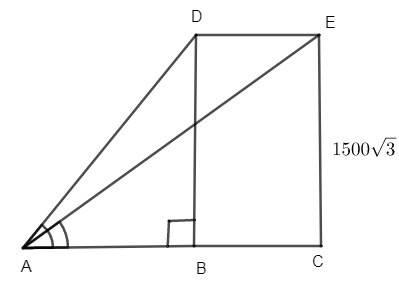
The angle of elevation from point A to the jet plane of position D is \[{{60}^{\circ }}\]. (From the figure)
Now the jet plane travels from point D to point E in 15 sections. Now as the jet plane is at E, the angle of elevation from ground point A to point E becomes \[{{30}^{\circ }}\].
The jet plane is flying at a constant height from the ground, which is \[1500\sqrt{3}\] meters.
From the figure we can say that DB = EC = \[1500\sqrt{3}\], i.e. at the height is constant from the ground and they are perpendicular to the ground.
Now, let us consider the \[\Delta ADB\],
\[\tan {{60}^{\circ }}\] = opposite side / adjacent side = \[\dfrac{DB}{AB}\].
From the trigonometric table, we know that, \[\tan {{60}^{\circ }}=\sqrt{3}\].
DB = \[1500\sqrt{3}\] (from figure)
\[\begin{align}
& \therefore \sqrt{3}=\dfrac{1500\sqrt{3}}{AB} \\
& \therefore AB=\dfrac{1500\sqrt{3}}{\sqrt{3}} \\
\end{align}\]
AB = 1500 meter
Thus we got the distance, AB = 1500 meters.
Now let us consider, \[\Delta ACE\],
\[\tan {{30}^{\circ }}\] = opposite side / adjacent side = \[\dfrac{EC}{AC}\].
From the trigonometric table, we know that \[\tan {{30}^{\circ }}=\dfrac{1}{\sqrt{3}}\].
EC = \[1500\sqrt{3}\] meters.
From figure, AC = AB + BC.
AC = 1500 + BC
Thus substitute all these values in the above expression.
\[\begin{align}
& \tan {{30}^{\circ }}=\dfrac{EC}{AC} \\
& \dfrac{1}{\sqrt{3}}=\dfrac{1500\sqrt{3}}{1500+BC} \\
\end{align}\]
Cross multiply and simplify it. Get the value of BC.
\[\begin{align}
& 1500+BC=1500\sqrt{3}\times \sqrt{3} \\
& 1500+BC=1500\times 3 \\
& BC=\left( 1500\times 3 \right)-1500 \\
& BC=1500\left( 3-1 \right)=1500\times 2 \\
\end{align}\]
BC = 3000 meters.
Thus we got distance, BC = 3000 meters.
The plane travels from point D to point F in 15 seconds. We said that DE = BC. Thus the distance travelled by the plane in 15 seconds is 3000m.
We are asked to find the speed of the jet plane. We know the formula of speed as,
Speed = Distance / Time
\[\therefore \] Speed of jet plane = Distance of point D to E / Time taken to travel from point D to E
= DE / Time taken
\[\therefore \] Speed of the jet plane = 3000 m / 15 sec = 200 m/sec.
Thus we got the speed of a jet plane as 200 m/sec.
\[\therefore \] Option (a) is the correct answer.
Note: Our main aim is to get the speed of the jet plane, which we know is distance by time. Here it is asked the speed of the jet plane in 15 seconds i.e. the distance we need is DE. Don’t take AC as the distance, which is the distance from point A and the time lapse from that point is not given. Thus required is DE and not AC.
Complete step-by-step answer:
We have been given the angle of elevation of a jet plane from point A on the ground.
The angle of elevation from point A to the jet plane of position D is \[{{60}^{\circ }}\]. (From the figure)
Now the jet plane travels from point D to point E in 15 sections. Now as the jet plane is at E, the angle of elevation from ground point A to point E becomes \[{{30}^{\circ }}\].
The jet plane is flying at a constant height from the ground, which is \[1500\sqrt{3}\] meters.
From the figure we can say that DB = EC = \[1500\sqrt{3}\], i.e. at the height is constant from the ground and they are perpendicular to the ground.
Now, let us consider the \[\Delta ADB\],
\[\tan {{60}^{\circ }}\] = opposite side / adjacent side = \[\dfrac{DB}{AB}\].
From the trigonometric table, we know that, \[\tan {{60}^{\circ }}=\sqrt{3}\].
DB = \[1500\sqrt{3}\] (from figure)
\[\begin{align}
& \therefore \sqrt{3}=\dfrac{1500\sqrt{3}}{AB} \\
& \therefore AB=\dfrac{1500\sqrt{3}}{\sqrt{3}} \\
\end{align}\]
AB = 1500 meter
Thus we got the distance, AB = 1500 meters.
Now let us consider, \[\Delta ACE\],
\[\tan {{30}^{\circ }}\] = opposite side / adjacent side = \[\dfrac{EC}{AC}\].
From the trigonometric table, we know that \[\tan {{30}^{\circ }}=\dfrac{1}{\sqrt{3}}\].
EC = \[1500\sqrt{3}\] meters.
From figure, AC = AB + BC.
AC = 1500 + BC
Thus substitute all these values in the above expression.
\[\begin{align}
& \tan {{30}^{\circ }}=\dfrac{EC}{AC} \\
& \dfrac{1}{\sqrt{3}}=\dfrac{1500\sqrt{3}}{1500+BC} \\
\end{align}\]
Cross multiply and simplify it. Get the value of BC.
\[\begin{align}
& 1500+BC=1500\sqrt{3}\times \sqrt{3} \\
& 1500+BC=1500\times 3 \\
& BC=\left( 1500\times 3 \right)-1500 \\
& BC=1500\left( 3-1 \right)=1500\times 2 \\
\end{align}\]
BC = 3000 meters.
Thus we got distance, BC = 3000 meters.
The plane travels from point D to point F in 15 seconds. We said that DE = BC. Thus the distance travelled by the plane in 15 seconds is 3000m.
We are asked to find the speed of the jet plane. We know the formula of speed as,
Speed = Distance / Time
\[\therefore \] Speed of jet plane = Distance of point D to E / Time taken to travel from point D to E
= DE / Time taken
\[\therefore \] Speed of the jet plane = 3000 m / 15 sec = 200 m/sec.
Thus we got the speed of a jet plane as 200 m/sec.
\[\therefore \] Option (a) is the correct answer.
Note: Our main aim is to get the speed of the jet plane, which we know is distance by time. Here it is asked the speed of the jet plane in 15 seconds i.e. the distance we need is DE. Don’t take AC as the distance, which is the distance from point A and the time lapse from that point is not given. Thus required is DE and not AC.
Recently Updated Pages
Three beakers labelled as A B and C each containing 25 mL of water were taken A small amount of NaOH anhydrous CuSO4 and NaCl were added to the beakers A B and C respectively It was observed that there was an increase in the temperature of the solutions contained in beakers A and B whereas in case of beaker C the temperature of the solution falls Which one of the following statements isarecorrect i In beakers A and B exothermic process has occurred ii In beakers A and B endothermic process has occurred iii In beaker C exothermic process has occurred iv In beaker C endothermic process has occurred

Master Class 11 Social Science: Engaging Questions & Answers for Success
Master Class 11 Physics: Engaging Questions & Answers for Success
Master Class 11 Maths: Engaging Questions & Answers for Success
Master Class 11 Economics: Engaging Questions & Answers for Success
Master Class 11 Computer Science: Engaging Questions & Answers for Success
Three beakers labelled as A B and C each containing 25 mL of water were taken A small amount of NaOH anhydrous CuSO4 and NaCl were added to the beakers A B and C respectively It was observed that there was an increase in the temperature of the solutions contained in beakers A and B whereas in case of beaker C the temperature of the solution falls Which one of the following statements isarecorrect i In beakers A and B exothermic process has occurred ii In beakers A and B endothermic process has occurred iii In beaker C exothermic process has occurred iv In beaker C endothermic process has occurred
Master Class 11 Social Science: Engaging Questions & Answers for Success
Master Class 11 Physics: Engaging Questions & Answers for Success
Trending doubts
One Metric ton is equal to kg A 10000 B 1000 C 100 class 11 physics CBSE
There are 720 permutations of the digits 1 2 3 4 5 class 11 maths CBSE
State and prove Bernoullis theorem class 11 physics CBSE
Draw a diagram of a plant cell and label at least eight class 11 biology CBSE
Difference Between Prokaryotic Cells and Eukaryotic Cells
1 Quintal is equal to a 110 kg b 10 kg c 100kg d 1000 class 11 physics CBSE