




What will be the angle of diffraction for the first order maximum due to Fraunhofer diffraction by a single slit of width 0.50 mm, using light of wavelength 500 nm.
A. $1\times {{10}^{-3}}rad$
B. $3\times {{10}^{-3}}rad$
C. $1.5\times {{10}^{-4}}rad$
D. $1.5\times {{10}^{-3}}rad$
Answer
 Verified
628.8k+ views
Hint: The given question is talking about first order maximum due to Fraunhofer diffraction. We will use the formula of maxima for Fraunhofer diffraction and obtain the result by assuming the angle of diffraction to be small.
Formula used:
$d\sin \theta =n\lambda $
Complete answer:
If the source of light is at a large (infinite) distance from the slit (obstacle) then the diffraction is called Fraunhofer diffraction.
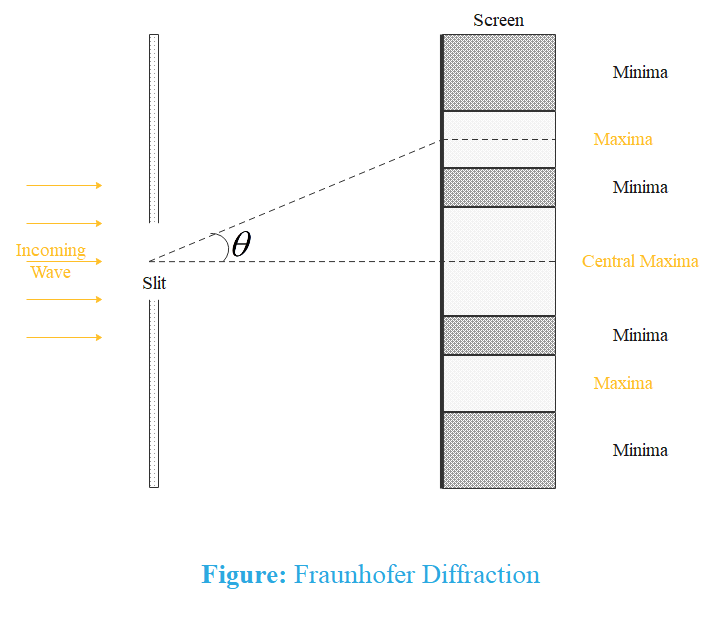
It is given that the diffraction is of first order and is performed with a single slit. Now it is just a formula based question if we know the formula we know the answer. So,
The formula is $d\sin \theta =n\lambda $
Where,
d is the slit width
$\sin \theta $ = angle of diffraction
n = Order of diffraction
$\lambda $ = Wavelength of incident light
Now as given in the question,
Slit width (d) = 0.50 mm = 0.50×${{10}^{-3}}m$ [1mm= ${{10}^{-3}}m$]
Diffraction is of first order which means n = 1
$\lambda $ = 500 nm = $500\times {{10}^{-9}}m$ [1nm=${{10}^{-9}}m$]
Now we have to calculate $\sin \theta $ corresponding to wavelength 500 nm.
Putting d, n and $\lambda $ in equation (i)
$d\sin \theta =n\lambda $
0.50$\times \sin \theta $=1$\times$500
$\sin \theta $= $\dfrac{500}{0.50}\times \dfrac{{{10}^{-9}}}{{{10}^{-3}}}$
=$~1\times {{10}^{-3}}rad$
So, the correct answer is “Option A”.
Additional Information:
There are two types of diffraction: Fresnel diffraction and Fraunhofer diffraction.
Fresnel diffraction is caused by spherical wave fronts and a fringed pattern is observed whereas Fraunhofer diffraction is caused by plane wave front.
Note:
We often forgot to change the measurements in basic units like in this question wavelength and split width is given in nm and mm respectively. So, convert those into meters or centimeters first.
Formula used:
$d\sin \theta =n\lambda $
Complete answer:
If the source of light is at a large (infinite) distance from the slit (obstacle) then the diffraction is called Fraunhofer diffraction.
It is given that the diffraction is of first order and is performed with a single slit. Now it is just a formula based question if we know the formula we know the answer. So,
The formula is $d\sin \theta =n\lambda $
Where,
d is the slit width
$\sin \theta $ = angle of diffraction
n = Order of diffraction
$\lambda $ = Wavelength of incident light
Now as given in the question,
Slit width (d) = 0.50 mm = 0.50×${{10}^{-3}}m$ [1mm= ${{10}^{-3}}m$]
Diffraction is of first order which means n = 1
$\lambda $ = 500 nm = $500\times {{10}^{-9}}m$ [1nm=${{10}^{-9}}m$]
Now we have to calculate $\sin \theta $ corresponding to wavelength 500 nm.
Putting d, n and $\lambda $ in equation (i)
$d\sin \theta =n\lambda $
0.50$\times \sin \theta $=1$\times$500
$\sin \theta $= $\dfrac{500}{0.50}\times \dfrac{{{10}^{-9}}}{{{10}^{-3}}}$
=$~1\times {{10}^{-3}}rad$
So, the correct answer is “Option A”.
Additional Information:
There are two types of diffraction: Fresnel diffraction and Fraunhofer diffraction.
Fresnel diffraction is caused by spherical wave fronts and a fringed pattern is observed whereas Fraunhofer diffraction is caused by plane wave front.
Note:
We often forgot to change the measurements in basic units like in this question wavelength and split width is given in nm and mm respectively. So, convert those into meters or centimeters first.
Recently Updated Pages
Master Class 10 Computer Science: Engaging Questions & Answers for Success

Master Class 10 Social Science: Engaging Questions & Answers for Success
Master Class 10 Science: Engaging Questions & Answers for Success
Class 10 Question and Answer - Your Ultimate Solutions Guide
Master Class 10 Maths: Engaging Questions & Answers for Success
Master Class 10 English: Engaging Questions & Answers for Success
Trending doubts
Which are the Top 10 Largest Countries of the World?
Differentiate between homogeneous and heterogeneous class 12 chemistry CBSE
What is the Full Form of PVC, PET, HDPE, LDPE, PP and PS ?
What is the Full Form of 1.DPT 2.DDT 3.BCG
Which alcohol is used in cough syrups and tonics class 12 chemistry CBSE
Consider three charges q1 q2 q3 q at the vertices of class 12 physics CBSE