




Terylene is a polymer obtained from:
a.) Ethylene Glycol and Glycerol
b.) Ethylene Glycol and Glyceraldehyde
c.) Ethylene Glycol and Terephthalic Acid
d.) None of the above.
Answer
 Verified
639.9k+ views
Hint: The structure of Terylene is as follows:
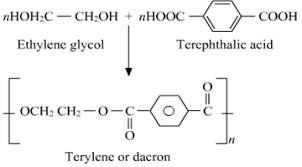 Monomers are relatively small and simple molecules or units of a large molecule or a polymer. Monomers bond together to form a polymer. With this idea of polymers in mind, think of which of the given options could feasibly polymerise to give Terylene.
Complete step by step solution:
Before we address this question directly, let us first understand what polymerisation really means.
A polymer is a large molecule/macromolecule which is a combination of many smaller molecules also known as monomers. 103−107u is the range of the molar mass of a polymer.
It is possible to find polymers naturally in plants and animals. These polymers are referred to as natural polymers. The polymers that are man-made however are known as synthetic polymers.
Different polymers have a number of unique physical and chemical properties due to which they find usage in everyday life.
Examples: Nylon 6,6 which is made up of monomers adipic acid and hexamethylenediamine.

Now let us come to the case of Terylene and analyse what its monomers really are.
Terylene is a practical example of a polyester. Like nylon, it is popular for the use in making synthetic textiles from the force constants for bond stretching and valence angle deformation the Young’s modulus E value for the crystal of terylene or fibre can be calculated.
It is made by the condensation polymerization of benzene-1, 4-dicarboxylic acid or we can say terephthalic acid with ethane-1,2-diol in the presence of an acid which works as a catalyst.
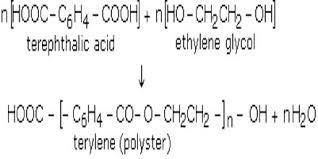 Therefore, we can conclude that the answer to this question is c) Ethylene Glycol and Terephthalic Acid.
NOTE: Remember the physical properties of Terylene in that it is a synthetic fibre used for making clothes and that it is elastic, highly durable and wrinkle-free for future reference. It is also very important to have thorough knowledge of the concepts of polymerisation, monomers and polymers for us to be able to answer this question correctly.
Complete step by step solution:
Before we address this question directly, let us first understand what polymerisation really means.
A polymer is a large molecule/macromolecule which is a combination of many smaller molecules also known as monomers. 103−107u is the range of the molar mass of a polymer.
It is possible to find polymers naturally in plants and animals. These polymers are referred to as natural polymers. The polymers that are man-made however are known as synthetic polymers.
Different polymers have a number of unique physical and chemical properties due to which they find usage in everyday life.
Examples: Nylon 6,6 which is made up of monomers adipic acid and hexamethylenediamine.
Now let us come to the case of Terylene and analyse what its monomers really are.
Terylene is a practical example of a polyester. Like nylon, it is popular for the use in making synthetic textiles from the force constants for bond stretching and valence angle deformation the Young’s modulus E value for the crystal of terylene or fibre can be calculated.
It is made by the condensation polymerization of benzene-1, 4-dicarboxylic acid or we can say terephthalic acid with ethane-1,2-diol in the presence of an acid which works as a catalyst.
NOTE: Remember the physical properties of Terylene in that it is a synthetic fibre used for making clothes and that it is elastic, highly durable and wrinkle-free for future reference. It is also very important to have thorough knowledge of the concepts of polymerisation, monomers and polymers for us to be able to answer this question correctly.
Recently Updated Pages
Master Class 12 Business Studies: Engaging Questions & Answers for Success

Master Class 12 Chemistry: Engaging Questions & Answers for Success
Master Class 12 Biology: Engaging Questions & Answers for Success
Class 12 Question and Answer - Your Ultimate Solutions Guide
Master Class 11 English: Engaging Questions & Answers for Success
Master Class 11 Social Science: Engaging Questions & Answers for Success
Trending doubts
Which are the Top 10 Largest Countries of the World?
Draw a labelled sketch of the human eye class 12 physics CBSE
The end of compass needle which points towards north class 12 physics CBSE
Differentiate between homogeneous and heterogeneous class 12 chemistry CBSE
Why is the cell called the structural and functional class 12 biology CBSE
When was the first election held in India a 194748 class 12 sst CBSE