




Symbol D stands for:
A. Dextrorotatory, which rotates P.P.L towards right.
B. Dextrorotatory, which rotates P.P.L toward left.
C. Relative configuration with respect to lactic acid taken as standard.
D. Relative configuration with respect to glyceraldehyde taken as standard and $\left( {{\text{OH}}} \right)$ group is on the right side.
Answer
 Verified
611.1k+ views
Hint:To solve this we must know that D is known as a dextrorotatory form. The monosaccharides are named as D (dextrorotatory) or L (laevorotatory) based on the stereochemical configuration.
Complete answer:
We know that the monosaccharides are named as D (dextrorotatory) or L (laevorotatory) based on the stereochemical configuration.
The monosaccharides are named based on the stereochemical configuration of glyceraldehyde.
The D (dextrorotatory) enantiomer of glyceraldehyde is a naturally occurring enantiomer. It is represented as (+)-glyceraldehyde or D- glyceraldehyde.
We know that a tetrahedral carbon atom is represented in Fischer projection by two crossed lines. The Fischer projection for D-glyceraldehyde is as follows:
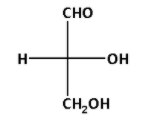
In the Fischer projection for D-glyceraldehyde, we can see that the most oxidised carbon atom lies at the top. The hydroxyl $\left( {{\text{OH}}} \right)$ group is at the lowest chirality centre and points towards right.
All the sugars in which the hydroxyl $\left( {{\text{OH}}} \right)$ group is at the lowest chirality centre and points towards right are known as D-sugars. In relative configurations, glyceraldehyde is taken as standard.
The D notation describes the configuration at only one chirality centre and it does not describe the other chirality centres present.
Thus, symbol D stands for relative configuration with respect to glyceraldehyde taken as standard and $\left( {{\text{OH}}} \right)$ group is on the right side.
Thus, the correct option is (D) relative configuration with respect to glyceraldehyde taken as standard and $\left( {{\text{OH}}} \right)$ group is on the right side.
Note:
The exact opposite of D-sugars are L-sugars. All the sugars in which the hydroxyl $\left( {{\text{OH}}} \right)$ group is at the lowest chirality centre and points towards left are known as L-sugars. In both D- and L-sugars the most oxidised carbon atom i.e. the aldehyde group $\left( {{\text{CHO}}} \right)$ lies at the top.
Complete answer:
We know that the monosaccharides are named as D (dextrorotatory) or L (laevorotatory) based on the stereochemical configuration.
The monosaccharides are named based on the stereochemical configuration of glyceraldehyde.
The D (dextrorotatory) enantiomer of glyceraldehyde is a naturally occurring enantiomer. It is represented as (+)-glyceraldehyde or D- glyceraldehyde.
We know that a tetrahedral carbon atom is represented in Fischer projection by two crossed lines. The Fischer projection for D-glyceraldehyde is as follows:
In the Fischer projection for D-glyceraldehyde, we can see that the most oxidised carbon atom lies at the top. The hydroxyl $\left( {{\text{OH}}} \right)$ group is at the lowest chirality centre and points towards right.
All the sugars in which the hydroxyl $\left( {{\text{OH}}} \right)$ group is at the lowest chirality centre and points towards right are known as D-sugars. In relative configurations, glyceraldehyde is taken as standard.
The D notation describes the configuration at only one chirality centre and it does not describe the other chirality centres present.
Thus, symbol D stands for relative configuration with respect to glyceraldehyde taken as standard and $\left( {{\text{OH}}} \right)$ group is on the right side.
Thus, the correct option is (D) relative configuration with respect to glyceraldehyde taken as standard and $\left( {{\text{OH}}} \right)$ group is on the right side.
Note:
The exact opposite of D-sugars are L-sugars. All the sugars in which the hydroxyl $\left( {{\text{OH}}} \right)$ group is at the lowest chirality centre and points towards left are known as L-sugars. In both D- and L-sugars the most oxidised carbon atom i.e. the aldehyde group $\left( {{\text{CHO}}} \right)$ lies at the top.
Recently Updated Pages
Master Class 12 Business Studies: Engaging Questions & Answers for Success

Master Class 12 Chemistry: Engaging Questions & Answers for Success
Master Class 12 Biology: Engaging Questions & Answers for Success
Class 12 Question and Answer - Your Ultimate Solutions Guide
Master Class 11 English: Engaging Questions & Answers for Success
Master Class 11 Social Science: Engaging Questions & Answers for Success
Trending doubts
Which are the Top 10 Largest Countries of the World?
The total number of vertebrae in man is a30 b31 c32 class 12 biology CBSE
Draw a labelled sketch of the human eye class 12 physics CBSE
The number of cranial nerves in a frog is A 10 pairs class 12 biology CBSE
Differentiate between homogeneous and heterogeneous class 12 chemistry CBSE
Differentiate between Pyramid of energy and pyramid class 12 biology CBSE