




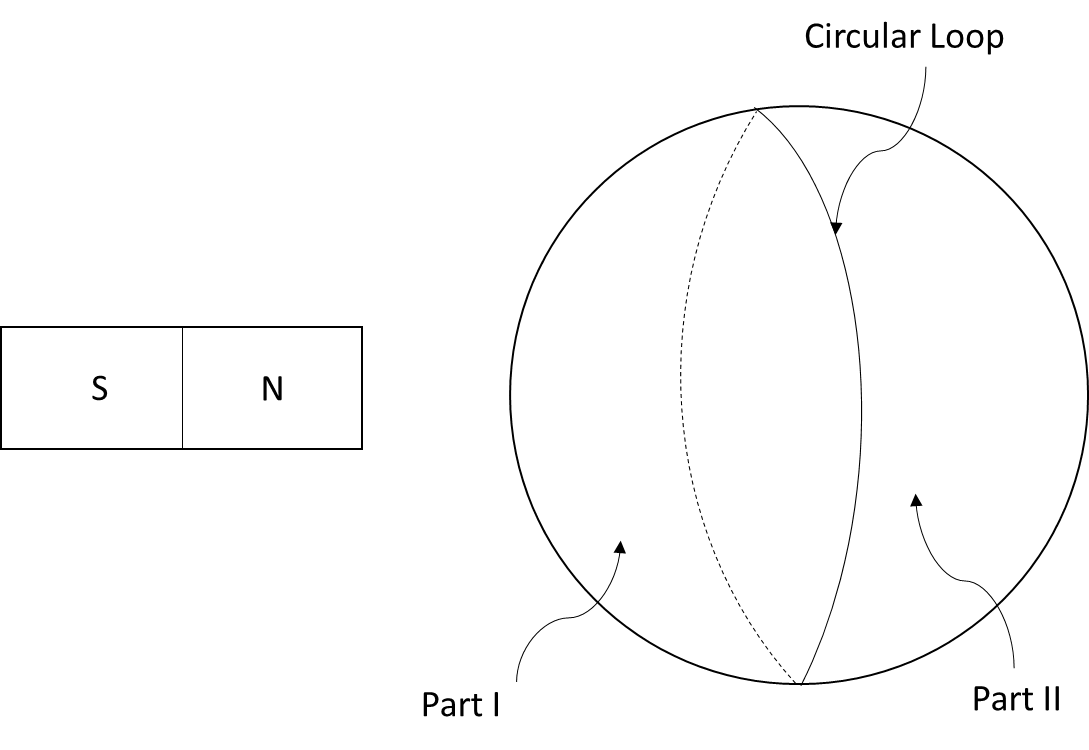
Suppose, we split a spherical surface into two parts by a circular loop. Now, a bar magnet is placed near the spherical system as shown in the figure. Through which of the two parts is the magnitude of the magnetic flux larger?
Answer
 Verified
584.7k+ views
Hintthe above problem can easily be solved by the concept of magnetic flux. In order to solve, first we will calculate the flux through each of two parts by using the formula of magnetic flux. Since the magnetic field due to the bar magnet as well as the area will be the same in both the cases we can easily compare the magnitude of magnetic flux in the two parts of the sphere.
Complete step-by-step solution:
We know that formula for magnetic flux linked with area is given by
${\phi _m} = \overrightarrow B .\overrightarrow A $
Where,
${\phi _m}$ = Magnetic Flux
$\overrightarrow B $= Magnetic Field Vector
\[\overrightarrow A \] = Area Vector
Assume magnetic field produced by the bar magnet = \[\overrightarrow B \]
Assume Area vector of part I = \[\overrightarrow {{A_1}} \]
Assume Area vector of part II = \[\overrightarrow {{A_2}} \]
Flux induced in part I of the sphere = \[{\phi _{1m}}\]
Flux induced in part II of the sphere = \[{\phi _{2m}}\]
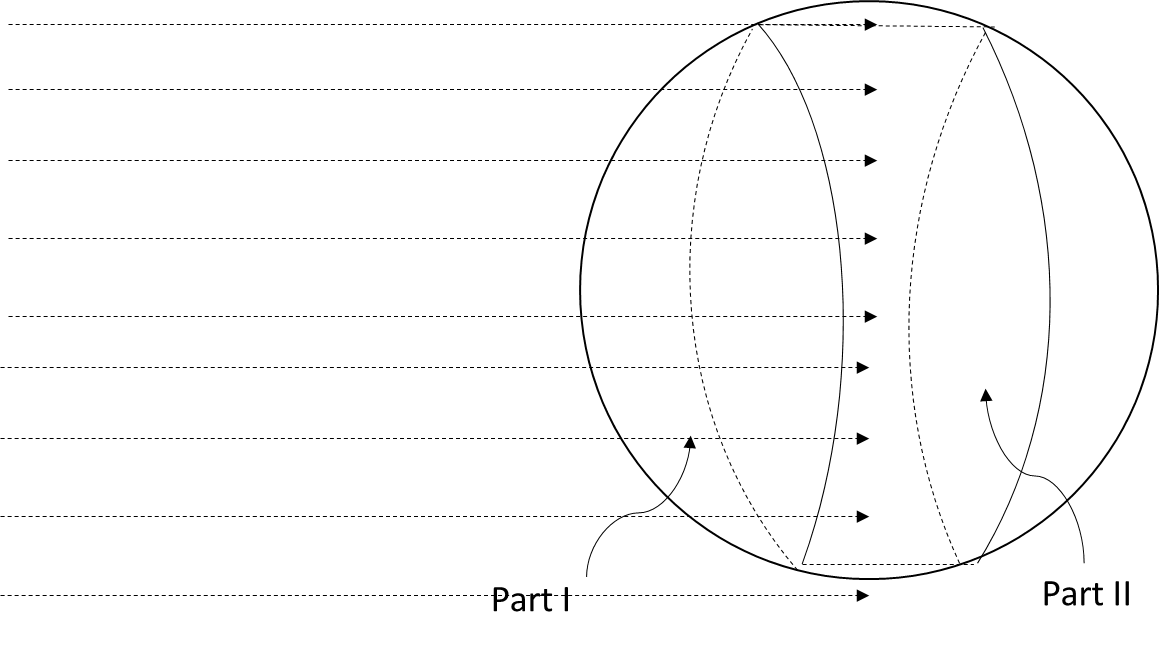
As clear from the above diagram it is clear that effective areas projected by the circular loop on the second part of the sphere are equal.
\[\overrightarrow {{A_1}} = \overrightarrow {{A_2}} \]
As dot product of two quantities is given by
\[\overrightarrow X \overrightarrow {.Y} = XY\cos \theta \]
$\therefore {\phi _{1m}} = B{A_1}\cos \theta $
Also the area vector is parallel to the magnetic field in both the parts
So the angle between area vector & Magnetic field is zero i.e. $\theta = 0$
${\phi _{1m}} = B{A_1}\cos {0^0}$
We can write
$\therefore $${\phi _{1m}} = B{A_1}$ (As $\cos 0 = 1$)
Similarly for other part we have
${\phi _{2m}} = \overrightarrow B .\overrightarrow {{A_2}} $
As dot product of two quantities is given by
\[\overrightarrow X \overrightarrow {.Y} = XY\cos \theta \]
$\therefore {\phi _{2m}} = B{A_2}\cos \theta $
Also $\theta = 0$
${\phi _{2m}} = B{A_2}\cos {0^0}$
${\phi _{2m}} = B{A_2}$ ( As $\cos 0 = 1$ )
On dividing ${\phi _{2m}}$ & ${\phi _{1m}}$
$\dfrac{{{\phi _{2m}}}}{{{\phi _{1m}}}} = \dfrac{{B{A_2}}}{{B{A_1}}}$
As \[\overrightarrow {{A_1}} = \overrightarrow {{A_2}} \]
$\therefore $${\phi _{1m}} = {\phi _{2m}}$
Hence the magnitude through both the parts of the spherical surface will be equal.
Additional Information: - The magnetic flux produced in a closed area only depends on the external magnetic field in which the area is placed in & also the area vector. It is basically the count of magnetic field lines passing through perpendicularly a closed area.
Note: This problem can also be solved from the concept that the total magnetic field entering the sphere is equal to the total magnetic field exiting. So the net flux is zero.
${\phi _{1m}} + {\phi _{2m}} = 0$
$\therefore $\[\left| {{\phi _{1m}}} \right| = \left| {{\phi _{2m}}} \right|\]
Complete step-by-step solution:
We know that formula for magnetic flux linked with area is given by
${\phi _m} = \overrightarrow B .\overrightarrow A $
Where,
${\phi _m}$ = Magnetic Flux
$\overrightarrow B $= Magnetic Field Vector
\[\overrightarrow A \] = Area Vector
Assume magnetic field produced by the bar magnet = \[\overrightarrow B \]
Assume Area vector of part I = \[\overrightarrow {{A_1}} \]
Assume Area vector of part II = \[\overrightarrow {{A_2}} \]
Flux induced in part I of the sphere = \[{\phi _{1m}}\]
Flux induced in part II of the sphere = \[{\phi _{2m}}\]
As clear from the above diagram it is clear that effective areas projected by the circular loop on the second part of the sphere are equal.
\[\overrightarrow {{A_1}} = \overrightarrow {{A_2}} \]
As dot product of two quantities is given by
\[\overrightarrow X \overrightarrow {.Y} = XY\cos \theta \]
$\therefore {\phi _{1m}} = B{A_1}\cos \theta $
Also the area vector is parallel to the magnetic field in both the parts
So the angle between area vector & Magnetic field is zero i.e. $\theta = 0$
${\phi _{1m}} = B{A_1}\cos {0^0}$
We can write
$\therefore $${\phi _{1m}} = B{A_1}$ (As $\cos 0 = 1$)
Similarly for other part we have
${\phi _{2m}} = \overrightarrow B .\overrightarrow {{A_2}} $
As dot product of two quantities is given by
\[\overrightarrow X \overrightarrow {.Y} = XY\cos \theta \]
$\therefore {\phi _{2m}} = B{A_2}\cos \theta $
Also $\theta = 0$
${\phi _{2m}} = B{A_2}\cos {0^0}$
${\phi _{2m}} = B{A_2}$ ( As $\cos 0 = 1$ )
On dividing ${\phi _{2m}}$ & ${\phi _{1m}}$
$\dfrac{{{\phi _{2m}}}}{{{\phi _{1m}}}} = \dfrac{{B{A_2}}}{{B{A_1}}}$
As \[\overrightarrow {{A_1}} = \overrightarrow {{A_2}} \]
$\therefore $${\phi _{1m}} = {\phi _{2m}}$
Hence the magnitude through both the parts of the spherical surface will be equal.
Additional Information: - The magnetic flux produced in a closed area only depends on the external magnetic field in which the area is placed in & also the area vector. It is basically the count of magnetic field lines passing through perpendicularly a closed area.
Note: This problem can also be solved from the concept that the total magnetic field entering the sphere is equal to the total magnetic field exiting. So the net flux is zero.
${\phi _{1m}} + {\phi _{2m}} = 0$
$\therefore $\[\left| {{\phi _{1m}}} \right| = \left| {{\phi _{2m}}} \right|\]
Recently Updated Pages
Master Class 12 Economics: Engaging Questions & Answers for Success

Master Class 12 Physics: Engaging Questions & Answers for Success
Master Class 12 English: Engaging Questions & Answers for Success
Master Class 12 Social Science: Engaging Questions & Answers for Success
Master Class 12 Maths: Engaging Questions & Answers for Success
Master Class 12 Business Studies: Engaging Questions & Answers for Success
Trending doubts
Which are the Top 10 Largest Countries of the World?
What are the major means of transport Explain each class 12 social science CBSE
Draw a labelled sketch of the human eye class 12 physics CBSE
Why cannot DNA pass through cell membranes class 12 biology CBSE
Differentiate between insitu conservation and exsitu class 12 biology CBSE
Draw a neat and well labeled diagram of TS of ovary class 12 biology CBSE