




Sun rays are incident on a concave mirror parallel to its principal axis. If the image of the sun is formed at $12cm$ distance from the pole of the mirror, find its radius of curvature.
Answer
 Verified
586.5k+ views
Hint: Here we need to go through the properties of a concave mirror and see where the image is forming for different object distance. Then we need to apply the concave mirror formula relating the object distance the image distance and the focal length of the mirror. Then we will apply the relation between the focal length and the radius of curvature.
Formula used: $\dfrac{1}{v}+\dfrac{1}{u}=\dfrac{1}{f}$
$R=2f$
Complete step by step answer:
When rays parallel to the principal axis are incident on a concave mirror, the image is formed at the focus of the mirror. The ray diagram is shown below.
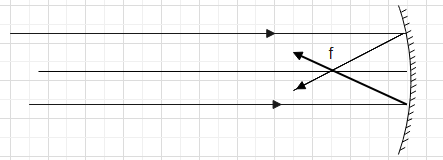
Now if $u$ is the object distance,$v$ is the image distance and $f$ is the focal length, we have
$\dfrac{1}{v}+\dfrac{1}{u}=\dfrac{1}{f}$. Now for parallel rays $u=\infty $ , so putting the values of all the quantities we get
\[\begin{align}
& \dfrac{1}{-12}+\dfrac{1}{\infty }=\dfrac{1}{f} \\
& orf=-12cm \\
\end{align}\]
Negative sign indicates the focus lies in front of the mirror.
Now the radius of curvature $R$ is related to $f$ as
$R=2f$ , so putting the value of $f$ we get
$R=2\times (-12)=-24cm$
So the magnitude of the radius of curvature of the mirror is $24cm$.
Note: To solve this type of question correctly we need to put the right sign for the different quantities in the formula and then the unknown quantity will come out with the correct sign. For a concave mirror the focal length is negative and for a convex mirror the focal length is positive. We also need to remember that when parallel rays are incident, that means the object is at infinity and theoretically we can say the image will be formed at the focal plane.
Formula used: $\dfrac{1}{v}+\dfrac{1}{u}=\dfrac{1}{f}$
$R=2f$
Complete step by step answer:
When rays parallel to the principal axis are incident on a concave mirror, the image is formed at the focus of the mirror. The ray diagram is shown below.
Now if $u$ is the object distance,$v$ is the image distance and $f$ is the focal length, we have
$\dfrac{1}{v}+\dfrac{1}{u}=\dfrac{1}{f}$. Now for parallel rays $u=\infty $ , so putting the values of all the quantities we get
\[\begin{align}
& \dfrac{1}{-12}+\dfrac{1}{\infty }=\dfrac{1}{f} \\
& orf=-12cm \\
\end{align}\]
Negative sign indicates the focus lies in front of the mirror.
Now the radius of curvature $R$ is related to $f$ as
$R=2f$ , so putting the value of $f$ we get
$R=2\times (-12)=-24cm$
So the magnitude of the radius of curvature of the mirror is $24cm$.
Note: To solve this type of question correctly we need to put the right sign for the different quantities in the formula and then the unknown quantity will come out with the correct sign. For a concave mirror the focal length is negative and for a convex mirror the focal length is positive. We also need to remember that when parallel rays are incident, that means the object is at infinity and theoretically we can say the image will be formed at the focal plane.
Recently Updated Pages
Basicity of sulphurous acid and sulphuric acid are

Master Class 12 English: Engaging Questions & Answers for Success
Master Class 12 Social Science: Engaging Questions & Answers for Success
Master Class 12 Maths: Engaging Questions & Answers for Success
Master Class 12 Economics: Engaging Questions & Answers for Success
Master Class 12 Physics: Engaging Questions & Answers for Success
Trending doubts
Which are the Top 10 Largest Countries of the World?
Draw a labelled sketch of the human eye class 12 physics CBSE
Which country did Danny Casey play for class 12 english CBSE
Give 10 examples of unisexual and bisexual flowers
Coming together federation is practiced in A India class 12 social science CBSE
Write the formula to find the shortest distance between class 12 maths CBSE