




Who suggested the clover leaf model of the tRNA?
A) Went
B) Flemming
C) Holley
D) Messelson
Answer
 Verified
607.2k+ views
Hint: American biochemist, assumes the clover leaf like structure of tRNA in 1965 due to the concept of folding of the single stranded tRNA. He shared the Nobel Prize in Physiology or Medicine in 1968 with Marshall Warren Nirenberg and Har Gobind Khorana.
Complete Answer:
- Robert William Holley was an American biochemist. He shared the Nobel Prize in Physiology or Medicine in 1968.
- He described the structure of alanine transfer RNA, linking DNA and protein synthesis. Their research helped to explain the role of genetic code in controlling the synthesis of proteins. They demonstrated the role of tRNAs (a specific type of ribonucleic acids) in the assembly of amino acids into proteins.
- Holley along with his collaborators worked to develop separation techniques which isolate the different transfer RNAs.
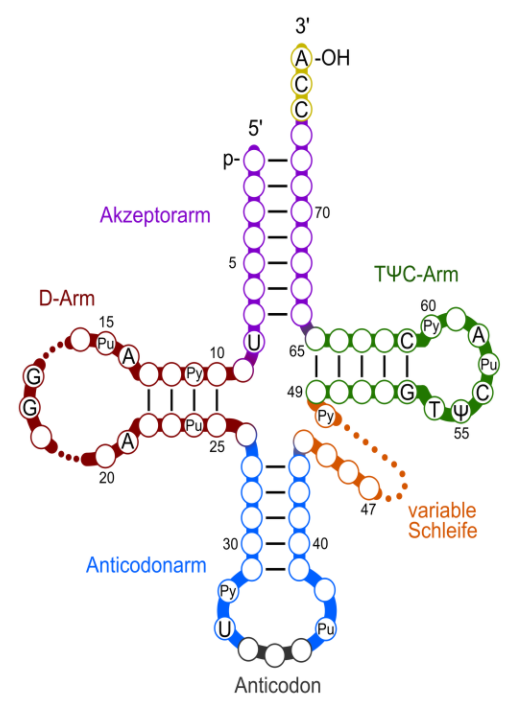
Additional Information:
- Due to the distinctive folded structure with three hairpin loops the tRNA molecule has a shape of a three-leafed clover form.
- Anticodon sequences are present in one these hairpin loops which can recognize and decode an mRNA codon.
- Each tRNA has specific anticodons present on the Anticodon loop and thus have specific corresponding amino acids, and that’s how specific tRNA searches its corresponding Amino acid and gets attached to its end.
Note: The American biologist Paul C. Zamecnik and Mahlon Hoagland discovered tRNA in 1956. The Dutch biologist Frits Warmolt Went demonstrated the existence of auxin in plants in an experiment in 1928. Alexander Fleming was a Scottish physician-scientist who discovered penicillin. Matthew Stanley Meselson is a geneticist and molecular biologist currently at Harvard University, known for his demonstration, with Franklin Stahl, of semi-conservative DNA replication.
Complete Answer:
- Robert William Holley was an American biochemist. He shared the Nobel Prize in Physiology or Medicine in 1968.
- He described the structure of alanine transfer RNA, linking DNA and protein synthesis. Their research helped to explain the role of genetic code in controlling the synthesis of proteins. They demonstrated the role of tRNAs (a specific type of ribonucleic acids) in the assembly of amino acids into proteins.
- Holley along with his collaborators worked to develop separation techniques which isolate the different transfer RNAs.
Additional Information:
- Due to the distinctive folded structure with three hairpin loops the tRNA molecule has a shape of a three-leafed clover form.
- Anticodon sequences are present in one these hairpin loops which can recognize and decode an mRNA codon.
- Each tRNA has specific anticodons present on the Anticodon loop and thus have specific corresponding amino acids, and that’s how specific tRNA searches its corresponding Amino acid and gets attached to its end.
Note: The American biologist Paul C. Zamecnik and Mahlon Hoagland discovered tRNA in 1956. The Dutch biologist Frits Warmolt Went demonstrated the existence of auxin in plants in an experiment in 1928. Alexander Fleming was a Scottish physician-scientist who discovered penicillin. Matthew Stanley Meselson is a geneticist and molecular biologist currently at Harvard University, known for his demonstration, with Franklin Stahl, of semi-conservative DNA replication.
Recently Updated Pages
Three beakers labelled as A B and C each containing 25 mL of water were taken A small amount of NaOH anhydrous CuSO4 and NaCl were added to the beakers A B and C respectively It was observed that there was an increase in the temperature of the solutions contained in beakers A and B whereas in case of beaker C the temperature of the solution falls Which one of the following statements isarecorrect i In beakers A and B exothermic process has occurred ii In beakers A and B endothermic process has occurred iii In beaker C exothermic process has occurred iv In beaker C endothermic process has occurred

Master Class 12 Social Science: Engaging Questions & Answers for Success
Master Class 12 Physics: Engaging Questions & Answers for Success
Master Class 12 Maths: Engaging Questions & Answers for Success
Master Class 12 Economics: Engaging Questions & Answers for Success
Master Class 12 Chemistry: Engaging Questions & Answers for Success
Three beakers labelled as A B and C each containing 25 mL of water were taken A small amount of NaOH anhydrous CuSO4 and NaCl were added to the beakers A B and C respectively It was observed that there was an increase in the temperature of the solutions contained in beakers A and B whereas in case of beaker C the temperature of the solution falls Which one of the following statements isarecorrect i In beakers A and B exothermic process has occurred ii In beakers A and B endothermic process has occurred iii In beaker C exothermic process has occurred iv In beaker C endothermic process has occurred
Master Class 12 Social Science: Engaging Questions & Answers for Success
Master Class 12 Physics: Engaging Questions & Answers for Success
Trending doubts
Which are the Top 10 Largest Countries of the World?
Draw a labelled sketch of the human eye class 12 physics CBSE
Differentiate between homogeneous and heterogeneous class 12 chemistry CBSE
What are the major means of transport Explain each class 12 social science CBSE
Sulphuric acid is known as the king of acids State class 12 chemistry CBSE
Why should a magnesium ribbon be cleaned before burning class 12 chemistry CBSE