




Study the given ray diagram and select the correct answer from the given statements.
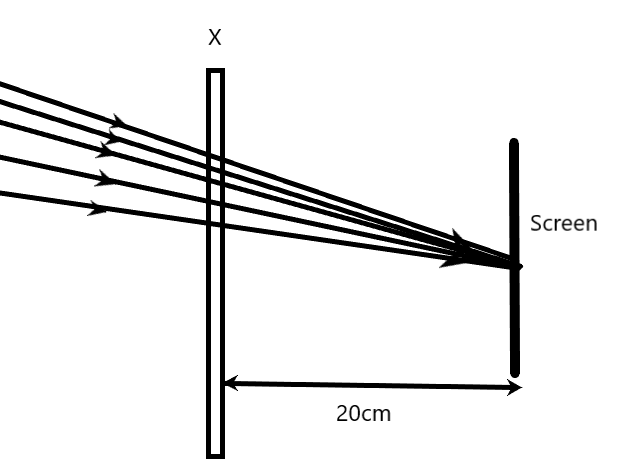
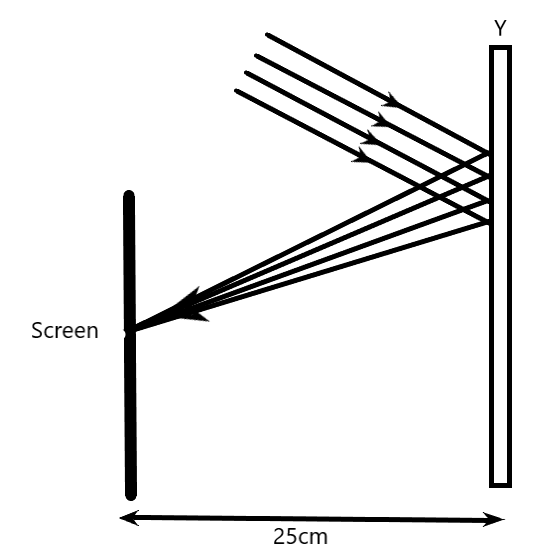
A) Device X is a concave mirror and device Y is a convex lens, whose focal lengths are 20cm and 25cm respectively.
B) Device X is a convex lens and device Y is a concave mirror, whose focal lengths are 10cm and 25cm respectively.
C) Device X is a concave lens and device Y is a convex mirror, whose focal lengths are 20cm and 25cm respectively.
D) Device X is a convex lens and device Y is a concave mirror, whose focal lengths are 20cm and 25cm respectively.
Answer
 Verified
577.8k+ views
Hint: We are provided with two devices on which parallel beams of light are falling. We have to find the type and focal length of device X and device Y kept in the path of these beams such that we get the image on the screen as shown in the figure.
Complete step by step answer:
We know that the two devices X and Y are incident with parallel beams of light. The lights bent while passing through the given devices as per the figure. Let us consider each of the figures in detail.
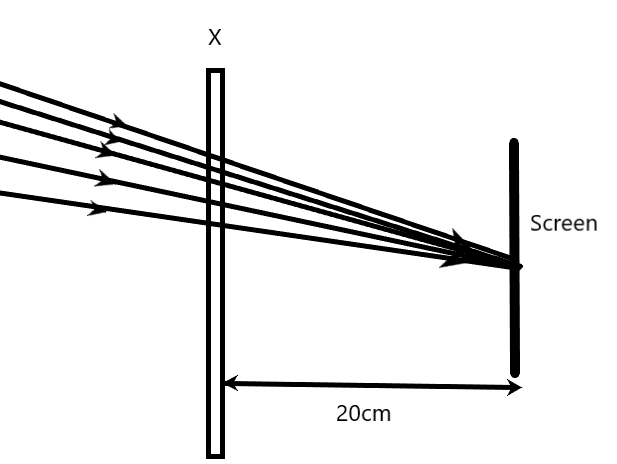
We can see that the rays coming from the left side of the device passes through the lens and forms a real image on a screen on the right side. So, the device here, should be a lens. Also, the lens is converging the parallel beams to a single point on the screen thus giving a point image.
Therefore, we can conclude that the device X is a converging lens or a convex lens with a focal length of 20cm.
Now, let us consider the device Y.
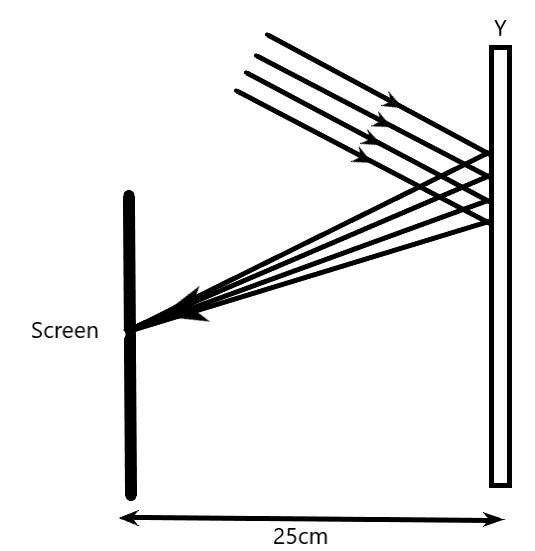
A beam of parallel rays is incident on the left side of the device and the real image is formed on a screen on the left side itself without extending. The device should be a mirror to satisfy this condition. Now, the rays falling parallel on the mirror are converged to a single point on the screen forming a point image, i.e., the image is formed at the focus of the mirror. Also, the mirror is converging in nature, without extending a diverging beam, so this is a concave mirror of focal length 25cm.
Therefore, the device Y is a concave mirror with focal length 25cm.
So, we can conclude that the device X is a convex lens and device Y is a concave mirror whose focal lengths are 20cm and 25cm respectively.
So, the correct answer is “Option D”.
Note: The descriptions for the type of lens or mirror used should be derived carefully. There can be possibilities in which the convex mirror acts like a concave mirror, when the object is placed close to it, but we can distinguish it by seeing the rays that form the image.
Complete step by step answer:
We know that the two devices X and Y are incident with parallel beams of light. The lights bent while passing through the given devices as per the figure. Let us consider each of the figures in detail.
We can see that the rays coming from the left side of the device passes through the lens and forms a real image on a screen on the right side. So, the device here, should be a lens. Also, the lens is converging the parallel beams to a single point on the screen thus giving a point image.
Therefore, we can conclude that the device X is a converging lens or a convex lens with a focal length of 20cm.
Now, let us consider the device Y.
A beam of parallel rays is incident on the left side of the device and the real image is formed on a screen on the left side itself without extending. The device should be a mirror to satisfy this condition. Now, the rays falling parallel on the mirror are converged to a single point on the screen forming a point image, i.e., the image is formed at the focus of the mirror. Also, the mirror is converging in nature, without extending a diverging beam, so this is a concave mirror of focal length 25cm.
Therefore, the device Y is a concave mirror with focal length 25cm.
So, we can conclude that the device X is a convex lens and device Y is a concave mirror whose focal lengths are 20cm and 25cm respectively.
So, the correct answer is “Option D”.
Note: The descriptions for the type of lens or mirror used should be derived carefully. There can be possibilities in which the convex mirror acts like a concave mirror, when the object is placed close to it, but we can distinguish it by seeing the rays that form the image.
Recently Updated Pages
Master Class 12 Economics: Engaging Questions & Answers for Success

Master Class 12 Physics: Engaging Questions & Answers for Success
Master Class 12 English: Engaging Questions & Answers for Success
Master Class 12 Social Science: Engaging Questions & Answers for Success
Master Class 12 Maths: Engaging Questions & Answers for Success
Master Class 12 Business Studies: Engaging Questions & Answers for Success
Trending doubts
Which are the Top 10 Largest Countries of the World?
What are the major means of transport Explain each class 12 social science CBSE
Draw a labelled sketch of the human eye class 12 physics CBSE
Why cannot DNA pass through cell membranes class 12 biology CBSE
Differentiate between insitu conservation and exsitu class 12 biology CBSE
Draw a neat and well labeled diagram of TS of ovary class 12 biology CBSE