




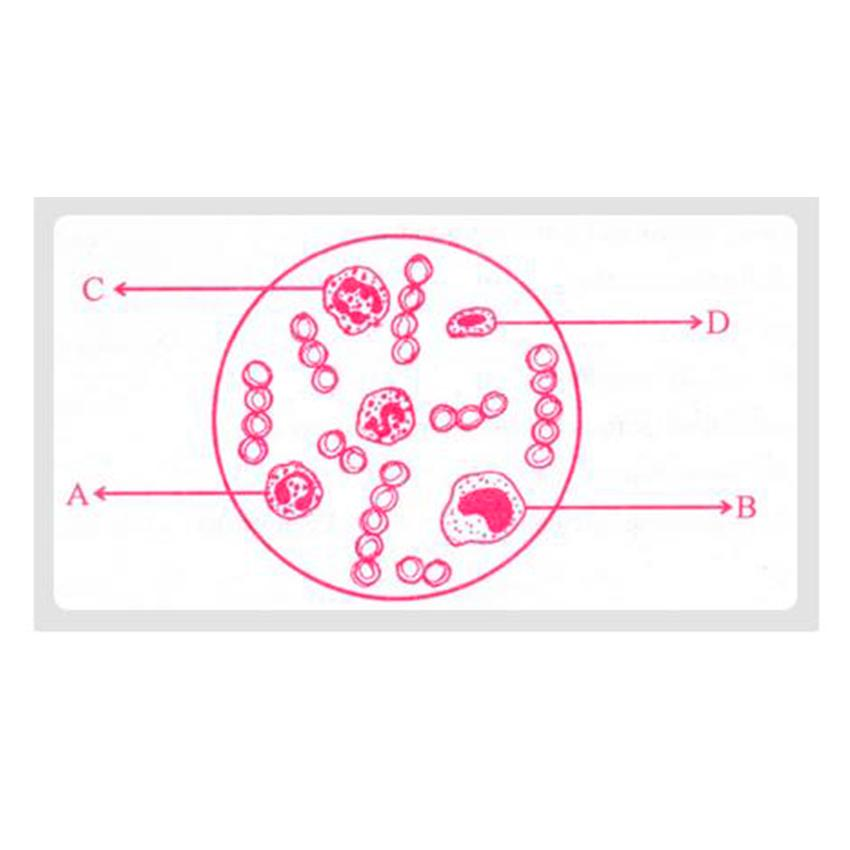
Study the diagram given below and identify the cells labelled as A, B, C and D, and choose the correct option.
A. A= Eosinophil, B= Erythrocyte, C= Neutrophil and D= Basophil
B. A= Eosinophil, B= Lymphocyte, C= Neutrophil and D= Monocyte
C. A= Erythrocyte, B= Basophil, C= Neutrophil and D= Monocyte
D. A= Eosinophil, B= Monocyte, C= Neutrophil and D= Lymphocyte
Answer
 Verified
607.2k+ views
Hint: A blood cell, also called a hematopoietic cell, hemocyte, or hematocyte, is a cell produced through hematopoiesis and found mainly in the blood. Major types of blood cells include red blood cells (erythrocytes), white blood cells (leukocytes), and platelets (thrombocytes).
Step by step answer:Eosinophil is a pro-inflammatory white blood cell that generally has a nucleus with two lobes (bilobed) and cytoplasm filled with approximately 200 large granules containing enzymes and proteins with different (known and unknown) functions.
The monocyte is a kidney bean-shaped cell. As the monocyte enters the tissue and differentiates into a macrophage, the cell volume and number of cytoplasmic granules increase.
Neutrophils have a characteristic multilobed nucleus, with 3 to 5 lobes joined by slender strands of genetic material. The cytoplasm of neutrophils contains numerous purplish granules called azurophilic or primary granules that contain microbicidal agents.
Lymphocytes look like monocytes, except that lymphocytes do not have a kidney-bean shaped nucleus, and lymphocytes are usually smaller. Larger lymphocytes are commonly activated lymphocytes.
They have a small spherical nucleus and has abundant dark staining condensed chromatin.
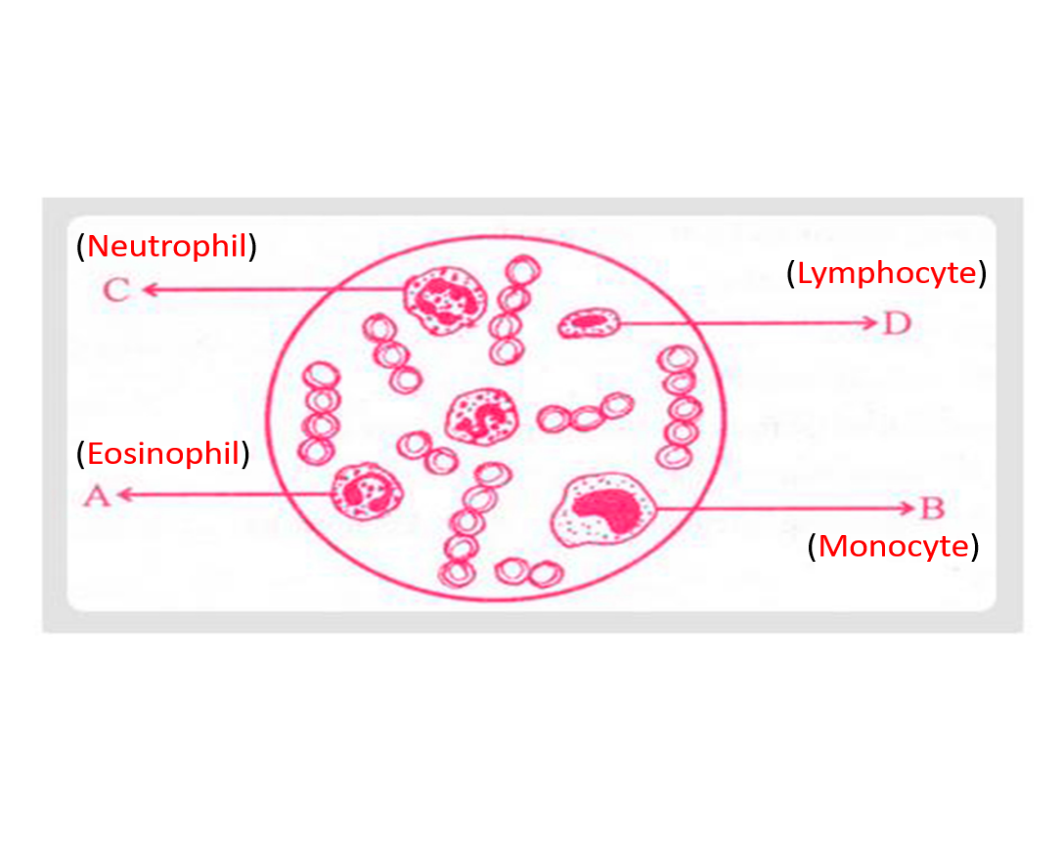
Hence, the correct answer is Option D
Note: White blood cells or leukocytes, are cells of the immune system involved in defending the body against both infectious disease and foreign materials. They are produced and derived from multipotent cells in the bone marrow known as a hematopoietic stem cell. White blood cells are divided into granulocytes and agranulocytes, distinguished by the presence or absence of granules in the cytoplasm. Granulocytes include basophils, eosinophils, neutrophils, and mast cells. Agranulocytes include lymphocytes and monocytes.
Step by step answer:Eosinophil is a pro-inflammatory white blood cell that generally has a nucleus with two lobes (bilobed) and cytoplasm filled with approximately 200 large granules containing enzymes and proteins with different (known and unknown) functions.
The monocyte is a kidney bean-shaped cell. As the monocyte enters the tissue and differentiates into a macrophage, the cell volume and number of cytoplasmic granules increase.
Neutrophils have a characteristic multilobed nucleus, with 3 to 5 lobes joined by slender strands of genetic material. The cytoplasm of neutrophils contains numerous purplish granules called azurophilic or primary granules that contain microbicidal agents.
Lymphocytes look like monocytes, except that lymphocytes do not have a kidney-bean shaped nucleus, and lymphocytes are usually smaller. Larger lymphocytes are commonly activated lymphocytes.
They have a small spherical nucleus and has abundant dark staining condensed chromatin.
Hence, the correct answer is Option D
Note: White blood cells or leukocytes, are cells of the immune system involved in defending the body against both infectious disease and foreign materials. They are produced and derived from multipotent cells in the bone marrow known as a hematopoietic stem cell. White blood cells are divided into granulocytes and agranulocytes, distinguished by the presence or absence of granules in the cytoplasm. Granulocytes include basophils, eosinophils, neutrophils, and mast cells. Agranulocytes include lymphocytes and monocytes.
Recently Updated Pages
Master Class 11 Social Science: Engaging Questions & Answers for Success

Master Class 11 English: Engaging Questions & Answers for Success
Master Class 11 Maths: Engaging Questions & Answers for Success
Master Class 11 Chemistry: Engaging Questions & Answers for Success
Master Class 11 Biology: Engaging Questions & Answers for Success
Master Class 11 Physics: Engaging Questions & Answers for Success
Trending doubts
Differentiate between an exothermic and an endothermic class 11 chemistry CBSE
One Metric ton is equal to kg A 10000 B 1000 C 100 class 11 physics CBSE
Difference Between Prokaryotic Cells and Eukaryotic Cells
There are 720 permutations of the digits 1 2 3 4 5 class 11 maths CBSE
Draw a diagram of a plant cell and label at least eight class 11 biology CBSE
Which chemical is known as king of chemicals A H 2 class 11 chemistry CBSE