




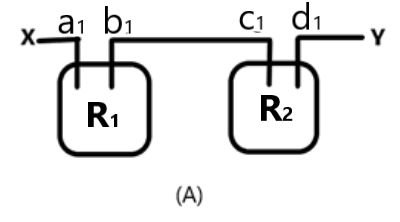
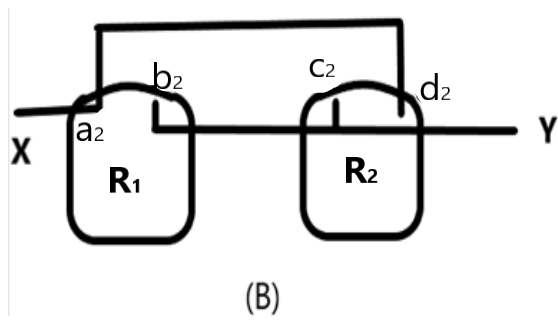
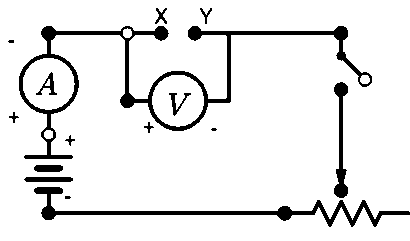
Students A and B connect the two resistors \[{{\text{R}}_{\text{1}}}\text{ and }{{\text{R}}_{\text{2}}}\]given to them in the manners as given below and then insert them at X and Y into the measuring circuit shown below.
We can say that –
A) Both the students will determine the equivalent resistance of the series combination of \[{{\text{R}}_{\text{1}}}\text{ and }{{\text{R}}_{\text{2}}}\].
B) Both the students will determine the equivalent resistance of the parallel combination of \[{{\text{R}}_{\text{1}}}\text{ and }{{\text{R}}_{\text{2}}}\].
C) Student A will determine the equivalent resistance of the series combination while the student B will determine the equivalent resistance of the parallel combination of \[{{\text{R}}_{\text{1}}}\text{ and }{{\text{R}}_{\text{2}}}\].
D) Student A will determine the equivalent resistance of the parallel combination while the student B will determine the equivalent resistance of the series combination of \[{{\text{R}}_{\text{1}}}\text{ and }{{\text{R}}_{\text{2}}}\].
Answer
 Verified
574.2k+ views
Hint: We have to determine the type of combination set up the students with the resistors they are offered with. The arrangement from the figures A and B will give the type of network they have used to get the equivalent resistance in the measuring circuit.
Complete step by step solution:
We can analyse the circuits arranged by the two students with the resistors. The connection between the points will help us understand the type of network they did arrange.
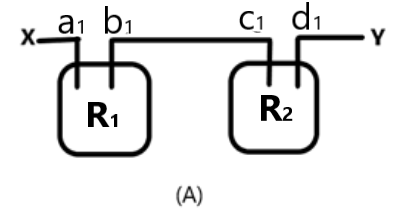
We can see from the figure that the resistors \[{{\text{R}}_{\text{1}}}\text{ and }{{\text{R}}_{\text{2}}}\]are connected to each other only once. This implies that the resistors \[{{\text{R}}_{\text{1}}}\text{ and }{{\text{R}}_{\text{2}}}\] are connected in series with each by the student A.
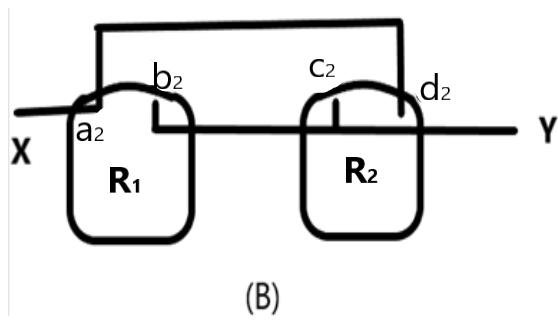
The resistors \[{{\text{R}}_{\text{1}}}\text{ and }{{\text{R}}_{\text{2}}}\]are connected to each other at two points in the arrangement done by the student B. The resistors \[{{\text{R}}_{\text{1}}}\text{ and }{{\text{R}}_{\text{2}}}\]are connected to each other from points $a_{1}$ to $d_{1}$ and from $b_{1}$ to $c_{1}$, which is in turn connected to X and Y respectively. Therefore, we can conclude that the resistors \[{{\text{R}}_{\text{1}}}\text{ and }{{\text{R}}_{\text{2}}}\]are connected parallel to each other by the student B.
Now, when the students employ their respective connections in the measuring circuit, we can say that the –
The student A will get the equivalent resistance of the series combination of the resistors \[{{\text{R}}_{\text{1}}}\text{ and }{{\text{R}}_{\text{2}}}\].
The student B will get the equivalent resistance of the parallel combination of the resistors \[{{\text{R}}_{\text{1}}}\text{ and }{{\text{R}}_{\text{2}}}\].
So, the correct answer is “Option C”.
Note: When two resistors are connected, they can either be connected in series combination or parallel combination only. The number of nodes connecting them together determine the type of combination they are designed in, two for parallel and one for series.
Complete step by step solution:
We can analyse the circuits arranged by the two students with the resistors. The connection between the points will help us understand the type of network they did arrange.
We can see from the figure that the resistors \[{{\text{R}}_{\text{1}}}\text{ and }{{\text{R}}_{\text{2}}}\]are connected to each other only once. This implies that the resistors \[{{\text{R}}_{\text{1}}}\text{ and }{{\text{R}}_{\text{2}}}\] are connected in series with each by the student A.
The resistors \[{{\text{R}}_{\text{1}}}\text{ and }{{\text{R}}_{\text{2}}}\]are connected to each other at two points in the arrangement done by the student B. The resistors \[{{\text{R}}_{\text{1}}}\text{ and }{{\text{R}}_{\text{2}}}\]are connected to each other from points $a_{1}$ to $d_{1}$ and from $b_{1}$ to $c_{1}$, which is in turn connected to X and Y respectively. Therefore, we can conclude that the resistors \[{{\text{R}}_{\text{1}}}\text{ and }{{\text{R}}_{\text{2}}}\]are connected parallel to each other by the student B.
Now, when the students employ their respective connections in the measuring circuit, we can say that the –
The student A will get the equivalent resistance of the series combination of the resistors \[{{\text{R}}_{\text{1}}}\text{ and }{{\text{R}}_{\text{2}}}\].
The student B will get the equivalent resistance of the parallel combination of the resistors \[{{\text{R}}_{\text{1}}}\text{ and }{{\text{R}}_{\text{2}}}\].
So, the correct answer is “Option C”.
Note: When two resistors are connected, they can either be connected in series combination or parallel combination only. The number of nodes connecting them together determine the type of combination they are designed in, two for parallel and one for series.
Recently Updated Pages
Master Class 12 Economics: Engaging Questions & Answers for Success

Master Class 12 Physics: Engaging Questions & Answers for Success
Master Class 12 English: Engaging Questions & Answers for Success
Master Class 12 Social Science: Engaging Questions & Answers for Success
Master Class 12 Maths: Engaging Questions & Answers for Success
Master Class 12 Business Studies: Engaging Questions & Answers for Success
Trending doubts
Which are the Top 10 Largest Countries of the World?
What are the major means of transport Explain each class 12 social science CBSE
Draw a labelled sketch of the human eye class 12 physics CBSE
Why cannot DNA pass through cell membranes class 12 biology CBSE
Differentiate between insitu conservation and exsitu class 12 biology CBSE
Draw a neat and well labeled diagram of TS of ovary class 12 biology CBSE