




Student obtains a blurred image of a distant object on a screen using a convex lens. To obtain a distinct image on the screen he should move the lens.
A.)Away from the screen
B.)Towards the screen
C.)To a position very far from the screen
D.)Either towards or away from the screen depending upon the position of the object
Answer
 Verified
673.5k+ views
Hint: We will consider different cases of image formation by a convex lens and will conclude whether the lens should be moved towards the screen or away from the screen to get a distinct image of the object.
Complete step by step answer:
The convex lens is a type of lens that converges the rays of light that convey parallel to its principal axis. Convex lens is relatively thick across the middle and thin at the lower and upper edges. The edges of the lens are curved outwards.
Image formation by Convex lens:
When an object is moved closer to the convex lens, we obtain a distinct, well illuminated, and enlarged image of the object.
To obtain a distinct image of an object on the screen, students should have to move the lens towards the screen. Second focus of the lens will behave as a screen. When an object is placed at infinity, image is obtained at the focus of the lens.
Hence, the correct option is B.
Note:
Convex lens, or converging lens, can produce both real and virtual images. The size of the image varies according to the position of the object. As we move objects close to the lens, we obtain a well-defined and magnified image of the object.
Complete step by step answer:
The convex lens is a type of lens that converges the rays of light that convey parallel to its principal axis. Convex lens is relatively thick across the middle and thin at the lower and upper edges. The edges of the lens are curved outwards.
Image formation by Convex lens:
| Object location | Ray diagram | Image location | Image nature | Image size |
| Infinity | 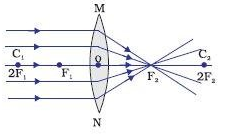
| At ${{\text{F}}_{\text{2}}}$ | Real and Inverted | Diminished |
| Beyond $\text{2}{{\text{F}}_{\text{1}}}$ | 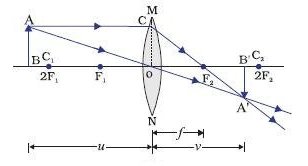
| Between ${{\text{F}}_{\text{2}}}$and $\text{2}{{\text{F}}_{\text{2}}}$ | Real and Inverted | Diminished |
| At $\text{2}{{\text{F}}_{\text{1}}}$ | 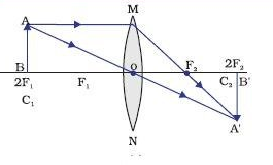
| At $\text{2}{{\text{F}}_{\text{2}}}$ | Real and Inverted | Same size |
| Between ${{\text{F}}_{\text{1}}}$and $\text{2}{{\text{F}}_{\text{1}}}$ | 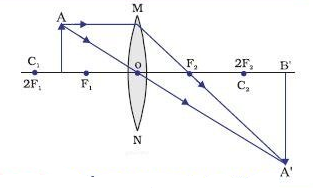
| Beyond $\text{2}{{\text{F}}_{\text{2}}}$ | Real and Inverted | Enlarged |
| At ${{\text{F}}_{\text{1}}}$ | 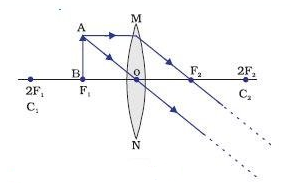
| At Infinity | Real and Inverted | Enlarged |
| Between $\text{O}$and ${{\text{F}}_{\text{1}}}$ | 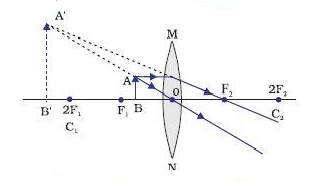
| On the same side as the object | Virtual and Erect | Enlarged |
When an object is moved closer to the convex lens, we obtain a distinct, well illuminated, and enlarged image of the object.
To obtain a distinct image of an object on the screen, students should have to move the lens towards the screen. Second focus of the lens will behave as a screen. When an object is placed at infinity, image is obtained at the focus of the lens.
Hence, the correct option is B.
Note:
Convex lens, or converging lens, can produce both real and virtual images. The size of the image varies according to the position of the object. As we move objects close to the lens, we obtain a well-defined and magnified image of the object.
Recently Updated Pages
Explain the structure of megasporangium class 12 biology CBSE

Why is chloroform kept in dark coloured bottles class 12 chemistry CBSE
Derive the balancing condition of a Wheatstone bri class 12 physics CBSE
Draw VI characteristics of a pn junction diode Explain class 12 physics CBSE
Is it possible to carry pride in ones language too class 12 english CBSE
In a population at Hardy Weinberg equilibrium the allele class 12 biology CBSE
Trending doubts
Draw a labelled sketch of the human eye class 12 physics CBSE
Which are the Top 10 Largest Countries of the World?
Draw ray diagrams each showing i myopic eye and ii class 12 physics CBSE
One megawatt is equal to how many units of electri class 12 physics CBSE
Which is the correct genotypic ratio of mendel dihybrid class 12 biology CBSE
Give 10 examples of unisexual and bisexual flowers