



How many structures of $ F $ are possible?
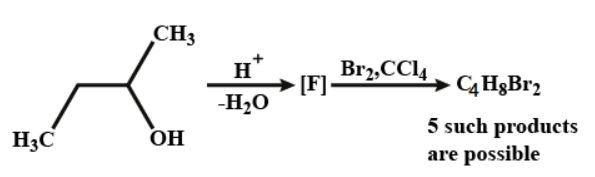
(A) $ 2 $
(B) $ 5 $
(C) $ 6 $
(D) $ 3 $
Answer
 Verified
537.6k+ views
Hint: We know that first of all look at the properties of which they are talking about. Cis $ -2 $ butene and Trans $ -2 $ butene have same chemical properties but their physical properties are different structures.
Complete answer:
Let us go to each point one by one, first is optical properties, so Cis $ -2 $ butene and Trans $ -2 $ butene have different physical properties but same optical properties. Optical isomers are mirror images that are not super impossible. Isomers are compounds that possess the same molecular formula but differ from each other in physical and chemical properties. Since isomers have the same molecular formula the difference in their properties might be due to different modes of combination of arrangement of atoms within the molecule.
Your hands, assuming that we do not examine them too closely for scratches and other imperfections, are non-superimposable images. Now the next property is “reduction property”. So both have the same reduction properties as Cis $ -2 $ butene and Trans $ -2 $ butene have same chemical properties. Similarly they will give the same products after ozonolysis. So these three are the incorrect options. Now the next one is an additional product with bromine. And in this case the products will be different as cis $ -2 $ butene gives two isomeric products and trans $ -2 $ butene gives products by following Markownikoff's rule.
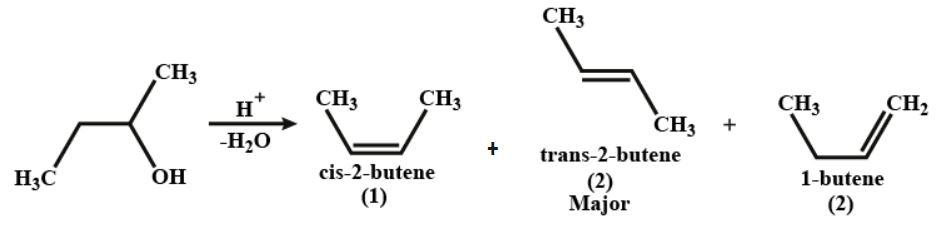
Therefore, the correct answer is option D.
Note:
Remember that it is to be noted that Cis $ -2 $ butene and Trans $ -2 $ butene have different boiling and melting points. They also have different structures. One important thing to keep in mind is that there might be a presence of a chiral centre but even after that there may not be optical isomers.
Complete answer:
Let us go to each point one by one, first is optical properties, so Cis $ -2 $ butene and Trans $ -2 $ butene have different physical properties but same optical properties. Optical isomers are mirror images that are not super impossible. Isomers are compounds that possess the same molecular formula but differ from each other in physical and chemical properties. Since isomers have the same molecular formula the difference in their properties might be due to different modes of combination of arrangement of atoms within the molecule.
Your hands, assuming that we do not examine them too closely for scratches and other imperfections, are non-superimposable images. Now the next property is “reduction property”. So both have the same reduction properties as Cis $ -2 $ butene and Trans $ -2 $ butene have same chemical properties. Similarly they will give the same products after ozonolysis. So these three are the incorrect options. Now the next one is an additional product with bromine. And in this case the products will be different as cis $ -2 $ butene gives two isomeric products and trans $ -2 $ butene gives products by following Markownikoff's rule.
Therefore, the correct answer is option D.
Note:
Remember that it is to be noted that Cis $ -2 $ butene and Trans $ -2 $ butene have different boiling and melting points. They also have different structures. One important thing to keep in mind is that there might be a presence of a chiral centre but even after that there may not be optical isomers.
Recently Updated Pages
Three beakers labelled as A B and C each containing 25 mL of water were taken A small amount of NaOH anhydrous CuSO4 and NaCl were added to the beakers A B and C respectively It was observed that there was an increase in the temperature of the solutions contained in beakers A and B whereas in case of beaker C the temperature of the solution falls Which one of the following statements isarecorrect i In beakers A and B exothermic process has occurred ii In beakers A and B endothermic process has occurred iii In beaker C exothermic process has occurred iv In beaker C endothermic process has occurred

Master Class 12 Social Science: Engaging Questions & Answers for Success
Master Class 12 Physics: Engaging Questions & Answers for Success
Master Class 12 Maths: Engaging Questions & Answers for Success
Master Class 12 Economics: Engaging Questions & Answers for Success
Master Class 12 Chemistry: Engaging Questions & Answers for Success
Three beakers labelled as A B and C each containing 25 mL of water were taken A small amount of NaOH anhydrous CuSO4 and NaCl were added to the beakers A B and C respectively It was observed that there was an increase in the temperature of the solutions contained in beakers A and B whereas in case of beaker C the temperature of the solution falls Which one of the following statements isarecorrect i In beakers A and B exothermic process has occurred ii In beakers A and B endothermic process has occurred iii In beaker C exothermic process has occurred iv In beaker C endothermic process has occurred
Master Class 12 Social Science: Engaging Questions & Answers for Success
Master Class 12 Physics: Engaging Questions & Answers for Success
Trending doubts
Which are the Top 10 Largest Countries of the World?
Draw a labelled sketch of the human eye class 12 physics CBSE
Differentiate between homogeneous and heterogeneous class 12 chemistry CBSE
What are the major means of transport Explain each class 12 social science CBSE
Sulphuric acid is known as the king of acids State class 12 chemistry CBSE
Why should a magnesium ribbon be cleaned before burning class 12 chemistry CBSE