



What structural feature distinguishes proline from other natural $\alpha - $ amino acids?
A. It is optically inactive.
B. It contains aromatic groups.
C. It is a dicarboxylic acid.
D. It has a secondary amine.
Answer
 Verified
577.5k+ views
Hint: A bi-functional organic molecule that contains both a carboxyl group, $ - {\text{COOH}}$ as well as an amine group, $ - {\text{N}}{{\text{H}}_2}$. Amino acids derived from proteins have the amino group on the $\alpha - $ carbon, i.e. the carbon next to the carboxyl group.
Complete step by step solution:
Amino acids are considered to be the building blocks of proteins. The general structural formula of amino acid is given below:
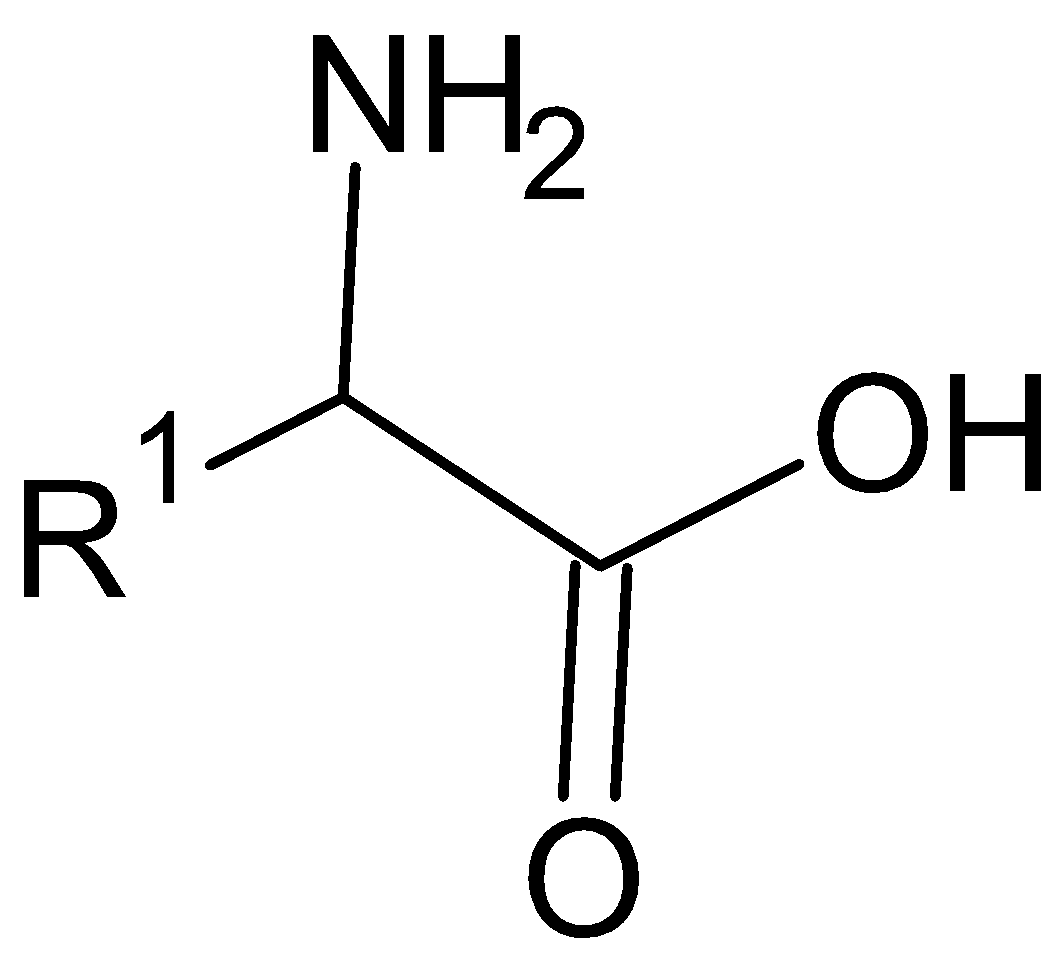
Amino acids are the structural units that make up the proteins. They join together to form short polymer chains called peptides or longer chains called either polypeptides or proteins. These polymers are linear and unbranched, with each amino acid within the chain attached to two neighboring amino acids.
Amino acids are classified as non-polar, polar amino acids with no charge, with positive charge and negative charge. Non-polar amino acids have the same number of amino and carboxyl groups, thus are neutral. They are hydrophobic and have no charge. Some examples are alanine, valine, leucine, isoleucine, phenylalanine, glycine, tryptophan, methionine and proline.
The structure of proline molecule is given below:
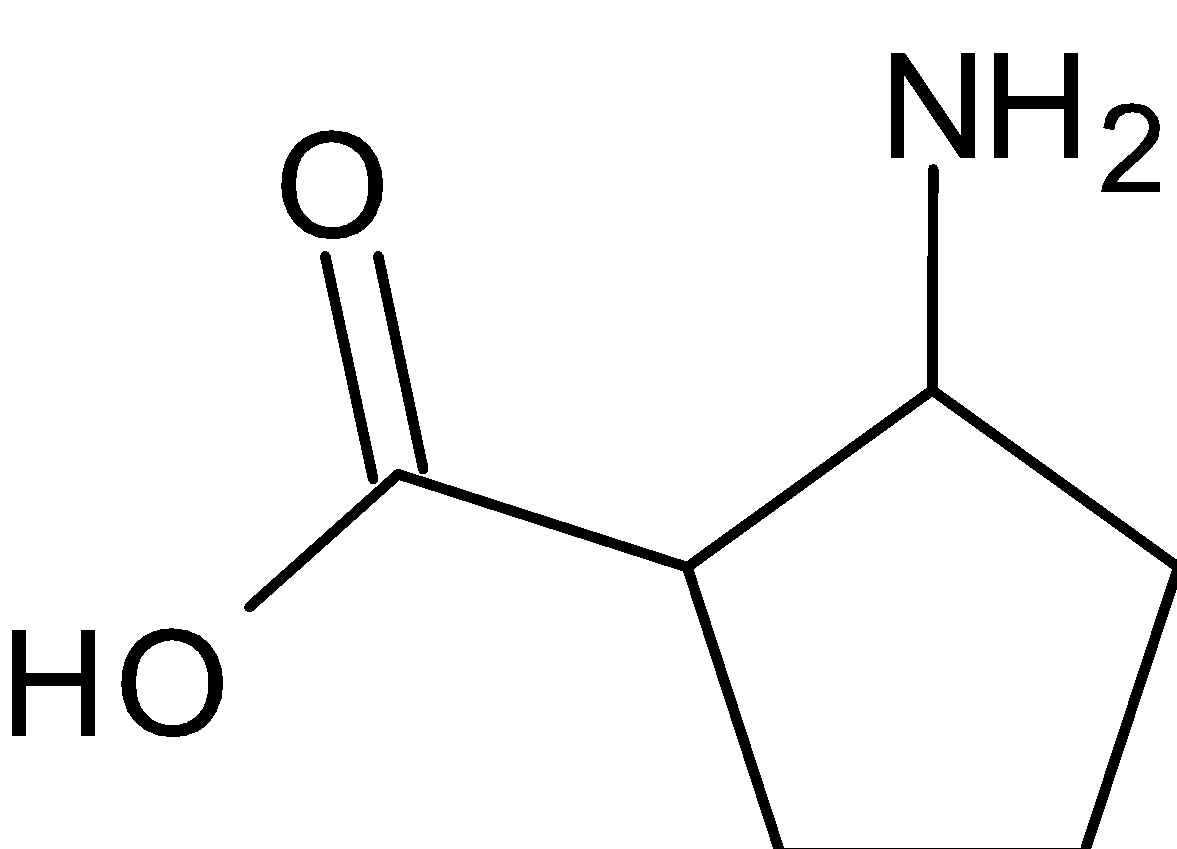
In this molecule, the same carbon is attached to the amino group and carboxyl group.
Hence proline is different from $\alpha - $ amino acids with a secondary amine.
So the correct option is D.
Note: There are $300$ amino acids that occur in nature. The amino acids differ in the nature of the ${\text{R - }}$ group attached to the $\alpha - $ carbon atom. The nature of the ${\text{R - }}$ group determines the properties of proteins. There are compounds which are similar to proline.
Complete step by step solution:
Amino acids are considered to be the building blocks of proteins. The general structural formula of amino acid is given below:
Amino acids are the structural units that make up the proteins. They join together to form short polymer chains called peptides or longer chains called either polypeptides or proteins. These polymers are linear and unbranched, with each amino acid within the chain attached to two neighboring amino acids.
Amino acids are classified as non-polar, polar amino acids with no charge, with positive charge and negative charge. Non-polar amino acids have the same number of amino and carboxyl groups, thus are neutral. They are hydrophobic and have no charge. Some examples are alanine, valine, leucine, isoleucine, phenylalanine, glycine, tryptophan, methionine and proline.
The structure of proline molecule is given below:
In this molecule, the same carbon is attached to the amino group and carboxyl group.
Hence proline is different from $\alpha - $ amino acids with a secondary amine.
So the correct option is D.
Note: There are $300$ amino acids that occur in nature. The amino acids differ in the nature of the ${\text{R - }}$ group attached to the $\alpha - $ carbon atom. The nature of the ${\text{R - }}$ group determines the properties of proteins. There are compounds which are similar to proline.
Recently Updated Pages
Master Class 12 Economics: Engaging Questions & Answers for Success

Master Class 12 Physics: Engaging Questions & Answers for Success
Master Class 12 English: Engaging Questions & Answers for Success
Master Class 12 Social Science: Engaging Questions & Answers for Success
Master Class 12 Maths: Engaging Questions & Answers for Success
Master Class 12 Business Studies: Engaging Questions & Answers for Success
Trending doubts
Which are the Top 10 Largest Countries of the World?
What are the major means of transport Explain each class 12 social science CBSE
Draw a labelled sketch of the human eye class 12 physics CBSE
Why cannot DNA pass through cell membranes class 12 biology CBSE
Differentiate between insitu conservation and exsitu class 12 biology CBSE
Draw a neat and well labeled diagram of TS of ovary class 12 biology CBSE