




Stratified Squamous epithelium is found in
(a) Pharynx
(b) Trachea
(c) Ileum
(d) Bowman’s capsule
Answer
 Verified
645.3k+ views
Hint: This is part of the digestive system and also of the conducting zone of the respiratory system which is lined by nonkeratinized squamous stratified epithelium. This tube in most people is about 4 inches long and less than an inch in diameter. It can be found just under the larynx (voice box) and runs down behind the breastbone (sternum).
Complete answer:
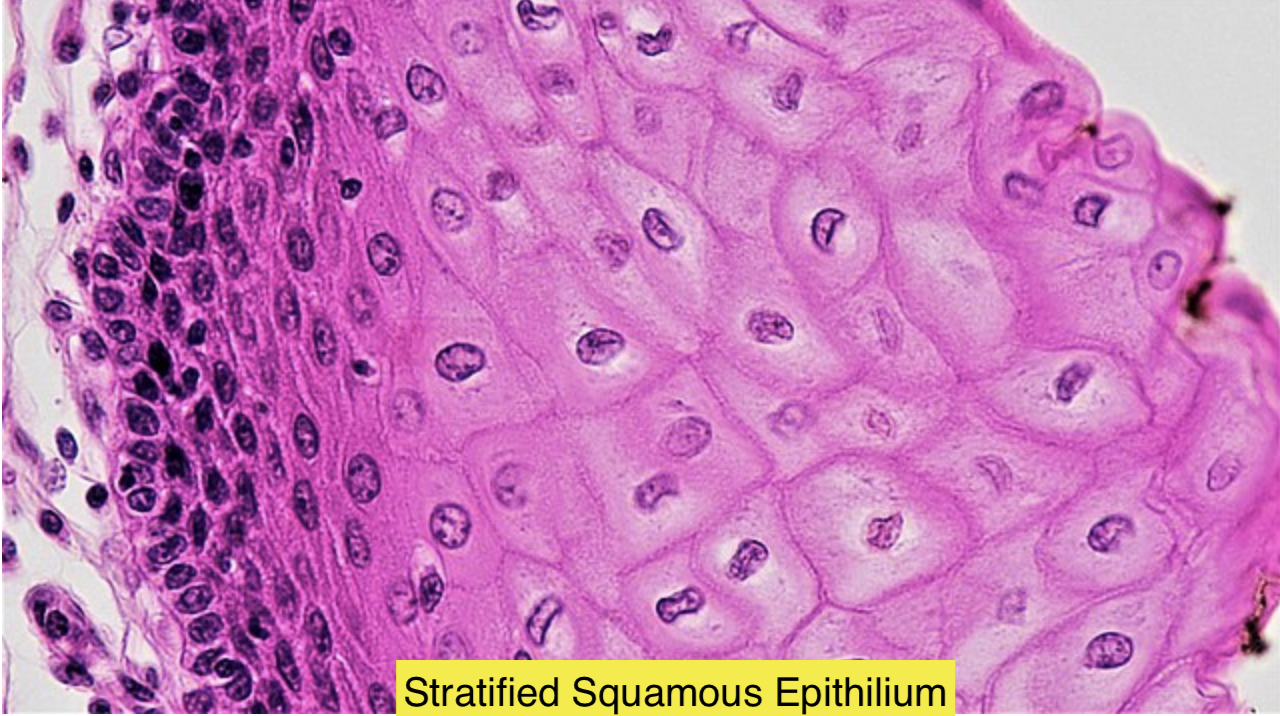
A cartilaginous tube that connects the larynx to the bronchi of the lungs, allowing the passage of air, and so is present in almost all air-breathing animals with lungs is called the trachea or the windpipe which extends from the larynx and branches into the two primary bronchi. Structurally, a stratified squamous epithelium consists of squamous (flattened) epithelial cells arranged in layers upon a basal membrane where only one layer is in contact with the basement membrane; and the other layers adhere to one another to maintain structural integrity. They are of two types: Non-keratinized and keratinized. The surfaces of non-keratinized stratified squamous epithelium must be kept moist by bodily secretions to prevent them from drying out. They include some parts of the oral cavity, esophagus, external female genitalia, and vagina. And the other one is keratinized stratified squamous epithelium which is protected from abrasion by keratin and kept hydrated and protected from dehydration by glycolipids produced in the stratum granulosum. This includes the epidermis of the palm and sole and the masticatory mucosa.
So, the correct answer is, ‘Trachea.’
Additional information:
1) Depending on the age of the epithelium and the damage it has experienced, non-keratinized surfaces consist of keratinocytes and have a minor superficial keratinized layer of varying thickness.
2) Stratified squamous epithelium is well suited to areas in the body subject to constant abrasion, as before the basement membrane is exposed the thickest layers can be sequentially sloughed off and replaced.
3) The prevalence and location of the epithelium reflect its principal functions which include: coverage, protection, absorption, secretion, sensation.
4) The movement of any substances can be either facilitated or inhibited by the epithelium making it a selective barrier for entering or leaving any tissue or organ must pass through the epithelium.
Note: These types of epithelial cells are found in nearly every organ system where the body comes into close contact with the outside environment starting from the skin to the respiratory, digestive, excretory, and reproductive systems and also it protects the body from desiccation and water loss.
Complete answer:
A cartilaginous tube that connects the larynx to the bronchi of the lungs, allowing the passage of air, and so is present in almost all air-breathing animals with lungs is called the trachea or the windpipe which extends from the larynx and branches into the two primary bronchi. Structurally, a stratified squamous epithelium consists of squamous (flattened) epithelial cells arranged in layers upon a basal membrane where only one layer is in contact with the basement membrane; and the other layers adhere to one another to maintain structural integrity. They are of two types: Non-keratinized and keratinized. The surfaces of non-keratinized stratified squamous epithelium must be kept moist by bodily secretions to prevent them from drying out. They include some parts of the oral cavity, esophagus, external female genitalia, and vagina. And the other one is keratinized stratified squamous epithelium which is protected from abrasion by keratin and kept hydrated and protected from dehydration by glycolipids produced in the stratum granulosum. This includes the epidermis of the palm and sole and the masticatory mucosa.
So, the correct answer is, ‘Trachea.’
Additional information:
1) Depending on the age of the epithelium and the damage it has experienced, non-keratinized surfaces consist of keratinocytes and have a minor superficial keratinized layer of varying thickness.
2) Stratified squamous epithelium is well suited to areas in the body subject to constant abrasion, as before the basement membrane is exposed the thickest layers can be sequentially sloughed off and replaced.
3) The prevalence and location of the epithelium reflect its principal functions which include: coverage, protection, absorption, secretion, sensation.
4) The movement of any substances can be either facilitated or inhibited by the epithelium making it a selective barrier for entering or leaving any tissue or organ must pass through the epithelium.
Note: These types of epithelial cells are found in nearly every organ system where the body comes into close contact with the outside environment starting from the skin to the respiratory, digestive, excretory, and reproductive systems and also it protects the body from desiccation and water loss.
Recently Updated Pages
If x a + bt + ct2 where x is in meters and t is in class 11 physics CBSE

A car covers the first half distance between two places class 11 physics CBSE
The resultant of two vectors overrightarrow P and overrightarrow class 11 physics CBSE
Find the value of cos 135 class 11 maths CBSE
A mass M is held in place by an applied force F and class 11 physics CBSE
A solution of glucose in water is labelled as 10 dfracwv class 11 chemistry CBSE
Trending doubts
One Metric ton is equal to kg A 10000 B 1000 C 100 class 11 physics CBSE
Find the value of the expression given below sin 30circ class 11 maths CBSE
What do you mean by retardation What is its SI uni class 11 physics CBSE
Draw a diagram of nephron and explain its structur class 11 biology CBSE
10 examples of friction in our daily life
Difference between physical and chemical change class 11 chemistry CBSE