




What is stopping voltage (or cut voltage)? Plot a graph of variation of photoelectric current with collector plate potential for two incident radiations of same frequency and different intensities.
Answer
 Verified
603.3k+ views
Hint: We know that the stopping voltage is a reference of voltage difference to stop electrons from moving plates and creating a current, from that we plot a graph of variation of photoelectric current with collector plate potential.
Complete answer:
In the photoelectric experiment, the stopping voltage (or stopping potential) refers to the voltage difference needed to stop electrons from moving between plates and producing a current. Photoelectrons are released from a metal, when illuminated with light, above the threshold frequency of the metal, with a spectrum of kinetic energies. The stopping potential is the voltage between the metal surface and a cathode, positioned near to the surface, in a vacuum, which only prevents them from creating a current.
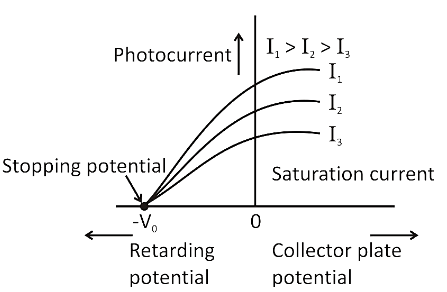
Additional information:
Stopping voltage: Stopping voltage (or stopping potential) refers to the voltage difference needed to stop electrons from travelling between plates and generating a current in the photoelectric experiment. Recall that light is focused onto a metal plate in the photoelectric experiment, and if the frequency of light is high enough, electrons are expelled from the surface. Then these electrons pass directly through a second metal plate. The work function is defined as the minimum amount of energy that is needed to eject an electron from the metal surface. By subtracting the work function from the energy contained in one photon of light, the maximum kinetic energy that the ejected electron has is given.
Note:The negative voltage on the collector plate at which the photoelectric current simply becomes is the stopping potential or voltage. The volt is the unit of stopping potential. Light is focused on a metal plate in the photoelectric experiment and if the frequency of light is sufficient, electrons are ejected from the surface.
Complete answer:
In the photoelectric experiment, the stopping voltage (or stopping potential) refers to the voltage difference needed to stop electrons from moving between plates and producing a current. Photoelectrons are released from a metal, when illuminated with light, above the threshold frequency of the metal, with a spectrum of kinetic energies. The stopping potential is the voltage between the metal surface and a cathode, positioned near to the surface, in a vacuum, which only prevents them from creating a current.
Additional information:
Stopping voltage: Stopping voltage (or stopping potential) refers to the voltage difference needed to stop electrons from travelling between plates and generating a current in the photoelectric experiment. Recall that light is focused onto a metal plate in the photoelectric experiment, and if the frequency of light is high enough, electrons are expelled from the surface. Then these electrons pass directly through a second metal plate. The work function is defined as the minimum amount of energy that is needed to eject an electron from the metal surface. By subtracting the work function from the energy contained in one photon of light, the maximum kinetic energy that the ejected electron has is given.
Note:The negative voltage on the collector plate at which the photoelectric current simply becomes is the stopping potential or voltage. The volt is the unit of stopping potential. Light is focused on a metal plate in the photoelectric experiment and if the frequency of light is sufficient, electrons are ejected from the surface.
Recently Updated Pages
Master Class 12 Business Studies: Engaging Questions & Answers for Success

Master Class 12 Biology: Engaging Questions & Answers for Success
Master Class 12 Chemistry: Engaging Questions & Answers for Success
Class 12 Question and Answer - Your Ultimate Solutions Guide
Master Class 11 English: Engaging Questions & Answers for Success
Master Class 11 Social Science: Engaging Questions & Answers for Success
Trending doubts
In a halfwave rectifier the rms value of the ac component class 12 physics CBSE
What is apomixis and what is its importance class 12 biology CBSE
One megawatt is equal to how many units of electri class 12 physics CBSE
The correct structure of ethylenediaminetetraacetic class 12 chemistry CBSE
The first microscope was invented by A Leeuwenhoek class 12 biology CBSE
Write a note on the Frankfurt parliament class 12 social science CBSE