




State whether true or false:
In the Carnot cycle, there are a total of 4 processes which take place?
Answer
 Verified
603.6k+ views
Hint: We know that when a system undergoes a series of processes and states and returns to its original state, a thermodynamics cycle has taken place. The Carnot cycle is an ideal thermodynamic cycle which undergoes isothermal and adiabatic processes.
Complete step by step answer:
A Carnot cycle is a most efficient reversible heat engine cycle that operates between two temperatures, one is known as source and other is known as sink.
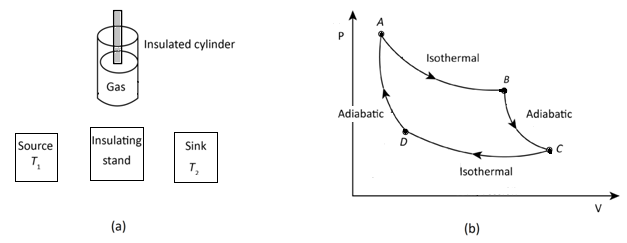
In the above figure, (a) represents the Carnot engine and (b) Carnot cycle.
The Carnot cycle consist of the following processes:
1. Isothermal expansion: In this process, the gas (working substance) attains the temperature of the source as it is placed on it and allows the gas to expand and do work on the surrounding. The temperature of the gas falls as the gas absorbs the required amount of heat from the source, to expand isothermally.
2. Adiabatic expansion: The gas is now placed on a thermally insulated stand and allowed to expand slowly till the temperature of the gas reaches to the temperature of the sink. There is no heat exchange taking place in order to expand the gas.
3. Isothermally compression: Now the gas is placed on the sink and slowly compressed so that the heat is generated and it easily flows to sink and thus the temperature of the gas remains the same.
4. Adiabatic compression: Now the gas is placed on the insulating stand again and the gas is further compressed slowly till it returns to its original state.
Thus, In Carnot cycle, there are total 4 processes which take place and this statement is true.
Note:
The assumptions of Carnot cycle: Isothermal compressions and expansion take place at extremely slow pace, the heat loss between the components is nil and the cycle does not have any friction.
The temperature of the gas falls as the gas absorbs the required amount of heat from the source, to expand isothermally.
Complete step by step answer:
A Carnot cycle is a most efficient reversible heat engine cycle that operates between two temperatures, one is known as source and other is known as sink.
In the above figure, (a) represents the Carnot engine and (b) Carnot cycle.
The Carnot cycle consist of the following processes:
1. Isothermal expansion: In this process, the gas (working substance) attains the temperature of the source as it is placed on it and allows the gas to expand and do work on the surrounding. The temperature of the gas falls as the gas absorbs the required amount of heat from the source, to expand isothermally.
2. Adiabatic expansion: The gas is now placed on a thermally insulated stand and allowed to expand slowly till the temperature of the gas reaches to the temperature of the sink. There is no heat exchange taking place in order to expand the gas.
3. Isothermally compression: Now the gas is placed on the sink and slowly compressed so that the heat is generated and it easily flows to sink and thus the temperature of the gas remains the same.
4. Adiabatic compression: Now the gas is placed on the insulating stand again and the gas is further compressed slowly till it returns to its original state.
Thus, In Carnot cycle, there are total 4 processes which take place and this statement is true.
Note:
The assumptions of Carnot cycle: Isothermal compressions and expansion take place at extremely slow pace, the heat loss between the components is nil and the cycle does not have any friction.
The temperature of the gas falls as the gas absorbs the required amount of heat from the source, to expand isothermally.
Recently Updated Pages
Master Class 12 Business Studies: Engaging Questions & Answers for Success

Master Class 12 Chemistry: Engaging Questions & Answers for Success
Master Class 12 Biology: Engaging Questions & Answers for Success
Class 12 Question and Answer - Your Ultimate Solutions Guide
Master Class 9 General Knowledge: Engaging Questions & Answers for Success
Master Class 9 Maths: Engaging Questions & Answers for Success
Trending doubts
Which are the Top 10 Largest Countries of the World?
Draw a labelled sketch of the human eye class 12 physics CBSE
Differentiate between homogeneous and heterogeneous class 12 chemistry CBSE
Sulphuric acid is known as the king of acids State class 12 chemistry CBSE
Why is the cell called the structural and functional class 12 biology CBSE
A dentist uses a small mirror that gives a magnification class 12 physics CBSE