




State whether true or false:
A magnet always has a pair of poles.
A. True.
B. False.
Answer
 Verified
593.1k+ views
Hint: We will see if we divide a magnet, it is always a magnet. This has been experimentally verified to the best of our ability to divide it into smaller and smaller pieces. This is why magnetic monopoles do not exist. No one has ever observed an isolated north or south pole in nature.
Complete step by step answer:
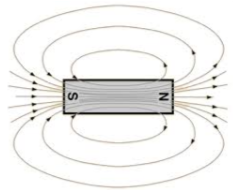
Magnetism is produced by electric current. A magnet will always have a pair of poles, a north and south because magnetic field lines are continuous and always form closed loops
That is why magnets always have a pair of poles.
Hence the statement is true.
Therefore the correct option is A.
Additional information:
Fundamental particles that make up the individual atoms of the magnet. The “source” of bulk magnetism in permanent magnets and ferromagnetic materials are the electrons within certain orbitals of atoms within those materials. Those atoms have a very real, fundamental net magnetic moment, and electrons have a fundamental magnetic moment that stems from their fundamental spin.
In another sense: depends- many permanent magnets rely on their bulk structure to maintain polarity. Even materials that rely on the ability of individual crystal cells of a bulk material to retain a magnetic moment by merit of their composition sometimes require surrounding crystals and perhaps other material phases to hold a magnetic moment.
So, in some magnets, we could break the magnet down to individual crystals, and still have a magnet; then take out select atoms from the crystal, and we would find a single-atom magnet; and then, if we took any atom, and pried out a single electron, we would find our self with a single-fundamental-particle magnet.
In other magnets, breaking down to the crystal-level would lose magnetism; but, going further down to atoms and electrons, we would still have tiny magnets.
The difference between the two is in the ability of the magnetic moments of individual atoms to maintain alignment within a crystal structure. In some materials, that ability relies on the context of a larger structure; in other materials, a single crystal maintains magnetism quite nicely.
Note:
Magnetic fields are produced by currents. The magnetic fields produced by currents are “solenoidal”, which means that the field lines form closed loops. That means that if magnetic field lines exit from one end of a magnet, they must re-enter somewhere, typically on the other end.
Complete step by step answer:
Magnetism is produced by electric current. A magnet will always have a pair of poles, a north and south because magnetic field lines are continuous and always form closed loops
That is why magnets always have a pair of poles.
Hence the statement is true.
Therefore the correct option is A.
Additional information:
Fundamental particles that make up the individual atoms of the magnet. The “source” of bulk magnetism in permanent magnets and ferromagnetic materials are the electrons within certain orbitals of atoms within those materials. Those atoms have a very real, fundamental net magnetic moment, and electrons have a fundamental magnetic moment that stems from their fundamental spin.
In another sense: depends- many permanent magnets rely on their bulk structure to maintain polarity. Even materials that rely on the ability of individual crystal cells of a bulk material to retain a magnetic moment by merit of their composition sometimes require surrounding crystals and perhaps other material phases to hold a magnetic moment.
So, in some magnets, we could break the magnet down to individual crystals, and still have a magnet; then take out select atoms from the crystal, and we would find a single-atom magnet; and then, if we took any atom, and pried out a single electron, we would find our self with a single-fundamental-particle magnet.
In other magnets, breaking down to the crystal-level would lose magnetism; but, going further down to atoms and electrons, we would still have tiny magnets.
The difference between the two is in the ability of the magnetic moments of individual atoms to maintain alignment within a crystal structure. In some materials, that ability relies on the context of a larger structure; in other materials, a single crystal maintains magnetism quite nicely.
Note:
Magnetic fields are produced by currents. The magnetic fields produced by currents are “solenoidal”, which means that the field lines form closed loops. That means that if magnetic field lines exit from one end of a magnet, they must re-enter somewhere, typically on the other end.
Recently Updated Pages
Basicity of sulphurous acid and sulphuric acid are

Master Class 12 English: Engaging Questions & Answers for Success
Master Class 12 Social Science: Engaging Questions & Answers for Success
Master Class 12 Maths: Engaging Questions & Answers for Success
Master Class 12 Economics: Engaging Questions & Answers for Success
Master Class 12 Physics: Engaging Questions & Answers for Success
Trending doubts
Which are the Top 10 Largest Countries of the World?
Draw a labelled sketch of the human eye class 12 physics CBSE
Which state in the country is at the forefront in controlling class 12 social science CBSE
Mention the role of cyanobacteria as a biofertiliz class 12 biology ICSE
Where is the largest hydroelectric power station located class 12 biology CBSE
Which country did Danny Casey play for class 12 english CBSE