



State whether the given statement is true or false.
“Every Integer is a Natural Number.”
Answer
 Verified
652.5k+ views
Hint: Think of the basic definition of integers and natural numbers and try to figure out the relation. Use the venn diagram to represent the sets of natural numbers and integers to get a better visualisation of the relation between them.
Complete step-by-step solution -
First, let us try to recall the definition of integer.
So, the basic definition of integer is “all the rational numbers which can be written without the use of any fractional component no matter whether it’s positive or negative is termed as integers.”
Now, before moving to natural numbers, we will discuss whole numbers.
So, by definition, whole numbers are those Rational numbers that can be written without the use of any kind of fractional component and must not be negative, i.e., either positive or zero.
Now, moving on to natural numbers, all the whole numbers except zero are natural numbers.
So, from the above definitions, we can say:
“All Natural numbers are integers, but all integers are not natural numbers.”
If we think in terms of sets, then natural numbers can be denoted by N and is given by:
N = {1,2,3,……………………. $\infty $ }
Also, we can denote the set of integers as Z and is given by:
Z = { $-\infty $ ,………..-1,0,1,2,3,……………………. $\infty $ }
This can be represented in the form of a Venn diagram as:
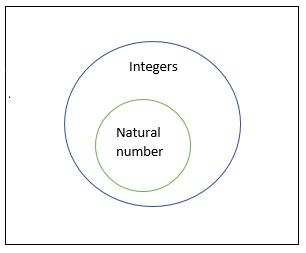
But the statement given in the question “Every Integer is a Natural Number.” Which states the opposite of what we get from the definition. So, the statement is False.
So, the answer to the question is False.
Note: Always read the question twice as there is a high probability that the phrases used might give you a wrong idea at your 1st call, as in such statements, the change of single words may change your answer. For example: in this statement, if you replace “Every” by “Some” the answer is changed. Also, be very sharp with the definitions of the terms as they might be confusing.
Complete step-by-step solution -
First, let us try to recall the definition of integer.
So, the basic definition of integer is “all the rational numbers which can be written without the use of any fractional component no matter whether it’s positive or negative is termed as integers.”
Now, before moving to natural numbers, we will discuss whole numbers.
So, by definition, whole numbers are those Rational numbers that can be written without the use of any kind of fractional component and must not be negative, i.e., either positive or zero.
Now, moving on to natural numbers, all the whole numbers except zero are natural numbers.
So, from the above definitions, we can say:
“All Natural numbers are integers, but all integers are not natural numbers.”
If we think in terms of sets, then natural numbers can be denoted by N and is given by:
N = {1,2,3,……………………. $\infty $ }
Also, we can denote the set of integers as Z and is given by:
Z = { $-\infty $ ,………..-1,0,1,2,3,……………………. $\infty $ }
This can be represented in the form of a Venn diagram as:
But the statement given in the question “Every Integer is a Natural Number.” Which states the opposite of what we get from the definition. So, the statement is False.
So, the answer to the question is False.
Note: Always read the question twice as there is a high probability that the phrases used might give you a wrong idea at your 1st call, as in such statements, the change of single words may change your answer. For example: in this statement, if you replace “Every” by “Some” the answer is changed. Also, be very sharp with the definitions of the terms as they might be confusing.
Recently Updated Pages
Master Class 11 English: Engaging Questions & Answers for Success

Master Class 11 Social Science: Engaging Questions & Answers for Success
Master Class 11 Maths: Engaging Questions & Answers for Success
Master Class 11 Biology: Engaging Questions & Answers for Success
Master Class 11 Physics: Engaging Questions & Answers for Success
Master Class 11 Chemistry: Engaging Questions & Answers for Success
Trending doubts