




State whether a voltmeter has a high resistance or a low resistance. Give reasons for your answer.
Answer
 Verified
672.6k+ views
Hint: Main principle of a voltmeter is that it is connected in parallel to the load where we want to measure the voltage. In any circuit, if we want to measure the voltage in the circuit across any two points or a load, we connect the voltmeter in parallel to that load. In the diagram. We are measuring the voltage across the load resistance, where the voltmeter is connected in parallel to the resistance.
Complete step by step answer:
Voltmeter is an instrument that can measure the voltage between two points.
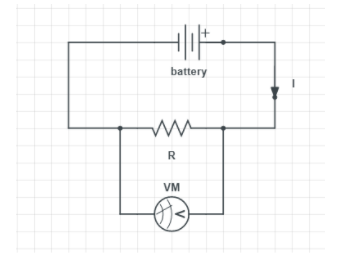
When we connect another conducting material to a circuit, current will also flow through this conductor. The main principle of a voltmeter is that when we measure the voltage of a circuit, we connect the voltmeter to the circuit in a parallel connection because of its high resistance. When we connect a high resistance material to a circuit the current will flow through the circuit, but not through the conductor. But if we connect the high resistance material to the circuit in a parallel connection then there will be no current flow through the circuit. Hence, we use the voltmeter in a parallel connection to the circuit.
Again, when we connect the voltmeter in parallel with the load, the parallel combination will have the same load impedance. Also, when connected in a parallel connection the voltage around the voltmeter will be the same as the voltage around the load.
Also, when we consider an ideal voltmeter in theory, the resistance of the voltmeter should be very high so that no current will flow through the voltmeter and then we will not have any power loss in the instrument.
So, we can say that voltmeter has a very high resistance.
Note: If we use a voltmeter which has low resistance, then current will flow through the voltmeter causing loss of power. Again, the total impedance of the parallel circuit will not be equal to the load. So, we can not use a voltmeter with a low resistance.
Complete step by step answer:
Voltmeter is an instrument that can measure the voltage between two points.
When we connect another conducting material to a circuit, current will also flow through this conductor. The main principle of a voltmeter is that when we measure the voltage of a circuit, we connect the voltmeter to the circuit in a parallel connection because of its high resistance. When we connect a high resistance material to a circuit the current will flow through the circuit, but not through the conductor. But if we connect the high resistance material to the circuit in a parallel connection then there will be no current flow through the circuit. Hence, we use the voltmeter in a parallel connection to the circuit.
Again, when we connect the voltmeter in parallel with the load, the parallel combination will have the same load impedance. Also, when connected in a parallel connection the voltage around the voltmeter will be the same as the voltage around the load.
Also, when we consider an ideal voltmeter in theory, the resistance of the voltmeter should be very high so that no current will flow through the voltmeter and then we will not have any power loss in the instrument.
So, we can say that voltmeter has a very high resistance.
Note: If we use a voltmeter which has low resistance, then current will flow through the voltmeter causing loss of power. Again, the total impedance of the parallel circuit will not be equal to the load. So, we can not use a voltmeter with a low resistance.
Recently Updated Pages
Master Class 12 Physics: Engaging Questions & Answers for Success

Master Class 12 Social Science: Engaging Questions & Answers for Success
Master Class 12 English: Engaging Questions & Answers for Success
Master Class 12 Maths: Engaging Questions & Answers for Success
Master Class 12 Business Studies: Engaging Questions & Answers for Success
Master Class 12 Chemistry: Engaging Questions & Answers for Success
Trending doubts
Draw a labelled sketch of the human eye class 12 physics CBSE
Which are the Top 10 Largest Countries of the World?
Draw ray diagrams each showing i myopic eye and ii class 12 physics CBSE
One megawatt is equal to how many units of electri class 12 physics CBSE
Which is the correct genotypic ratio of mendel dihybrid class 12 biology CBSE
Give 10 examples of unisexual and bisexual flowers