




State true or false for the given trigonometric expression $\cos 11{}^\circ -\cos 2{}^\circ >0$,
A. True
B. False
Answer
 Verified
630k+ views
Hint: We will first calculate the value of $\cos 11{}^\circ $ and then we will calculate the value of $\cos 2{}^\circ $. Finally we will subtract the value of $\cos 2{}^\circ $with $\cos 11{}^\circ $ to get the final result.
Complete step-by-step answer:
It is given that we have to find the relation $\cos 11{}^\circ -\cos 2{}^\circ >0$ is true or false.
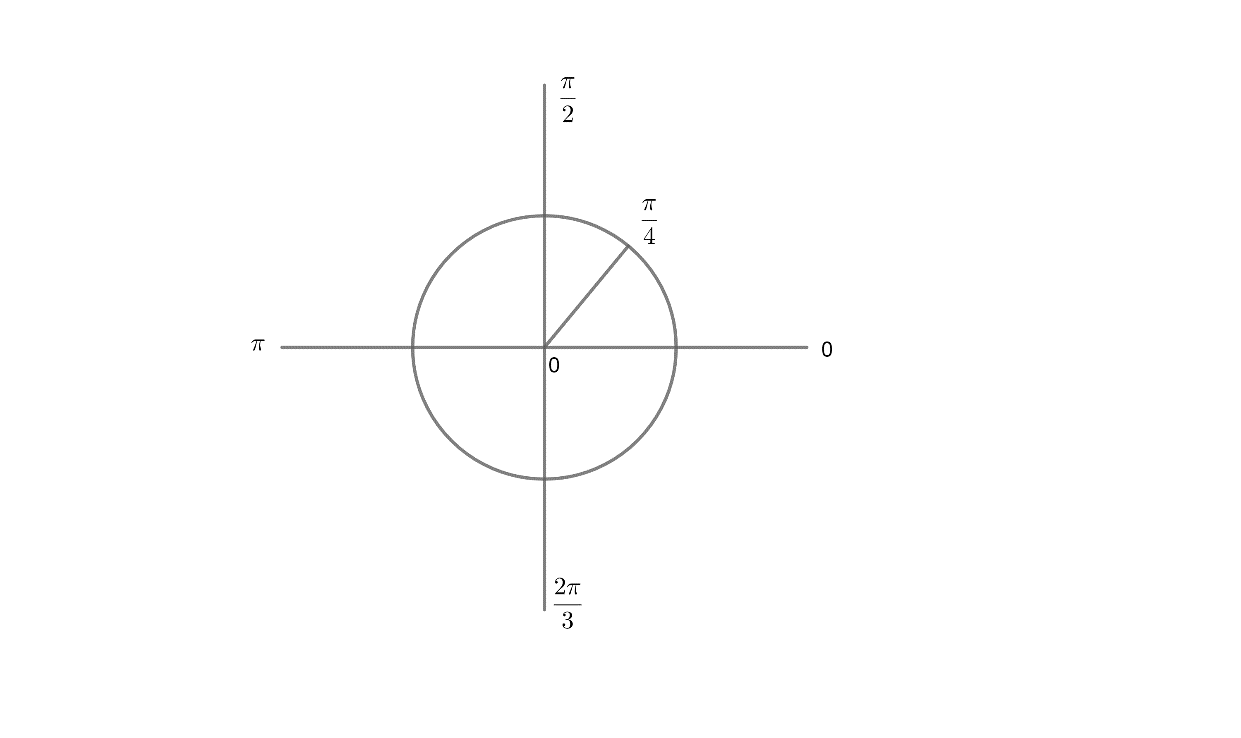
This picture and the values below the picture shows $\cos \theta $ values at different angles.
$\cos \theta $
Values
$\cos 0{}^\circ $ =1
$\cos 30{}^\circ $=$\dfrac{\sqrt{3}}{2}$
$\cos 45{}^\circ $=$\dfrac{1}{\sqrt{2}}$
$\cos 60{}^\circ $=$\dfrac{1}{2}$
$\cos 90{}^\circ $=0
$\cos 180{}^\circ $=-1
So, from above we get an idea about the trend of $\cos \theta $ and their values in different angles. Please note that the value of $\cos \theta $ decreases with the increase in angle from the of $\cos \theta $.
In the 1st quadrant $\cos \theta $ is maximum at $\cos 0{}^\circ $ which is the minimum angle possible and value of $\cos 0{}^\circ $ is 1. Also, with the increase in angle the value of $\cos \theta $ decreases.
The value of $\cos 90{}^\circ $ is 0 and the value of $\cos 180{}^\circ $ is -1 which is the minimum value possible for $\cos \theta $.
Also, we know that the value of $\cos \theta $ varies from 1 to -1.
This picture is showing the graph of $\cos \theta $.
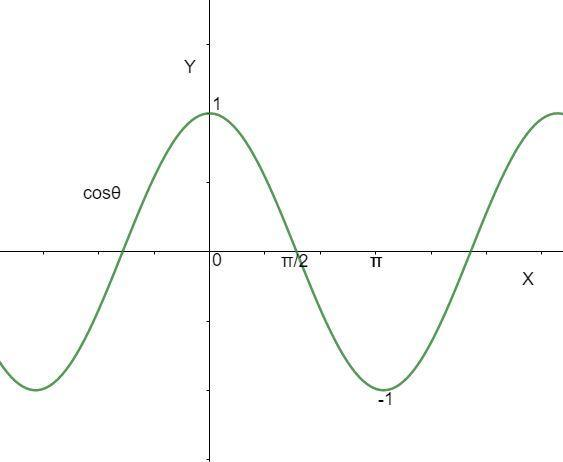
From graph of $\cos \theta $ it is clear that the maximum value of $\cos \theta $ is at $0{}^\circ $which is 1 and the minimum value of $\cos \theta $ is at $180{}^\circ $ which is -1.
Also, we know that if we subtract any greater integer number with any smaller integer number we always get the result as a negative number.
Let us assume that a and b are two positive integer numbers and also a < b.
Then when we subtract (a – b) we get a negative number.
Now, if we analyse the value of $\cos 2{}^\circ $ and $\cos 11{}^\circ $then keeping above discussion in mind we can conclude that the value of $\cos 2{}^\circ $ is greater than the value of $\cos 11{}^\circ $.
As the angle $\cos 2{}^\circ $ is smaller than $\cos 11{}^\circ $. So, it is clear that the value of $\cos 2{}^\circ $is always greater than $\cos 11{}^\circ $. Also, $\cos 2{}^\circ $ and $\cos 11{}^\circ $ both lie in the first quadrant and all the values in the first quadrant are always positive.
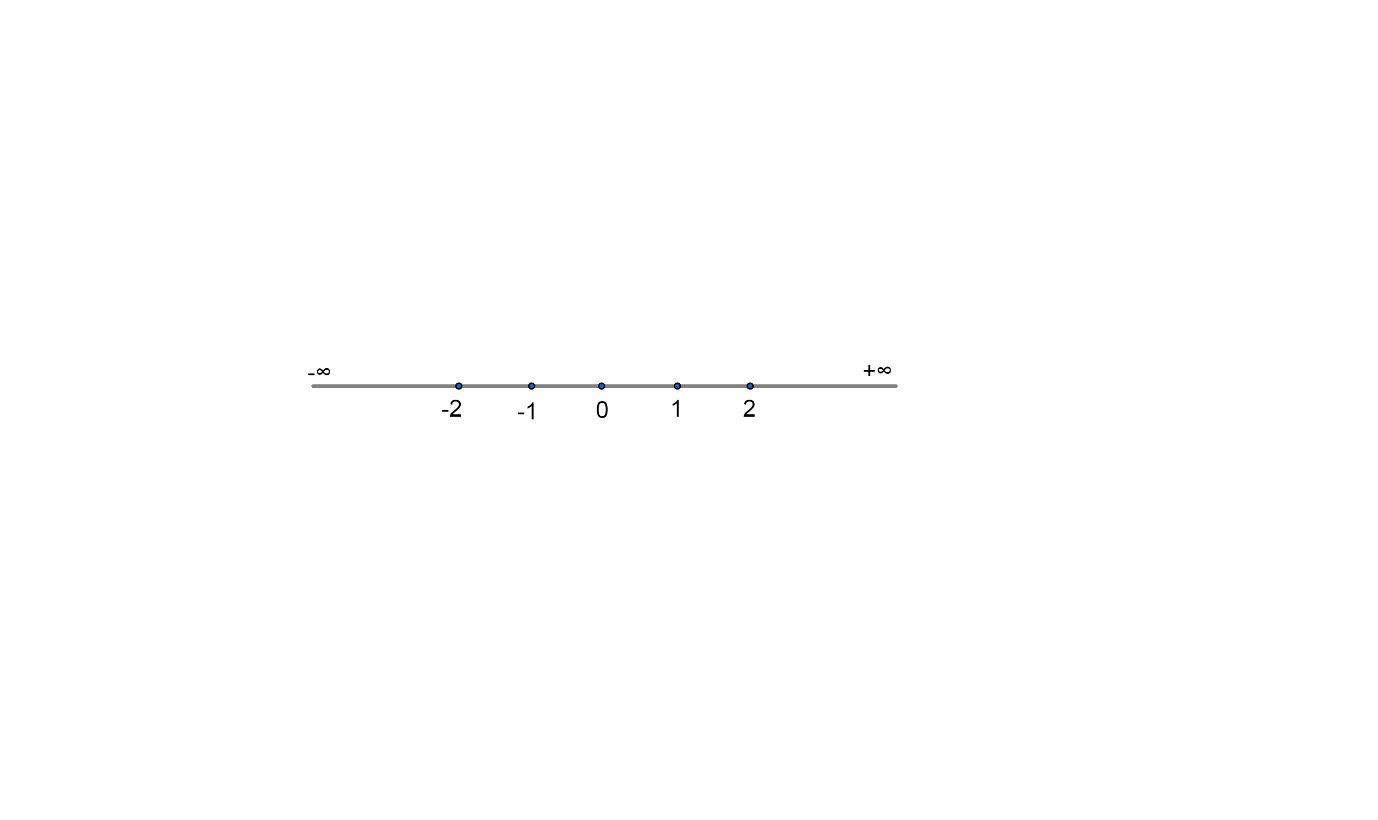
So, if we subtract $\cos 2{}^\circ $ from $\cos 11{}^\circ $ then we are subtracting a smaller value from a greater value. So the resulting value is always a negative number and we know that negative numbers are smaller than 0 as they are lying on the left side of 0 in the number line.
This picture is showing a number line of integers.
So, from all the above discussion we can conclude that
$\cos 11{}^\circ -\cos 2{}^\circ <0$
Or, when we subtract $\cos 2{}^\circ $ from $\cos 11{}^\circ $we will get a negative value which is always less than 0 in the first quadrant.
But in question, the statement is $\cos 11{}^\circ -\cos 2{}^\circ >0$ which is incorrect.
Thus, the given statement is false.
Note: This is a basic question and if you know the trend of $\cos \theta $ a different angle then you can even solve this question without writing a single word.
The value of $\cos \theta $ decreases with increase the value of $\theta $.
$\cos \theta $ is maximum at $\cos 0{}^\circ $ and $\cos \theta $ is minimum at $\cos 180{}^\circ $.
$\cos 0{}^\circ =1$ and $\cos 180{}^\circ =-1$
You may directly calculate the value of $\cos 11{}^\circ $ and $\cos 2{}^\circ $ using a calculator.
$\begin{align}
& \Rightarrow \cos 11{}^\circ -\cos 2{}^\circ <0 \\
& \Rightarrow 0.98-0.99<0 \\
& \Rightarrow -0.01<0 \\
\end{align}$
Thus, the given statement in the question is false.
Complete step-by-step answer:
It is given that we have to find the relation $\cos 11{}^\circ -\cos 2{}^\circ >0$ is true or false.
This picture and the values below the picture shows $\cos \theta $ values at different angles.
$\cos \theta $
Values
$\cos 0{}^\circ $ =1
$\cos 30{}^\circ $=$\dfrac{\sqrt{3}}{2}$
$\cos 45{}^\circ $=$\dfrac{1}{\sqrt{2}}$
$\cos 60{}^\circ $=$\dfrac{1}{2}$
$\cos 90{}^\circ $=0
$\cos 180{}^\circ $=-1
So, from above we get an idea about the trend of $\cos \theta $ and their values in different angles. Please note that the value of $\cos \theta $ decreases with the increase in angle from the of $\cos \theta $.
In the 1st quadrant $\cos \theta $ is maximum at $\cos 0{}^\circ $ which is the minimum angle possible and value of $\cos 0{}^\circ $ is 1. Also, with the increase in angle the value of $\cos \theta $ decreases.
The value of $\cos 90{}^\circ $ is 0 and the value of $\cos 180{}^\circ $ is -1 which is the minimum value possible for $\cos \theta $.
Also, we know that the value of $\cos \theta $ varies from 1 to -1.
This picture is showing the graph of $\cos \theta $.
From graph of $\cos \theta $ it is clear that the maximum value of $\cos \theta $ is at $0{}^\circ $which is 1 and the minimum value of $\cos \theta $ is at $180{}^\circ $ which is -1.
Also, we know that if we subtract any greater integer number with any smaller integer number we always get the result as a negative number.
Let us assume that a and b are two positive integer numbers and also a < b.
Then when we subtract (a – b) we get a negative number.
Now, if we analyse the value of $\cos 2{}^\circ $ and $\cos 11{}^\circ $then keeping above discussion in mind we can conclude that the value of $\cos 2{}^\circ $ is greater than the value of $\cos 11{}^\circ $.
As the angle $\cos 2{}^\circ $ is smaller than $\cos 11{}^\circ $. So, it is clear that the value of $\cos 2{}^\circ $is always greater than $\cos 11{}^\circ $. Also, $\cos 2{}^\circ $ and $\cos 11{}^\circ $ both lie in the first quadrant and all the values in the first quadrant are always positive.
So, if we subtract $\cos 2{}^\circ $ from $\cos 11{}^\circ $ then we are subtracting a smaller value from a greater value. So the resulting value is always a negative number and we know that negative numbers are smaller than 0 as they are lying on the left side of 0 in the number line.
This picture is showing a number line of integers.
So, from all the above discussion we can conclude that
$\cos 11{}^\circ -\cos 2{}^\circ <0$
Or, when we subtract $\cos 2{}^\circ $ from $\cos 11{}^\circ $we will get a negative value which is always less than 0 in the first quadrant.
But in question, the statement is $\cos 11{}^\circ -\cos 2{}^\circ >0$ which is incorrect.
Thus, the given statement is false.
Note: This is a basic question and if you know the trend of $\cos \theta $ a different angle then you can even solve this question without writing a single word.
The value of $\cos \theta $ decreases with increase the value of $\theta $.
$\cos \theta $ is maximum at $\cos 0{}^\circ $ and $\cos \theta $ is minimum at $\cos 180{}^\circ $.
$\cos 0{}^\circ =1$ and $\cos 180{}^\circ =-1$
You may directly calculate the value of $\cos 11{}^\circ $ and $\cos 2{}^\circ $ using a calculator.
$\begin{align}
& \Rightarrow \cos 11{}^\circ -\cos 2{}^\circ <0 \\
& \Rightarrow 0.98-0.99<0 \\
& \Rightarrow -0.01<0 \\
\end{align}$
Thus, the given statement in the question is false.
Recently Updated Pages
Basicity of sulphurous acid and sulphuric acid are

Master Class 12 English: Engaging Questions & Answers for Success
Master Class 12 Social Science: Engaging Questions & Answers for Success
Master Class 12 Maths: Engaging Questions & Answers for Success
Master Class 12 Economics: Engaging Questions & Answers for Success
Master Class 12 Physics: Engaging Questions & Answers for Success
Trending doubts
Which are the Top 10 Largest Countries of the World?
Draw a labelled sketch of the human eye class 12 physics CBSE
Which state in the country is at the forefront in controlling class 12 social science CBSE
Where is the largest hydroelectric power station located class 12 biology CBSE
Which country did Danny Casey play for class 12 english CBSE
Coming together federation is practiced in A India class 12 social science CBSE