




State the underlying principle of a transformer. How is the large scale transmission of electric energy over long distances done with the use of transformers?
Answer
 Verified
634.2k+ views
Hint: A transformer is a device which is used to transfer electrical energy from one circuit to another. Its working is based on the mutual induction of two coils placed in vicinity of each other.
Complete step by step solution:
A transformer is an electrical device which is used to couple one circuit to another. The transformer transforms the electrical energy from one circuit to another.
A transformer is constructed using two coils wound around a laminated steel core. All the components are electrically insulated from one another.
The basic working principle of a transformer is mutual inductance between the coils of the transformer. In a transformer, we have a primary coil and a secondary coil. An input signal is fed to the primary coil. The change in flux in secondary coil due to flow of current in primary coil induces an e.m.f in secondary coil. The amount of e.m.f produced in the coils depends on the number of windings of the coils.
On the basis of windings, we have two types of transformers:
1) Step-down transformer: The primary coil has more windings than secondary coil. It decreases or steps down the voltage.

2) Step-up transformer: The secondary coil has more windings than primary coil. It increases or steps up the voltage.
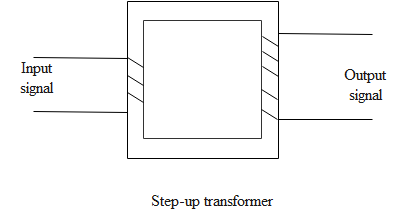
Electricity is transmitted over long distances at high voltage in order to reduce resistance offered by cables. In order to increase the voltage, a step-up transformer is used before transmitting and a step-down transformer is used to lower the voltage at the receiving station.
Note: We use a laminated steel core in a transformer because it reduces losses due to eddy currents. Eddy currents are currents which are set up in a conductor due to changing magnetic fields around it. They are not useful and lead to loss of energy.
Complete step by step solution:
A transformer is an electrical device which is used to couple one circuit to another. The transformer transforms the electrical energy from one circuit to another.
A transformer is constructed using two coils wound around a laminated steel core. All the components are electrically insulated from one another.
The basic working principle of a transformer is mutual inductance between the coils of the transformer. In a transformer, we have a primary coil and a secondary coil. An input signal is fed to the primary coil. The change in flux in secondary coil due to flow of current in primary coil induces an e.m.f in secondary coil. The amount of e.m.f produced in the coils depends on the number of windings of the coils.
On the basis of windings, we have two types of transformers:
1) Step-down transformer: The primary coil has more windings than secondary coil. It decreases or steps down the voltage.
2) Step-up transformer: The secondary coil has more windings than primary coil. It increases or steps up the voltage.
Electricity is transmitted over long distances at high voltage in order to reduce resistance offered by cables. In order to increase the voltage, a step-up transformer is used before transmitting and a step-down transformer is used to lower the voltage at the receiving station.
Note: We use a laminated steel core in a transformer because it reduces losses due to eddy currents. Eddy currents are currents which are set up in a conductor due to changing magnetic fields around it. They are not useful and lead to loss of energy.
Recently Updated Pages
Master Class 12 Business Studies: Engaging Questions & Answers for Success

Master Class 12 Biology: Engaging Questions & Answers for Success
Master Class 12 Chemistry: Engaging Questions & Answers for Success
Class 12 Question and Answer - Your Ultimate Solutions Guide
Master Class 11 English: Engaging Questions & Answers for Success
Master Class 11 Social Science: Engaging Questions & Answers for Success
Trending doubts
Which are the Top 10 Largest Countries of the World?
Draw a labelled sketch of the human eye class 12 physics CBSE
Differentiate between homogeneous and heterogeneous class 12 chemistry CBSE
Why is the cell called the structural and functional class 12 biology CBSE
Draw ray diagrams each showing i myopic eye and ii class 12 physics CBSE
Which is the correct genotypic ratio of mendel dihybrid class 12 biology CBSE