




State the two Kirchhoff’s rules used in electric networks. How are these rules justified?
Answer
 Verified
615.6k+ views
Hint: The two Kirchhoff’s rules for electric circuits are related to the current and voltage respectively. The first law is related to the sum of current entering and leaving a point in an electric circuit while the second law is related to the sum of the voltages flowing through a closed loop of an electric circuit.
Complete step-by-step solution:
We have two Kirchhoff’s laws for electrical circuits which give relation for currents and voltages flowing through an electrical circuit.
The first Kirchhoff’s law is known as Kirchhoff’s current law. This law states that the sum of all the currents entering and leaving a point in an electrical circuit is always equal to zero. Consider the following figure in which we have four currents \[{I_1}\], \[{I_2}\], \[{I_3}\], and \[{I_4}\] which are flowing towards or away from the common point P where all of them meet.
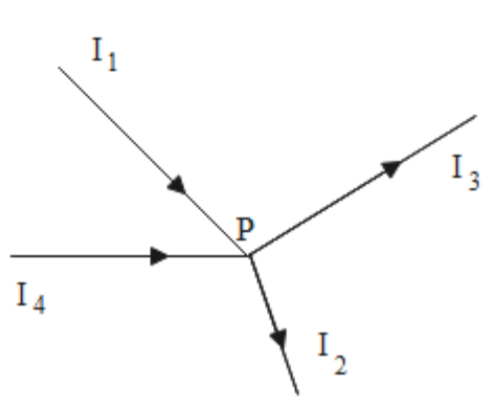
Following the convention given in note, we get \[{I_1} + \left( { - {I_2}} \right) + \left( { - {I_3}} \right) + {I_4} = 0\]
The second Kirchhoff’s law is known as Kirchhoff’s voltage law which states that in a closed-loop in an electrical circuit, the sum of all voltages is always zero taken in either clockwise or anticlockwise direction. Consider the following diagram
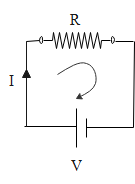
Using the convention given in the note, we get the following expression:
$ - V + IR = 0$
These two laws are justified by the fact that the first law of currents shows us the conservation of charge in the circuit while the second law of voltages shows the conservation of energy in the circuit.
Note: 1. We follow the following convention for the first law: All current entering a junction are taken to be positive while all currents leaving a junction are taken as negative.
2. The convention used for the second law is that when we go from a positive potential to negative potential then the potential difference is taken as positive and vice-versa.
Complete step-by-step solution:
We have two Kirchhoff’s laws for electrical circuits which give relation for currents and voltages flowing through an electrical circuit.
The first Kirchhoff’s law is known as Kirchhoff’s current law. This law states that the sum of all the currents entering and leaving a point in an electrical circuit is always equal to zero. Consider the following figure in which we have four currents \[{I_1}\], \[{I_2}\], \[{I_3}\], and \[{I_4}\] which are flowing towards or away from the common point P where all of them meet.
Following the convention given in note, we get \[{I_1} + \left( { - {I_2}} \right) + \left( { - {I_3}} \right) + {I_4} = 0\]
The second Kirchhoff’s law is known as Kirchhoff’s voltage law which states that in a closed-loop in an electrical circuit, the sum of all voltages is always zero taken in either clockwise or anticlockwise direction. Consider the following diagram
Using the convention given in the note, we get the following expression:
$ - V + IR = 0$
These two laws are justified by the fact that the first law of currents shows us the conservation of charge in the circuit while the second law of voltages shows the conservation of energy in the circuit.
Note: 1. We follow the following convention for the first law: All current entering a junction are taken to be positive while all currents leaving a junction are taken as negative.
2. The convention used for the second law is that when we go from a positive potential to negative potential then the potential difference is taken as positive and vice-versa.
Recently Updated Pages
Master Class 12 Economics: Engaging Questions & Answers for Success

Master Class 12 English: Engaging Questions & Answers for Success
Master Class 12 Social Science: Engaging Questions & Answers for Success
Master Class 12 Maths: Engaging Questions & Answers for Success
Master Class 12 Physics: Engaging Questions & Answers for Success
Master Class 9 General Knowledge: Engaging Questions & Answers for Success
Trending doubts
Which are the Top 10 Largest Countries of the World?
Draw a labelled sketch of the human eye class 12 physics CBSE
Differentiate between homogeneous and heterogeneous class 12 chemistry CBSE
Sulphuric acid is known as the king of acids State class 12 chemistry CBSE
Why is the cell called the structural and functional class 12 biology CBSE
A dentist uses a small mirror that gives a magnification class 12 physics CBSE