




State the difference between Cytoplasm and protoplasm.
Answer
 Verified
615.6k+ views
Hint: Cytoplasm and protoplasm both are the constituents of the cell, out of which one of them plays a major role in making the cell living while the other one helps in holding the various cell organelles together.
Complete answer:
Each of the cells is filled by a thick jelly-like solution called the cytoplasm and is also protected by an outer membrane called the cell membrane.
Each cell consists of a living part that is called the protoplasm and is found to be enclosed by a plasma membrane.
The cell consists of several cell organelles like the endoplasmic reticulum, Golgi body, etc. Which are engulfed in a gel-like substance called cytosol and together all of them are known as cytoplasm but it does not involve the nucleus.
Difference between cytoplasm and protoplasm
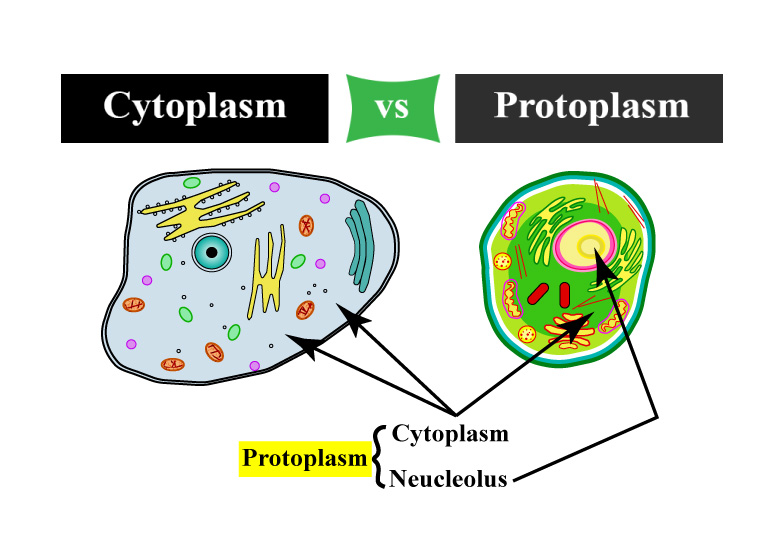
Note: In prokaryotes, only the cytoplasm is present since there is no distinct nucleus and other cell organelles. The cytoplasm itself contains the chromatin and protects genetic material by behaving as the nucleoplasm in prokaryotes. In eukaryotes, as the nucleus is present so it covers the area inside the cell and outside the nucleus.
Complete answer:
Each of the cells is filled by a thick jelly-like solution called the cytoplasm and is also protected by an outer membrane called the cell membrane.
Each cell consists of a living part that is called the protoplasm and is found to be enclosed by a plasma membrane.
The cell consists of several cell organelles like the endoplasmic reticulum, Golgi body, etc. Which are engulfed in a gel-like substance called cytosol and together all of them are known as cytoplasm but it does not involve the nucleus.
Difference between cytoplasm and protoplasm
| Cytoplasm | Protoplasm |
| It consists of a jelly-like substance called cytosol and all cell organelles. | It consists of cytosol, cell organelles along with the nucleus. |
| It is made up of water and structural filaments. | It is made up of cytoplasm, nucleoplasm, and nucleus. |
| It is one of the constituents of protoplasm. | It is a thick, viscous fluid made up of proteins, lipids, carbohydrates, nucleic acid, and inorganic salts. |
| It is a semi-solid material, present between the nucleus and the cell membrane. | It is the living substance of the cell, and it surrounds the cell membrane. |
Note: In prokaryotes, only the cytoplasm is present since there is no distinct nucleus and other cell organelles. The cytoplasm itself contains the chromatin and protects genetic material by behaving as the nucleoplasm in prokaryotes. In eukaryotes, as the nucleus is present so it covers the area inside the cell and outside the nucleus.
Recently Updated Pages
The given figure shows two endocrine glands marked class 11 biology NEET_UG

Match columnI with columnII and select the correct class 11 biology NEET
Match column I with column II and select the correct class 11 biology NEET_UG
Which floral family has left 9 right + 1 arrangement class 11 biology NEET_UG
Which is not a variety of sheep A Lohi B Beetal C Nellore class 11 biology NEET_UG
Match column I with column II and select the correct class 11 biology NEET_UG
Trending doubts
Draw a diagram of a plant cell and label at least eight class 11 biology CBSE
Difference Between Prokaryotic Cells and Eukaryotic Cells
One Metric ton is equal to kg A 10000 B 1000 C 100 class 11 physics CBSE
Two of the body parts which do not appear in MRI are class 11 biology CBSE
1 ton equals to A 100 kg B 1000 kg C 10 kg D 10000 class 11 physics CBSE
10 examples of law on inertia in our daily life