




State Kirchhoff’s law for an electrical network. Using these laws, deduce the condition for balance in a wheatstone bridge.
Answer
 Verified
682.5k+ views
- Hint – In order to solve this question, firstly we will understand the Kirchhoff’s laws i.e. Kirchhoff’s current law and Kirchhoff’s voltage law for an electrical network. Then we will use these two laws to find the required answer.
Complete step-by-step solution -
In 1845, a German physicist, Kirchhoff developed a pair or set of rules or laws that addressed current and energy conservation within electrical circuits. These two rules are commonly known as Kirchhoff’s current law (KCL) while other law deals with the voltage sources present in a closed circuit, Kirchhoff’s voltage law (KVL).
Kirchhoff's first law or KCL states that the total current or charge entering a junction or node is exactly the same as the charge leaving the node because it has no other way to go but to exit, because no charge is lost within the node. At any intersection, the algebraic number of the currents is zero.
$\therefore \sum I = 0$
Kirchhoff's second law, or KVL, states that the total voltage around the loop is equal to the sum of all the voltage drops within the same loop in any closed loop network. Inside the loop the algebraic sum of all voltages must be equal to zero.
$\therefore \sum {\left( {IR} \right) + \sum {E = 0} } $
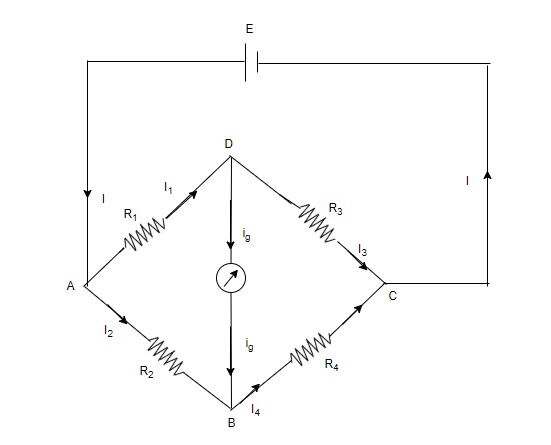
Wheatstone bridge: Wheatstone’s bridge circuit consists of four resistances ${R_1},{R_2},{R_3},{R_4}$ are connected to form a closed path. A cell of emf$\varepsilon $is connected between the point A and C and a galvanometer is connected between the points D and B. The current through the various branches are indicated in the figure. The current through the galvanometer is ${I_g}$ and the resistance if the galvanometer is G.
Now applying Kirchhoff’s first law-
At the junction D, ${I_1} - {I_3} - {I_g} = 0.......\left( 1 \right)$
At the junction B, ${I_2} + {I_g} - {I_4} = 0.......\left( 2 \right)$
Applying Kirchhoff’s second law to the closed path ADBA-
$ - {I_1}{R_1} - {I_g}G + {I_2}{R_2} = 0$
$\Rightarrow {I_1}{R_1} + {I_g}G = {I_2}{R_2}.......\left( 3 \right)$
$ \Rightarrow $ to the closed path DCBD
$ - {I_3}{R_3} + {I_4}{R_4} + {I_g}G = 0$
$\Rightarrow {I_3}{R_3} - {I_g}G = {I_4}{R_4}.......\left( 4 \right)$
When the galvanometer shows zero deflection the points D and B are at the same potential,
So ${I_g} = 0$
Substituting this value in 1, 2, 3 and 4-
$
{I_1} = {I_3}..........\left( 5 \right) \\
{I_2} = {I_4}...........\left( 6 \right) \\
{I_1}{R_1} = {I_2}{R_2}.......\left( 7 \right) \\
{I_3}{R_3} = {I_4}{R_4}........\left( 8 \right) \\
$
Dividing 7 by 8,
$\dfrac{{{I_1}{R_1}}}{{{I_3}{R_3}}} = \dfrac{{{I_2}{R_2}}}{{{I_4}{R_4}}}$
$ \Rightarrow \dfrac{{{R_1}}}{{{R_3}}} = \dfrac{{{R_2}}}{{{R_1}}}\left[ {\because {I_1} = {I_3},{I_2} = {I_4}} \right]$
Wheatstone’s bridge principle:
$\therefore {R_4} = {R_3} \times \dfrac{{{R_2}}}{{{R_1}}}$
Note- While solving this question, we must know that the Kirchhoff’s current law or KCL is also known as junction law and Kirchhoff’s voltage law or KVL is also known as loop law, so that it is beneficial to solve similar kinds of questions.
Complete step-by-step solution -
In 1845, a German physicist, Kirchhoff developed a pair or set of rules or laws that addressed current and energy conservation within electrical circuits. These two rules are commonly known as Kirchhoff’s current law (KCL) while other law deals with the voltage sources present in a closed circuit, Kirchhoff’s voltage law (KVL).
Kirchhoff's first law or KCL states that the total current or charge entering a junction or node is exactly the same as the charge leaving the node because it has no other way to go but to exit, because no charge is lost within the node. At any intersection, the algebraic number of the currents is zero.
$\therefore \sum I = 0$
Kirchhoff's second law, or KVL, states that the total voltage around the loop is equal to the sum of all the voltage drops within the same loop in any closed loop network. Inside the loop the algebraic sum of all voltages must be equal to zero.
$\therefore \sum {\left( {IR} \right) + \sum {E = 0} } $
Wheatstone bridge: Wheatstone’s bridge circuit consists of four resistances ${R_1},{R_2},{R_3},{R_4}$ are connected to form a closed path. A cell of emf$\varepsilon $is connected between the point A and C and a galvanometer is connected between the points D and B. The current through the various branches are indicated in the figure. The current through the galvanometer is ${I_g}$ and the resistance if the galvanometer is G.
Now applying Kirchhoff’s first law-
At the junction D, ${I_1} - {I_3} - {I_g} = 0.......\left( 1 \right)$
At the junction B, ${I_2} + {I_g} - {I_4} = 0.......\left( 2 \right)$
Applying Kirchhoff’s second law to the closed path ADBA-
$ - {I_1}{R_1} - {I_g}G + {I_2}{R_2} = 0$
$\Rightarrow {I_1}{R_1} + {I_g}G = {I_2}{R_2}.......\left( 3 \right)$
$ \Rightarrow $ to the closed path DCBD
$ - {I_3}{R_3} + {I_4}{R_4} + {I_g}G = 0$
$\Rightarrow {I_3}{R_3} - {I_g}G = {I_4}{R_4}.......\left( 4 \right)$
When the galvanometer shows zero deflection the points D and B are at the same potential,
So ${I_g} = 0$
Substituting this value in 1, 2, 3 and 4-
$
{I_1} = {I_3}..........\left( 5 \right) \\
{I_2} = {I_4}...........\left( 6 \right) \\
{I_1}{R_1} = {I_2}{R_2}.......\left( 7 \right) \\
{I_3}{R_3} = {I_4}{R_4}........\left( 8 \right) \\
$
Dividing 7 by 8,
$\dfrac{{{I_1}{R_1}}}{{{I_3}{R_3}}} = \dfrac{{{I_2}{R_2}}}{{{I_4}{R_4}}}$
$ \Rightarrow \dfrac{{{R_1}}}{{{R_3}}} = \dfrac{{{R_2}}}{{{R_1}}}\left[ {\because {I_1} = {I_3},{I_2} = {I_4}} \right]$
Wheatstone’s bridge principle:
$\therefore {R_4} = {R_3} \times \dfrac{{{R_2}}}{{{R_1}}}$
Note- While solving this question, we must know that the Kirchhoff’s current law or KCL is also known as junction law and Kirchhoff’s voltage law or KVL is also known as loop law, so that it is beneficial to solve similar kinds of questions.
Recently Updated Pages
Master Class 12 Physics: Engaging Questions & Answers for Success

Master Class 12 Social Science: Engaging Questions & Answers for Success
Master Class 12 English: Engaging Questions & Answers for Success
Master Class 12 Maths: Engaging Questions & Answers for Success
Master Class 12 Business Studies: Engaging Questions & Answers for Success
Master Class 12 Chemistry: Engaging Questions & Answers for Success
Trending doubts
Draw a labelled sketch of the human eye class 12 physics CBSE
Which are the Top 10 Largest Countries of the World?
Draw ray diagrams each showing i myopic eye and ii class 12 physics CBSE
One megawatt is equal to how many units of electri class 12 physics CBSE
Which is the correct genotypic ratio of mendel dihybrid class 12 biology CBSE
Give 10 examples of unisexual and bisexual flowers