



State Fleming’s right hand rule. For what purpose is it used?
Answer
 Verified
676.2k+ views
Hint: Fleming’s right hand rule is used to determine the direction of induced current in a conductor which is moving inside the magnetic field. As per Fleming’s we use thumb, index finger and middle finger for various directions.
Complete step by step answer:
Fleming’s right rule as the name suggests was discovered by Sir John Ambrose Fleming.
Consider a wire or any conductor placed in a region having a magnetic field. As this conductor is placed inside a magnetic field so an electric current is induced in it as per Faraday’s Law of Induction.
So, the direction of induced current in this conductor is given by Fleming’s right hand rule.
According to Fleming's right hand rule, the thumb shows the direction of the motion of the conductor with respect to the magnetic field. The index finger of the right hand shows the direction of the magnetic field. The middle finger shows the direction of the induced current in the conductor.
Consider the below figure:
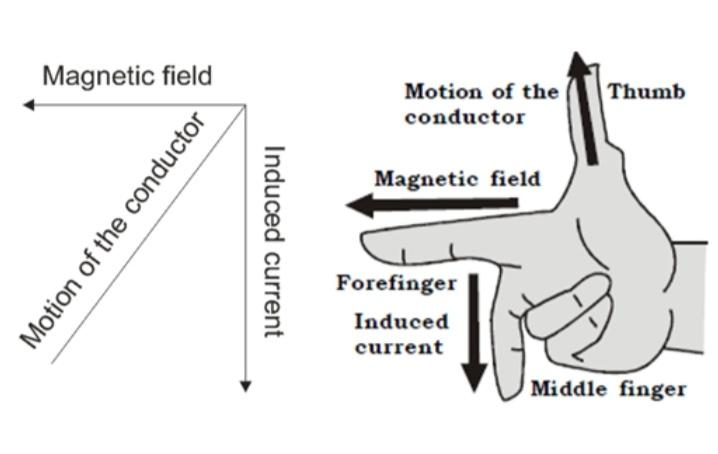
Hold your right hand as shown in the figure above such that the index finger and middle finger are at right angles to each other.
Now first point your thumb in the direction of the motion of the conductor, then place your index finger in the direction of the magnetic field. Then bring your middle finger perpendicular to the index finger, the direction of the middle finger represents the direction of the induced current in the conductor
Additional information:
When electrons, or any charged particles, flow in the same direction (for example, as an electric current in an electrical conductor, such as a metal wire), they generate a cylindrical magnetic field that wraps round the conductor.
Fleming's right hand rule does not determine the magnitude but instead shows the direction of any of the three parameters (magnetic field, current, force) when the direction of the other two parameters is known.
Note:
To remember this rule, remember FBI
F – Force or Motion
B – Magnetic field
I – Induced current
Students often get confused between Fleming’s right hand rule and left hand rule. Remember Fleming’s left hand rule is used in case of electric motors.
Complete step by step answer:
Fleming’s right rule as the name suggests was discovered by Sir John Ambrose Fleming.
Consider a wire or any conductor placed in a region having a magnetic field. As this conductor is placed inside a magnetic field so an electric current is induced in it as per Faraday’s Law of Induction.
So, the direction of induced current in this conductor is given by Fleming’s right hand rule.
According to Fleming's right hand rule, the thumb shows the direction of the motion of the conductor with respect to the magnetic field. The index finger of the right hand shows the direction of the magnetic field. The middle finger shows the direction of the induced current in the conductor.
Consider the below figure:
Hold your right hand as shown in the figure above such that the index finger and middle finger are at right angles to each other.
Now first point your thumb in the direction of the motion of the conductor, then place your index finger in the direction of the magnetic field. Then bring your middle finger perpendicular to the index finger, the direction of the middle finger represents the direction of the induced current in the conductor
Additional information:
When electrons, or any charged particles, flow in the same direction (for example, as an electric current in an electrical conductor, such as a metal wire), they generate a cylindrical magnetic field that wraps round the conductor.
Fleming's right hand rule does not determine the magnitude but instead shows the direction of any of the three parameters (magnetic field, current, force) when the direction of the other two parameters is known.
Note:
To remember this rule, remember FBI
F – Force or Motion
B – Magnetic field
I – Induced current
Students often get confused between Fleming’s right hand rule and left hand rule. Remember Fleming’s left hand rule is used in case of electric motors.
Recently Updated Pages
Master Class 12 Physics: Engaging Questions & Answers for Success

Master Class 12 Social Science: Engaging Questions & Answers for Success
Master Class 12 English: Engaging Questions & Answers for Success
Master Class 12 Maths: Engaging Questions & Answers for Success
Master Class 12 Business Studies: Engaging Questions & Answers for Success
Master Class 12 Chemistry: Engaging Questions & Answers for Success
Trending doubts
Draw a labelled sketch of the human eye class 12 physics CBSE
Which are the Top 10 Largest Countries of the World?
Draw ray diagrams each showing i myopic eye and ii class 12 physics CBSE
One megawatt is equal to how many units of electri class 12 physics CBSE
Which is the correct genotypic ratio of mendel dihybrid class 12 biology CBSE
Give 10 examples of unisexual and bisexual flowers