




State Faraday’s law of electromagnetic induction and Lenz’s law.
Answer
 Verified
659.1k+ views
Hint: Faraday's law of electromagnetic induction which is also referred to as Faraday's law is a basic law of electromagnetism which predicts how a magnetic field will get interacted with an electric circuit in order to create an electromotive force (emf).
Complete step by step answer:
Faraday’s law of electromagnetic induction states that a current is induced in a conductor which is in a changing magnetic field. In accordance with Faraday's first law, any minute variation in the magnetic field of the coil will result in an emf which is getting induced in the coil. The ways in which the magnetic field can be varied are,
(a) The movement of a bar magnet towards and away from the coil.
(b)The movement of the coil into and out of a magnetic field.
(c) Varying the area where the coil is placed which will result in a change in magnetic field.
(d) The rotation of the coil relative to the magnet will bring the variation in magnetic field.
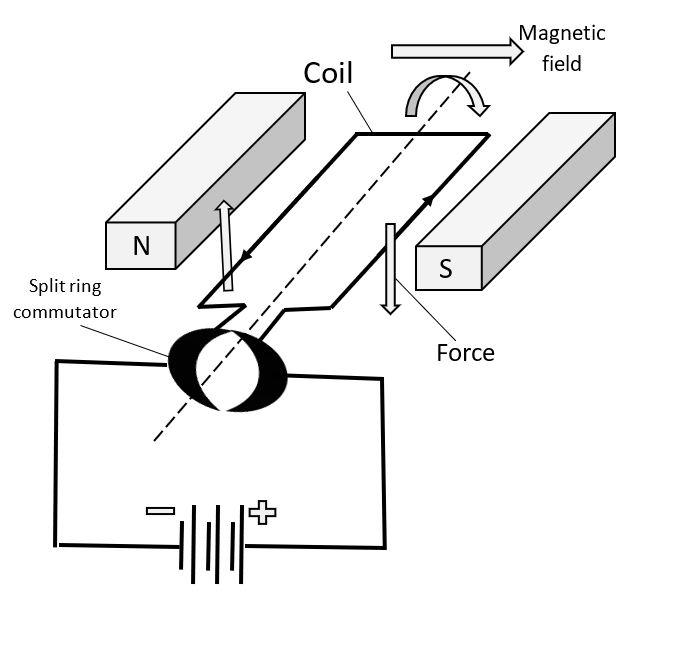
Faraday's law considers how the changing magnetic fields can cause current to flow in wires. Lenz’s law in electromagnetic induction states that the direction of the induced current will be such that the magnetic field generated by the induced current will oppose the initial changing magnetic field which created it. The direction of current flow is determined using Fleming’s right-hand rule.
Formula of faraday's law is
$-N\Delta \phi \Delta t=emf$
Note:
The negative sign in the formula of Faraday’s law of electromagnetic induction indicates the direction of the induced field. The direction of the induced field can be found by using Lenz's law. According to Lenz's law, current flow is due to emf which is created in the magnetic field opposes the change in the flux that creates it.
Complete step by step answer:
Faraday’s law of electromagnetic induction states that a current is induced in a conductor which is in a changing magnetic field. In accordance with Faraday's first law, any minute variation in the magnetic field of the coil will result in an emf which is getting induced in the coil. The ways in which the magnetic field can be varied are,
(a) The movement of a bar magnet towards and away from the coil.
(b)The movement of the coil into and out of a magnetic field.
(c) Varying the area where the coil is placed which will result in a change in magnetic field.
(d) The rotation of the coil relative to the magnet will bring the variation in magnetic field.
Faraday's law considers how the changing magnetic fields can cause current to flow in wires. Lenz’s law in electromagnetic induction states that the direction of the induced current will be such that the magnetic field generated by the induced current will oppose the initial changing magnetic field which created it. The direction of current flow is determined using Fleming’s right-hand rule.
Formula of faraday's law is
$-N\Delta \phi \Delta t=emf$
Note:
The negative sign in the formula of Faraday’s law of electromagnetic induction indicates the direction of the induced field. The direction of the induced field can be found by using Lenz's law. According to Lenz's law, current flow is due to emf which is created in the magnetic field opposes the change in the flux that creates it.
Recently Updated Pages
Which of the following graphs shows the variation of class 12 physics CBSE

Draw a labelled diagram of the human male reproductive class 12 biology CBSE
Describe the experiment to compare the emf of two cells class 12 physics CBSE
What is standard hydrogen electrode
What is conventional current and electric current class 12 physics CBSE
2Bromopentane is treated with an alcoholic KOH solution class 12 chemistry CBSE
Trending doubts
Draw a labelled sketch of the human eye class 12 physics CBSE
Which are the Top 10 Largest Countries of the World?
Differentiate between homogeneous and heterogeneous class 12 chemistry CBSE
Draw ray diagrams each showing i myopic eye and ii class 12 physics CBSE
Which is the correct genotypic ratio of mendel dihybrid class 12 biology CBSE
What is the Full Form of PVC, PET, HDPE, LDPE, PP and PS ?