




State Coulomb’s law in electrostatics.
Answer
 Verified
618.3k+ views
Hint: The coulomb’s law gives the force acting between two stationary charges in space. The law gives the relationship between force, magnitude of charges and the distance between them. The two charges are joined by a line; along it is the direction of force. The electrostatic force is either an attractive force or a repulsive force.
Complete answer:
According to Coulomb's law in electrostatics, when a charge is kept in the vicinity of another charged particle, the force acting on the charge is directly proportional to the product of their charges and inversely proportional to the square of the distance between them. It is given by-
$F\propto \dfrac{{{q}_{1}}{{q}_{2}}}{{{r}^{2}}}$
Here, $F$ is the force acting between the charges
${{q}_{1}},\,{{q}_{2}}$ are the magnitude of charges
$r$ is the distance between them
On removing the sign of proportionality, we get,
$F=\dfrac{{{q}_{1}}{{q}_{2}}}{4\pi {{\varepsilon }_{0}}{{r}^{2}}}$
The constant of proportionality is$\dfrac{1}{4\pi {{\varepsilon }_{0}}}$. Here,${{\varepsilon }_{0}}$ is the permeability of free space.
The force in the vector form can be given as-
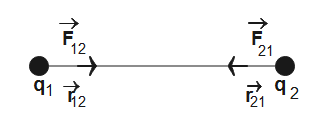
$\vec{F}=\dfrac{{{q}_{1}}{{q}_{2}}}{4\pi {{\varepsilon }_{0}}{{\left| {{{\vec{r}}}_{12}} \right|}^{2}}}{{\hat{r}}_{12}}$
${{\vec{F}}_{12}}$ is the force acting on ${{q}_{2}}$due to ${{q}_{1}}$
Similarly,${{\vec{F}}_{21}}$ is the force acting on ${{q}_{1}}$due to ${{q}_{2}}$
The forces ${{\vec{F}}_{21}}$,${{\vec{F}}_{12}}$ have opposite directions but the same magnitude.
$\therefore {{\vec{F}}_{12}}=-{{\vec{F}}_{21}}$
Additional Information:
The Electric field due to a charged particle is defined as the force acting per unit charge. It can also be defined as the work required bringing a unit charge from infinity to the field of a charged particle. It is given as-
$E=\dfrac{q}{4\pi {{\varepsilon }_{0}}{{r}^{2}}}$.
Note:
The force acts along the straight line passing through the two charges. The electrostatic force is either an attractive force or a repulsive force. It is analogous to the law of gravitation. As seen from coulomb’s law, the force also depends on the surrounding medium. The coulomb’s law is used to derive the gauss law.
Complete answer:
According to Coulomb's law in electrostatics, when a charge is kept in the vicinity of another charged particle, the force acting on the charge is directly proportional to the product of their charges and inversely proportional to the square of the distance between them. It is given by-
$F\propto \dfrac{{{q}_{1}}{{q}_{2}}}{{{r}^{2}}}$
Here, $F$ is the force acting between the charges
${{q}_{1}},\,{{q}_{2}}$ are the magnitude of charges
$r$ is the distance between them
On removing the sign of proportionality, we get,
$F=\dfrac{{{q}_{1}}{{q}_{2}}}{4\pi {{\varepsilon }_{0}}{{r}^{2}}}$
The constant of proportionality is$\dfrac{1}{4\pi {{\varepsilon }_{0}}}$. Here,${{\varepsilon }_{0}}$ is the permeability of free space.
The force in the vector form can be given as-
$\vec{F}=\dfrac{{{q}_{1}}{{q}_{2}}}{4\pi {{\varepsilon }_{0}}{{\left| {{{\vec{r}}}_{12}} \right|}^{2}}}{{\hat{r}}_{12}}$
${{\vec{F}}_{12}}$ is the force acting on ${{q}_{2}}$due to ${{q}_{1}}$
Similarly,${{\vec{F}}_{21}}$ is the force acting on ${{q}_{1}}$due to ${{q}_{2}}$
The forces ${{\vec{F}}_{21}}$,${{\vec{F}}_{12}}$ have opposite directions but the same magnitude.
$\therefore {{\vec{F}}_{12}}=-{{\vec{F}}_{21}}$
Additional Information:
The Electric field due to a charged particle is defined as the force acting per unit charge. It can also be defined as the work required bringing a unit charge from infinity to the field of a charged particle. It is given as-
$E=\dfrac{q}{4\pi {{\varepsilon }_{0}}{{r}^{2}}}$.
Note:
The force acts along the straight line passing through the two charges. The electrostatic force is either an attractive force or a repulsive force. It is analogous to the law of gravitation. As seen from coulomb’s law, the force also depends on the surrounding medium. The coulomb’s law is used to derive the gauss law.
Recently Updated Pages
Basicity of sulphurous acid and sulphuric acid are

Master Class 12 Economics: Engaging Questions & Answers for Success
Master Class 12 Biology: Engaging Questions & Answers for Success
Master Class 11 English: Engaging Questions & Answers for Success
Master Class 11 Physics: Engaging Questions & Answers for Success
Master Class 11 Computer Science: Engaging Questions & Answers for Success
Trending doubts
Draw a labelled sketch of the human eye class 12 physics CBSE
The chemical formula of tear gas is A CO Cl 2 B C 10 class 12 chemistry CBSE
Draw ray diagrams each showing i myopic eye and ii class 12 physics CBSE
Which are the Top 10 Largest Countries of the World?
Differentiate between homogeneous and heterogeneous class 12 chemistry CBSE
Which is the correct genotypic ratio of mendel dihybrid class 12 biology CBSE