




State and explain Kirchhoff’s Laws in the current electricity.
Answer
 Verified
555.1k+ views
Hint: Junction is any point in the circuit where the current can split. Use sign concentrations to find KVL and KCL. First law deals with the sum of current coming and leaving at a junction. Second law deals with the sum of potential differences plus the algebraic sum of e.m.f is equal to zero.
Complete step-by-step answer:
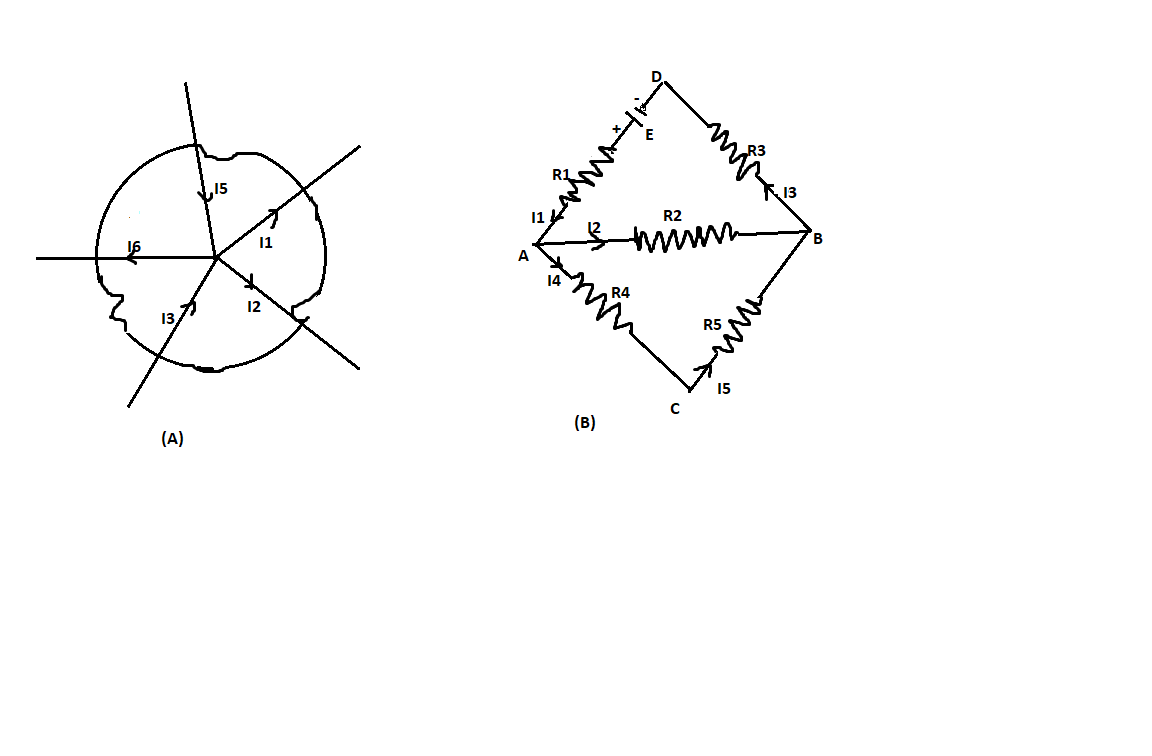
Kirchhoff’s laws are generally used to analyse the electrical circuit that is to calculate the current and resistance in the network. Kirchhoff's law Voltage law and current law are derived on the basis of principle of conservation of energy. Kirchhoff’s law is of two type:
1. Kirchhoff’s Current Law(KCL)
Statement: The algebraic sum of current entering and leaving at any junction in a circuit is zero.
$i.e.\sum\limits_{{}}^{{}}{i=0}$
Consider a surface as containing the conductor meeting at a point P as shown in figure (a). Now, taking the current flowing away from the junction as positive and current flowing towards the junction as negative, then
\[\begin{array}{*{35}{l}}
{{I}_{1}}-{{I}_{2}}+{{I}_{3}}-{{I}_{4}}+{{I}_{5}}=0 \\
{{I}_{1}}+{{I}_{3}}={{I}_{2}}+{{I}_{4}}-{{I}_{5}} \\
\end{array}\]
2. Kirchhoff’s Current Law(KVL)
Statement: The sum of voltage of sources and all potential drop (IR drop) in any closed loop of a network is zero.
While applying KVL, positive value of current is taken when we are travelling in the direction of current and e.m.f is taken negative when we travel from negative to positive electrode of source.
In ABDA loop,
${{I}_{1}}{{R}_{1}}+{{I}_{2}}{{R}_{2}}+{{I}_{3}}{{R}_{3}}=E$
In ABCA loop,
$\begin{align}
& {{I}_{2}}{{R}_{2}}-{{I}_{5}}{{R}_{5}}-{{I}_{4}}{{R}_{4}}=0 \\
& {{I}_{2}}{{R}_{2}}={{I}_{5}}{{R}_{5}}-{{I}_{4}}{{R}_{4}} \\
\end{align}$
Note: Do not get confused between ohm's law and Kirchhoff’ law. Kirchhoff’s laws are used to determine currents and potential difference in the complicated circuit. Ohms law is valid only for graphs passing through origin. Current is the rate of flow of electric charge. Steady state current is electric current which does not depend upon time.
Complete step-by-step answer:
Kirchhoff’s laws are generally used to analyse the electrical circuit that is to calculate the current and resistance in the network. Kirchhoff's law Voltage law and current law are derived on the basis of principle of conservation of energy. Kirchhoff’s law is of two type:
1. Kirchhoff’s Current Law(KCL)
Statement: The algebraic sum of current entering and leaving at any junction in a circuit is zero.
$i.e.\sum\limits_{{}}^{{}}{i=0}$
Consider a surface as containing the conductor meeting at a point P as shown in figure (a). Now, taking the current flowing away from the junction as positive and current flowing towards the junction as negative, then
\[\begin{array}{*{35}{l}}
{{I}_{1}}-{{I}_{2}}+{{I}_{3}}-{{I}_{4}}+{{I}_{5}}=0 \\
{{I}_{1}}+{{I}_{3}}={{I}_{2}}+{{I}_{4}}-{{I}_{5}} \\
\end{array}\]
2. Kirchhoff’s Current Law(KVL)
Statement: The sum of voltage of sources and all potential drop (IR drop) in any closed loop of a network is zero.
While applying KVL, positive value of current is taken when we are travelling in the direction of current and e.m.f is taken negative when we travel from negative to positive electrode of source.
In ABDA loop,
${{I}_{1}}{{R}_{1}}+{{I}_{2}}{{R}_{2}}+{{I}_{3}}{{R}_{3}}=E$
In ABCA loop,
$\begin{align}
& {{I}_{2}}{{R}_{2}}-{{I}_{5}}{{R}_{5}}-{{I}_{4}}{{R}_{4}}=0 \\
& {{I}_{2}}{{R}_{2}}={{I}_{5}}{{R}_{5}}-{{I}_{4}}{{R}_{4}} \\
\end{align}$
Note: Do not get confused between ohm's law and Kirchhoff’ law. Kirchhoff’s laws are used to determine currents and potential difference in the complicated circuit. Ohms law is valid only for graphs passing through origin. Current is the rate of flow of electric charge. Steady state current is electric current which does not depend upon time.
Recently Updated Pages
Master Class 12 Economics: Engaging Questions & Answers for Success

Master Class 12 English: Engaging Questions & Answers for Success
Master Class 12 Social Science: Engaging Questions & Answers for Success
Master Class 12 Maths: Engaging Questions & Answers for Success
Master Class 12 Physics: Engaging Questions & Answers for Success
Master Class 9 General Knowledge: Engaging Questions & Answers for Success
Trending doubts
Which are the Top 10 Largest Countries of the World?
Draw a labelled sketch of the human eye class 12 physics CBSE
Differentiate between homogeneous and heterogeneous class 12 chemistry CBSE
Why is the cell called the structural and functional class 12 biology CBSE
Draw ray diagrams each showing i myopic eye and ii class 12 physics CBSE
Which is the correct genotypic ratio of mendel dihybrid class 12 biology CBSE