



State and draw the lines of symmetry for a rhombus.
Answer
 Verified
646.8k+ views
Hint: We will consider the fact that the diagonals are the lines of symmetry of a rhombus. We will also compare the rhombus with square and rectangle in order to reduce the doubt about symmetry. Moreover, then we will also use a diagram to understand the symmetry better.
Complete step-by-step answer:
If we see a rhombus we get to know that it comes from a family of squares and rectangular shapes. This is because if we see the rhombus we come to know that these three have the similar lines or we can say that these three have parallel lines opposite to each other.
The figure for a rhombus is shown below.
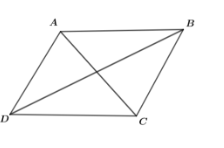
Now, we look at its lines of symmetry. If we see then only by folding a rhombus into vertically half then we see that this half line cannot be the line of symmetry as the lines will not coincide. Similarly, if we fold the rhombus into horizontally half then we come across a there is also no line of symmetry forming again. By this we have come to the conclusion that if we fold the rhombus into two halves one by one in a way that they coincide on their halves, then a rhombus still has only 2 lines of symmetry. And these lines of symmetries are its diagonals.
Hence, rhombus has two lines of symmetry.
Note: By comparing the rhombus to a square one can draw four lines of symmetry as a square has four lines of symmetry. Since, all the angles of a rhombus are not ${{90}^{\circ }}$ like that of a square then its lines of symmetry is only 2. Similarly, after comparing to the rectangle we will see the folding coinciding to each other in case of both rectangle and rhombus. One can mistake while finding the symmetries of any shape. By using the above folding part, we will be able to answer any question properly regarding symmetry of any form or shape. Also, while solving these types of questions, remembering the degree of the shape will ease us in finding the symmetries.
Complete step-by-step answer:
If we see a rhombus we get to know that it comes from a family of squares and rectangular shapes. This is because if we see the rhombus we come to know that these three have the similar lines or we can say that these three have parallel lines opposite to each other.
The figure for a rhombus is shown below.
Now, we look at its lines of symmetry. If we see then only by folding a rhombus into vertically half then we see that this half line cannot be the line of symmetry as the lines will not coincide. Similarly, if we fold the rhombus into horizontally half then we come across a there is also no line of symmetry forming again. By this we have come to the conclusion that if we fold the rhombus into two halves one by one in a way that they coincide on their halves, then a rhombus still has only 2 lines of symmetry. And these lines of symmetries are its diagonals.
Hence, rhombus has two lines of symmetry.
Note: By comparing the rhombus to a square one can draw four lines of symmetry as a square has four lines of symmetry. Since, all the angles of a rhombus are not ${{90}^{\circ }}$ like that of a square then its lines of symmetry is only 2. Similarly, after comparing to the rectangle we will see the folding coinciding to each other in case of both rectangle and rhombus. One can mistake while finding the symmetries of any shape. By using the above folding part, we will be able to answer any question properly regarding symmetry of any form or shape. Also, while solving these types of questions, remembering the degree of the shape will ease us in finding the symmetries.

Recently Updated Pages
Master Class 11 English: Engaging Questions & Answers for Success

Master Class 11 Social Science: Engaging Questions & Answers for Success
Master Class 11 Maths: Engaging Questions & Answers for Success
Master Class 11 Biology: Engaging Questions & Answers for Success
Master Class 11 Physics: Engaging Questions & Answers for Success
Master Class 11 Chemistry: Engaging Questions & Answers for Success
Trending doubts
In Indian rupees 1 trillion is equal to how many c class 8 maths CBSE
What is BLO What is the full form of BLO class 8 social science CBSE
What are the 12 elements of nature class 8 chemistry CBSE
Citizens of India can vote at the age of A 18 years class 8 social science CBSE
Which of the following leader has given the term insensate class 8 social science CBSE
Name the states through which the Tropic of Cancer class 8 social science CBSE