




State Ampere’s circuital law.
Answer
 Verified
549.9k+ views
Hint: In this question consider a straight current carrying wire since current is simply flow of electrons and this flow of electrons give rise to a magnetic field thus magnetic fields and also consider an imaginary loop around this conductor as shown also known as imperial loop of radius r, so write the magnetic field at any point on this loop. This will help approaching the problem.
Step By Step Answer:
Ampere’s Circuital law:
It is the relationship between the current and the magnetic field created by the current.
So according to this law the integral of magnetic field density (B) along an imaginary path is equal to the product of the permeability of the free space and the current enclosed by the path.
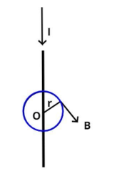
Let us consider an electrical conductor which carries current I in the downward direction as shown in the figure, we also consider an imaginary loop around this conductor as shown also known as amperian loop, so due to this the magnetic field at any point on this loop is given as,
$\oint {\vec B.d\vec l = {\mu _o} \times } I$
Where, ${\mu _o}$ = permeability of the free space = $4\pi \times {10^{ - 7}}$H/m.
This law is the basis of the Biot – savart law
Biot – savart law –
The Biot-Savart Law is an equation that describes the magnetic field created by a current-carrying wire and allows you to calculate its strength at various points.
Biot Savart Law
$\left( i \right)$ Directly proportional to current (I)
$\left( {ii} \right)$ Directly proportional to the length of the element (dl)
$\left( {iii} \right)$ Directly proportional to the sine of angle θ between the direction of current and the line joining the element dl.
$\left( {iv} \right)$ Inversely proportional to the square of the distance (r) of point A from the element dl.
$\left( v \right)$ $B = \dfrac{{{\mu _o}}}{{4\pi }}\dfrac{{Idl\sin \theta }}{{{r^2}}}$
Note: The same role ampere’s circuital law plays in magnetic physics the same is played by Gauss Law in electrostatic physics. The common thing about Gauss law and ampere circuital law is that both are applied to the systems in which the current flowing has symmetrical distribution.
Step By Step Answer:
Ampere’s Circuital law:
It is the relationship between the current and the magnetic field created by the current.
So according to this law the integral of magnetic field density (B) along an imaginary path is equal to the product of the permeability of the free space and the current enclosed by the path.
Let us consider an electrical conductor which carries current I in the downward direction as shown in the figure, we also consider an imaginary loop around this conductor as shown also known as amperian loop, so due to this the magnetic field at any point on this loop is given as,
$\oint {\vec B.d\vec l = {\mu _o} \times } I$
Where, ${\mu _o}$ = permeability of the free space = $4\pi \times {10^{ - 7}}$H/m.
This law is the basis of the Biot – savart law
Biot – savart law –
The Biot-Savart Law is an equation that describes the magnetic field created by a current-carrying wire and allows you to calculate its strength at various points.
Biot Savart Law
$\left( i \right)$ Directly proportional to current (I)
$\left( {ii} \right)$ Directly proportional to the length of the element (dl)
$\left( {iii} \right)$ Directly proportional to the sine of angle θ between the direction of current and the line joining the element dl.
$\left( {iv} \right)$ Inversely proportional to the square of the distance (r) of point A from the element dl.
$\left( v \right)$ $B = \dfrac{{{\mu _o}}}{{4\pi }}\dfrac{{Idl\sin \theta }}{{{r^2}}}$
Note: The same role ampere’s circuital law plays in magnetic physics the same is played by Gauss Law in electrostatic physics. The common thing about Gauss law and ampere circuital law is that both are applied to the systems in which the current flowing has symmetrical distribution.
Recently Updated Pages
Master Class 12 Business Studies: Engaging Questions & Answers for Success

Master Class 12 Biology: Engaging Questions & Answers for Success
Master Class 12 Chemistry: Engaging Questions & Answers for Success
Class 12 Question and Answer - Your Ultimate Solutions Guide
Master Class 11 Social Science: Engaging Questions & Answers for Success
Master Class 11 English: Engaging Questions & Answers for Success
Trending doubts
Which is more stable and why class 12 chemistry CBSE
Which are the Top 10 Largest Countries of the World?
Draw a labelled sketch of the human eye class 12 physics CBSE
Differentiate between homogeneous and heterogeneous class 12 chemistry CBSE
What are the major means of transport Explain each class 12 social science CBSE
Sulphuric acid is known as the king of acids State class 12 chemistry CBSE