




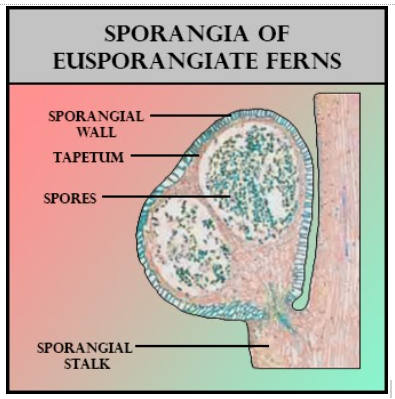
Sporangia of eusporangiate ferns
(a)Possess a single layer of wall cells
(b)Produce very few spores
(c)Originate from a group of initial cells
(d)Dehiscence at the region of a wall defined stomium
Answer
 Verified
662.4k+ views
Hint: Vascular spore plants, whose sporangia originate from multiple epidermal cells, are Eusporangiate ferns. They contain specialized ring-shaped cells for spore release. Up to 7000 spores are produced by the Christensenia fern per sporangium. A periclinal wall, containing an outer and inner daughter cell, separates a superficial cell.
Complete answer:
There is a large sporangium in Eusporangiate ferns that grows from many initial cells that contain several spores. The sporangium fuses in certain instances to form Synangium. E.g., Selaginella and Psilotum. These ferns usually have reduced root systems and sporangia that contain large quantities of spores. E.g., Psilotum, Equisetum, etc.
The sporangia are thin-walled and an area of cells with thick inner walls and thin outer walls, causes dehiscence, generally in a ring called the annulus.
Additional Information: An annulus on the sporangium is an arc or a ring of specialized cells. These cells are grouped in one row and are associated with spore release or dispersal.
Leptosporangiate has a small sporangium and it grows from a single initial cell. They are capable of producing a small, definite number of spores (Less than 128).
So, the correct answer is, ‘Originate from a group of initial cells’.
Note: -A sporangium (the plural form is known as sporangia) is the capsule structure of many plants and fungi that produces and stores reproductive spores. Via meiosis, most sporangia create haploid spores, although some can develop spores via mitosis.
-Both land plants undergo an alteration to replicate over centuries. The sporangium is held by the sporophyte.
Complete answer:
There is a large sporangium in Eusporangiate ferns that grows from many initial cells that contain several spores. The sporangium fuses in certain instances to form Synangium. E.g., Selaginella and Psilotum. These ferns usually have reduced root systems and sporangia that contain large quantities of spores. E.g., Psilotum, Equisetum, etc.
The sporangia are thin-walled and an area of cells with thick inner walls and thin outer walls, causes dehiscence, generally in a ring called the annulus.
Additional Information: An annulus on the sporangium is an arc or a ring of specialized cells. These cells are grouped in one row and are associated with spore release or dispersal.
Leptosporangiate has a small sporangium and it grows from a single initial cell. They are capable of producing a small, definite number of spores (Less than 128).
So, the correct answer is, ‘Originate from a group of initial cells’.
Note: -A sporangium (the plural form is known as sporangia) is the capsule structure of many plants and fungi that produces and stores reproductive spores. Via meiosis, most sporangia create haploid spores, although some can develop spores via mitosis.
-Both land plants undergo an alteration to replicate over centuries. The sporangium is held by the sporophyte.
Recently Updated Pages
Which will be the least stable resonating structure class 11 chemistry CBSE

How many 5 digit telephone numbers can be construc-class-11-maths-CBSE
How do you find the angle of the resultant vector class 11 physics CBSE
Draw labelled diagram of the following i Gram seed class 11 biology CBSE
1 Quintal is equal to a 110 kg b 10 kg c 100kg d 1000 class 11 physics CBSE
What is the need and importance of classification class 11 biology CBSE
Trending doubts
Find the value of the expression given below sin 30circ class 11 maths CBSE
One Metric ton is equal to kg A 10000 B 1000 C 100 class 11 physics CBSE
Draw a diagram of nephron and explain its structur class 11 biology CBSE
10 examples of friction in our daily life
Draw a diagram of a plant cell and label at least eight class 11 biology CBSE
Difference Between Prokaryotic Cells and Eukaryotic Cells