




Spirogyra is a
(a)Fungi
(b)Bacteria
(c)Algae
(d)None of the above
Answer
 Verified
602.4k+ views
Hint: Spirogyra is also known as water silk, mermaid’s tresses, and blanket weed. It has a filamentous structure and is known for the helical or spiral arrangement of its chloroplast. Defined in freshwater habitats and are present in more than 400 species around the world.
Complete answer:
Spirogyra is an alga. It is a filamentous green alga that is found in eutrophic water. It develops slimy filamentous green masses. Spirogyra grows well underwater but forms bubbles between the Tangled filaments when there is enough sunlight and warmth. They produce a large amount of oxygen in the presence of sunlight. The filamentous green algae form large masses when it comes to the surface and forms slim green mats that are visible on the surface of the water. They contain unbranched vegetative structures. The name of the genus Spirogyra is named after the chloroplast present in the cell of algae. Spirogyra is photosynthetic and helps in carbon dioxide fixation. They started increasing the level of oxygen in their habitat and many of the aquatic organisms started feeding on them.
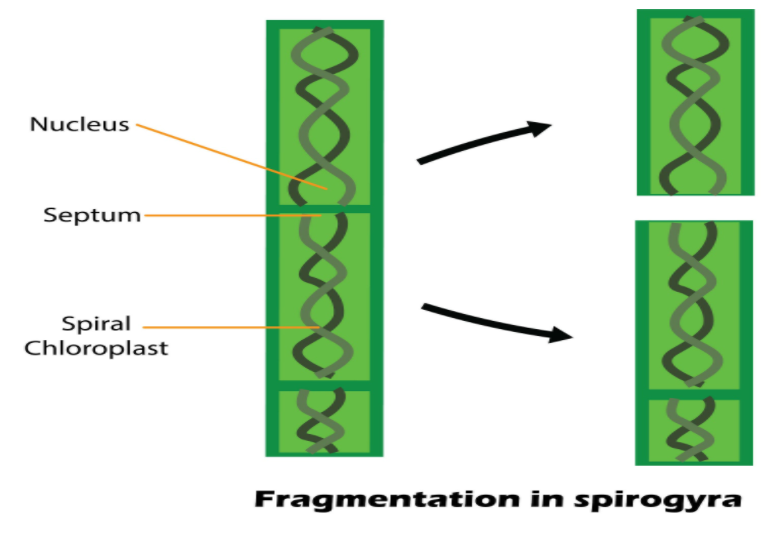
Additional Information: Due to the presence of chlorophyll, spirogyra is classified under the Chlorophyta. The vegetative structure of spirogyra is an unbranched filamentous thallus. It is multicellular with each cylindrical cell joined from end to end. The cell wall of spirogyra contains cellulose and pectose on the inner and outer layers respectively. Pectose gets dissolved in the water due to which the mucilage sheath gets slimy. It contains a 1-16 chloroplast which is arranged spirally. Pyrenoids are present in the chloroplast which stores starch in protein. Spirogyra reproduces sexually and asexually. Spirogyra undergoes vegetative reproduction by the process of fragmentation through which a vegetative filament develops into a new filament. Fragmentation can be due to mechanical injury. Sexual reproduction is done by the formation of aplanospores and zygospores which are unable to fuse during sexual reproduction and develop a new filament asexually.
So, the correct answer is 'algae'.
Note: Spirogyra is known for its spiral shape and reproduction by the conjugation method. It ranges from 10-100 micrometers in width. It can stretch up to several centimeters. It performs two types of conjugation that are scalariform and lateral.
Complete answer:
Spirogyra is an alga. It is a filamentous green alga that is found in eutrophic water. It develops slimy filamentous green masses. Spirogyra grows well underwater but forms bubbles between the Tangled filaments when there is enough sunlight and warmth. They produce a large amount of oxygen in the presence of sunlight. The filamentous green algae form large masses when it comes to the surface and forms slim green mats that are visible on the surface of the water. They contain unbranched vegetative structures. The name of the genus Spirogyra is named after the chloroplast present in the cell of algae. Spirogyra is photosynthetic and helps in carbon dioxide fixation. They started increasing the level of oxygen in their habitat and many of the aquatic organisms started feeding on them.
Additional Information: Due to the presence of chlorophyll, spirogyra is classified under the Chlorophyta. The vegetative structure of spirogyra is an unbranched filamentous thallus. It is multicellular with each cylindrical cell joined from end to end. The cell wall of spirogyra contains cellulose and pectose on the inner and outer layers respectively. Pectose gets dissolved in the water due to which the mucilage sheath gets slimy. It contains a 1-16 chloroplast which is arranged spirally. Pyrenoids are present in the chloroplast which stores starch in protein. Spirogyra reproduces sexually and asexually. Spirogyra undergoes vegetative reproduction by the process of fragmentation through which a vegetative filament develops into a new filament. Fragmentation can be due to mechanical injury. Sexual reproduction is done by the formation of aplanospores and zygospores which are unable to fuse during sexual reproduction and develop a new filament asexually.
So, the correct answer is 'algae'.
Note: Spirogyra is known for its spiral shape and reproduction by the conjugation method. It ranges from 10-100 micrometers in width. It can stretch up to several centimeters. It performs two types of conjugation that are scalariform and lateral.
Recently Updated Pages
Master Class 11 Social Science: Engaging Questions & Answers for Success

Master Class 11 Chemistry: Engaging Questions & Answers for Success
Master Class 9 General Knowledge: Engaging Questions & Answers for Success
Master Class 9 Maths: Engaging Questions & Answers for Success
Master Class 9 Science: Engaging Questions & Answers for Success
Master Class 9 English: Engaging Questions & Answers for Success
Trending doubts
Explain zero factorial class 11 maths CBSE
Draw a diagram of a plant cell and label at least eight class 11 biology CBSE
What is the atomic mass of Sodium a 22 gmol b 23 gmol class 11 chemistry CBSE
Draw a diagram of nephron and explain its structur class 11 biology CBSE
How do I get the molar mass of urea class 11 chemistry CBSE
What organs are located on the left side of your body class 11 biology CBSE