




Some stars appear red in colour and some blue in colour. Which one of the statements is true?
A. Star with blue colour has more temperature than a red colour star.
B. The temperature of a blue colour star is less than a red colour star.
C. There is no relation between the colour of the star and temperature.
D. Blue colour stars and red colour stars have an equal temperature.
Answer
 Verified
658.5k+ views
Hint: Wien’s displacement law indicates that a black body of a certain temperature will emit maximum radiation at a specific wavelength and the wavelength depends on the temperature of the black body. So, the temperature of the sun guides the wavelength of emission. Wavelength is inversely proportional to the temperature.
Complete step-by-step answer:
Let us look at the Wien’s displacement law to understand the black body radiations. It states that -
“ The black-body radiation curve for different temperatures will peak at different wavelengths that are inversely proportional to the temperature.”
The following diagram shows the implications of this law.
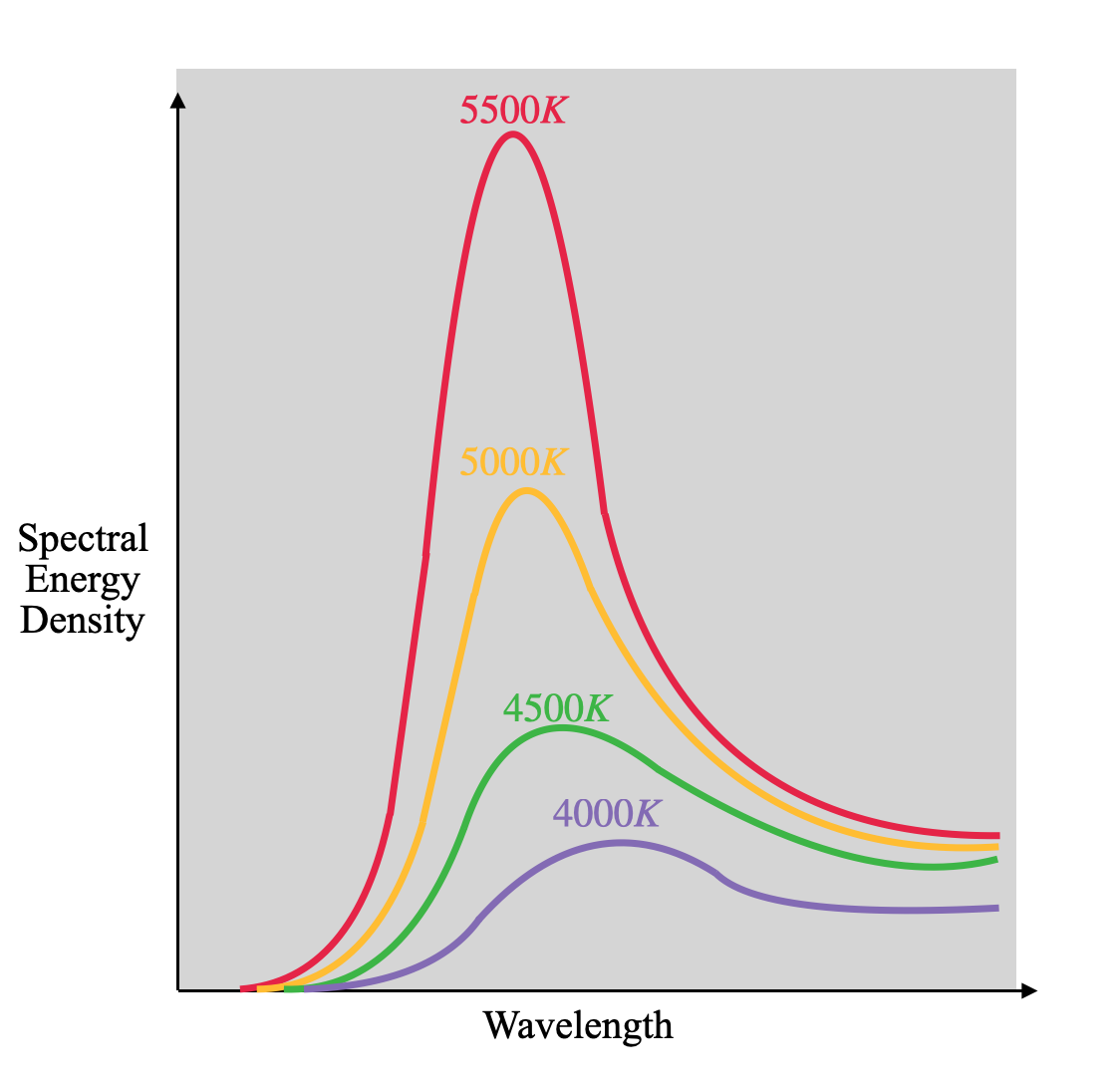
As we can see in the diagram, the temperature of the black-body guides the wavelength at which the spectral energy density is highest.
Blue light has a smaller wavelength in comparison to red light. As the temperature of a black body is inversely proportional to the wavelength of the light, hot bodies emit light in the ultraviolet region or sometimes blue. Colder bodies emit in the red or infrared region.
Colour of an object does not depend on the distance between the observer and the object. The intensity decreases as we move further from the emitting object. However, the colour remains the same, because all the colours go through the same intensity change.
So, the correct option is - (A).
Note:
The following table gives an average estimate of the surface temperature of the star with respect to its colour.
Complete step-by-step answer:
Let us look at the Wien’s displacement law to understand the black body radiations. It states that -
“ The black-body radiation curve for different temperatures will peak at different wavelengths that are inversely proportional to the temperature.”
The following diagram shows the implications of this law.
As we can see in the diagram, the temperature of the black-body guides the wavelength at which the spectral energy density is highest.
Blue light has a smaller wavelength in comparison to red light. As the temperature of a black body is inversely proportional to the wavelength of the light, hot bodies emit light in the ultraviolet region or sometimes blue. Colder bodies emit in the red or infrared region.
Colour of an object does not depend on the distance between the observer and the object. The intensity decreases as we move further from the emitting object. However, the colour remains the same, because all the colours go through the same intensity change.
So, the correct option is - (A).
Note:
The following table gives an average estimate of the surface temperature of the star with respect to its colour.
| Star Colour | Estimated Temperature |
| Blue | 25,000K |
| White | 10,000K |
| Yellow | 6000K |
| Red | 3000K |
Recently Updated Pages
Explain the structure of megasporangium class 12 biology CBSE

Why is chloroform kept in dark coloured bottles class 12 chemistry CBSE
Derive the balancing condition of a Wheatstone bri class 12 physics CBSE
Draw VI characteristics of a pn junction diode Explain class 12 physics CBSE
Is it possible to carry pride in ones language too class 12 english CBSE
In a population at Hardy Weinberg equilibrium the allele class 12 biology CBSE
Trending doubts
Draw a labelled sketch of the human eye class 12 physics CBSE
Which are the Top 10 Largest Countries of the World?
Draw ray diagrams each showing i myopic eye and ii class 12 physics CBSE
Which is the correct genotypic ratio of mendel dihybrid class 12 biology CBSE
Differentiate between homogeneous and heterogeneous class 12 chemistry CBSE
Which animal never drinks water in its entire life class 12 biology CBSE