




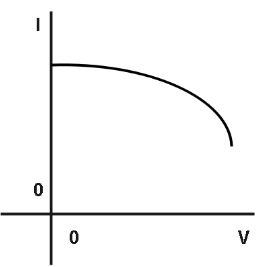
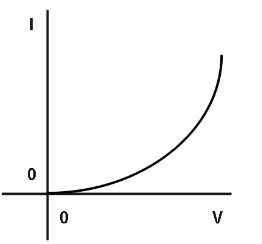
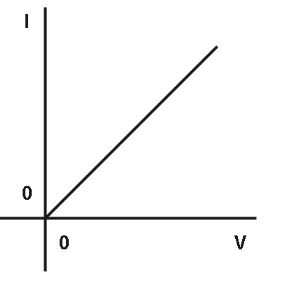
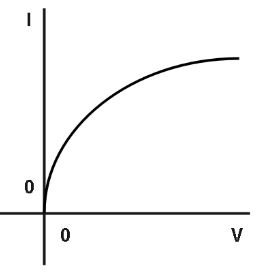
Some early electric light bulbs used carbon filaments, the resistances of which decreased as their temperature increased. Which of the following graphs best represents the way in which $I$, the current through such a bulb, would depend upon $V$, the potential difference across it?
A.
B.
C.
D.
Answer
 Verified
480.3k+ views
Hint: To solve this question, you must have a concept of the heating effect of current and Ohm’s law then you can easily solve this question. Here first we will understand the question very clearly and then as per the question we will obtain the equation and then with the concept of heating effect of current we will pick the correct answer.
Complete step by step answer:
According to the questions, as we increase in temperature we see a decrease in resistance.
\[T \propto \dfrac{1}{R}\]
Now, if we increase the voltage across the bulb then, heat will be increased, temperature will be increased, resistance of the carbon resistor decreases and more current consumed.As a result, as the voltage is increased, the current through the bulb increases, and this growth is parabolic in form since the heat decapitation is proportional to${v^2}$ , as does the increase in current.
So, we can say that the correct option is B.
Note: Thermal energy is generated inside the conductor when the current runs through it. The current's heating impact is influenced by three primary elements. Resistance is directly proportional to the amount of heat generated. Time is directly proportional to the amount of heat generated. Current is directly proportional to the amount of heat generated.We can conclude that $H = {I^2}RT$.
Complete step by step answer:
According to the questions, as we increase in temperature we see a decrease in resistance.
\[T \propto \dfrac{1}{R}\]
Now, if we increase the voltage across the bulb then, heat will be increased, temperature will be increased, resistance of the carbon resistor decreases and more current consumed.As a result, as the voltage is increased, the current through the bulb increases, and this growth is parabolic in form since the heat decapitation is proportional to${v^2}$ , as does the increase in current.
So, we can say that the correct option is B.
Note: Thermal energy is generated inside the conductor when the current runs through it. The current's heating impact is influenced by three primary elements. Resistance is directly proportional to the amount of heat generated. Time is directly proportional to the amount of heat generated. Current is directly proportional to the amount of heat generated.We can conclude that $H = {I^2}RT$.
Recently Updated Pages
Master Class 12 Economics: Engaging Questions & Answers for Success

Master Class 12 Physics: Engaging Questions & Answers for Success
Master Class 12 English: Engaging Questions & Answers for Success
Master Class 12 Social Science: Engaging Questions & Answers for Success
Master Class 12 Maths: Engaging Questions & Answers for Success
Master Class 12 Business Studies: Engaging Questions & Answers for Success
Trending doubts
Which are the Top 10 Largest Countries of the World?
What are the major means of transport Explain each class 12 social science CBSE
Draw a labelled sketch of the human eye class 12 physics CBSE
Why cannot DNA pass through cell membranes class 12 biology CBSE
Differentiate between insitu conservation and exsitu class 12 biology CBSE
Draw a neat and well labeled diagram of TS of ovary class 12 biology CBSE