



Solve the following systems of linear equations graphically:
$\begin{align}
& 2x+3y=6 \\
& 4x+6y=12 \\
\end{align}$
Answer
 Verified
606.9k+ views
Hint: Here, we will sketch the graph of both the given lines and then we will check that at which point they intersect each other. This point of intersection will give us the solution to the given system of linear equations.
Complete step-by-step answer:
To solve a system of equations or simultaneous equations by the graphical method, we draw the graph for each of the equations and look for a point of intersections between the two graphs. The co-ordinates of the point of intersection will be the solution to the system of equations. The solution is such that it satisfies both the lines.
If the two lines become parallel to each other, that is they do not intersect then the system of equations has no solution and if the lines coincide, the system of equations has infinite number of solutions.
The system of equations given to us here is:
$\begin{align}
& 2x+3y=6.........\left( 1 \right) \\
& 4x+6y=12........\left( 2 \right) \\
\end{align}$
For the first line i.e. 2x+3y=6, we can give values of y corresponding to different values of x as follows:
When we take x =3, we can write from equation (1):
$\begin{align}
& 2\times 3+3y=6 \\
& \Rightarrow 6+3y=6 \\
& \Rightarrow 3y=6-6 \\
& \Rightarrow y=0 \\
\end{align}$
When we take x= -3, we have:
$\begin{align}
& 2\times \left( -3 \right)+3y=6 \\
& \Rightarrow -6+3y=6 \\
& \Rightarrow 3y=12 \\
& \Rightarrow y=4 \\
\end{align}$
So, two points lying on the 1st line are (3, 0) and (-3, 4).
Similarly for the second line, i.e.4x+6y=12, we can give values of y corresponding to different values of x as follows:
When we take x= 6, we can write from equation (2):
$\begin{align}
& 4\times 6+6y=12 \\
& \Rightarrow 24+6y=12 \\
& \Rightarrow 6y=-12 \\
& \Rightarrow y=-2 \\
\end{align}$
When we take x= -3, we have:
$\begin{align}
& 4\times \left( -3 \right)+6y=12 \\
& \Rightarrow -12+6y=12 \\
& \Rightarrow 6y=24 \\
& \Rightarrow y=4 \\
\end{align}$
So, two points lying on the 2nd line are (6, -2) and (-3, 4).
So, the graph of the given lines can be made as:
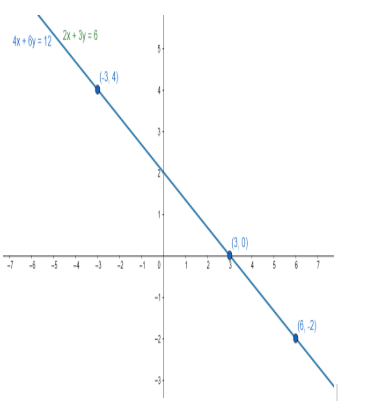
We can see that the graph of both the lines coincide with each other.
Hence, there are infinitely many solutions of the given system of equations.
Note: Students should note here that we can take any value of x to get a corresponding value of y but for our convenience we should prefer to take simple values. The graph must be made properly. We can also cross- verify the answer by solving the equations algebraically.
Complete step-by-step answer:
To solve a system of equations or simultaneous equations by the graphical method, we draw the graph for each of the equations and look for a point of intersections between the two graphs. The co-ordinates of the point of intersection will be the solution to the system of equations. The solution is such that it satisfies both the lines.
If the two lines become parallel to each other, that is they do not intersect then the system of equations has no solution and if the lines coincide, the system of equations has infinite number of solutions.
The system of equations given to us here is:
$\begin{align}
& 2x+3y=6.........\left( 1 \right) \\
& 4x+6y=12........\left( 2 \right) \\
\end{align}$
For the first line i.e. 2x+3y=6, we can give values of y corresponding to different values of x as follows:
When we take x =3, we can write from equation (1):
$\begin{align}
& 2\times 3+3y=6 \\
& \Rightarrow 6+3y=6 \\
& \Rightarrow 3y=6-6 \\
& \Rightarrow y=0 \\
\end{align}$
When we take x= -3, we have:
$\begin{align}
& 2\times \left( -3 \right)+3y=6 \\
& \Rightarrow -6+3y=6 \\
& \Rightarrow 3y=12 \\
& \Rightarrow y=4 \\
\end{align}$
So, two points lying on the 1st line are (3, 0) and (-3, 4).
Similarly for the second line, i.e.4x+6y=12, we can give values of y corresponding to different values of x as follows:
When we take x= 6, we can write from equation (2):
$\begin{align}
& 4\times 6+6y=12 \\
& \Rightarrow 24+6y=12 \\
& \Rightarrow 6y=-12 \\
& \Rightarrow y=-2 \\
\end{align}$
When we take x= -3, we have:
$\begin{align}
& 4\times \left( -3 \right)+6y=12 \\
& \Rightarrow -12+6y=12 \\
& \Rightarrow 6y=24 \\
& \Rightarrow y=4 \\
\end{align}$
So, two points lying on the 2nd line are (6, -2) and (-3, 4).
So, the graph of the given lines can be made as:
We can see that the graph of both the lines coincide with each other.
Hence, there are infinitely many solutions of the given system of equations.
Note: Students should note here that we can take any value of x to get a corresponding value of y but for our convenience we should prefer to take simple values. The graph must be made properly. We can also cross- verify the answer by solving the equations algebraically.
Recently Updated Pages
Complete reduction of benzene diazonium chloride with class 12 chemistry CBSE

How can you identify optical isomers class 12 chemistry CBSE
The coating formed on the metals such as iron silver class 12 chemistry CBSE
Metals are refined by using different methods Which class 12 chemistry CBSE
What do you understand by denaturation of proteins class 12 chemistry CBSE
Assertion Nitrobenzene is used as a solvent in FriedelCrafts class 12 chemistry CBSE
Trending doubts
Difference Between Plant Cell and Animal Cell
Fill the blanks with the suitable prepositions 1 The class 9 english CBSE
Which places in India experience sunrise first and class 9 social science CBSE
What is pollution? How many types of pollution? Define it
Name 10 Living and Non living things class 9 biology CBSE
What is the full form of pH?