




What is soap $?$ Describe its preparation.
Answer
 Verified
582.6k+ views
Hint :Soap, a surfactant is a form of lipid which is a mixture of sodium salts of various naturally occurring higher fatty acids like palmitic acid $ ({C_{15}}{H_{31}}COOH) $ i.e. fatty acids having long carbon chain. Soap can be made from the base hydrolysis of a fat or an oil, the process known as saponification.
Complete Step By Step Answer:
Soap is a form of lipid and is a mixture of sodium salts of various naturally occurring higher fatty acids. A fatty acid is a carboxylic acid with a long aliphatic chain, which is either saturated or unsaturated. Most naturally occurring fatty acids have an unbranched chain of an even number of carbon atoms, from 4 to 28. Soaps generally contain higher fatty acids having long carbon chains like palmitic acid $ ({C_{15}}{H_{31}}COOH) $ .
Soap is made from the base hydrolysis of a fat or an oil and this process of hydrolysis is called saponification.
When fats and oils are triesters of glycerol and three fatty acids are hydrolysed, esters are hydrolyzed to their alcohol and carboxylic acid components in the presence of bases like $ NaOH $ or $ KOH $ . Since a base is used for hydrolysis, the fatty acids produced are deprotonated and are present as the corresponding carboxylate salts. Glycerol is obtained as the side product in the reaction. The equation corresponding to saponification is:
$ Triesters\,of\,glycerol\,and\,three\,fatty\,acids\, + \,3\,NaOH\, \to \,Glycerol\, + \,Soap $ .
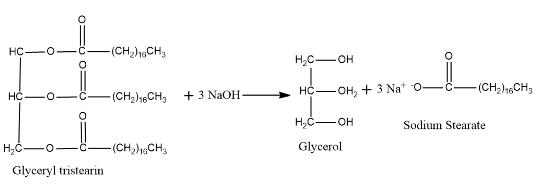
Example: When glycerol tristearin, a fat is hydrolysed we get sodium stearate, a soap and glycerol as the side product.
Note :
Detergents are similar to soaps in that they have a charged head group and a long nonpolar tail group, but they are not prepared from natural fats or oils. Soaps are less effective in hard water which contains a significant concentration of $ C{a^{ + 2}} $ and $ M{g^{ + 2}} $ ions as these ions form precipitates with soap molecules. Soaps are effective in soft water where formation of precipitate is less. While detergents are useful because they do not form precipitates with $ C{a^{ + 2}} $ and $ M{g^{ + 2}} $ ions, which means that they work in both soft and hard water.
Complete Step By Step Answer:
Soap is a form of lipid and is a mixture of sodium salts of various naturally occurring higher fatty acids. A fatty acid is a carboxylic acid with a long aliphatic chain, which is either saturated or unsaturated. Most naturally occurring fatty acids have an unbranched chain of an even number of carbon atoms, from 4 to 28. Soaps generally contain higher fatty acids having long carbon chains like palmitic acid $ ({C_{15}}{H_{31}}COOH) $ .
Soap is made from the base hydrolysis of a fat or an oil and this process of hydrolysis is called saponification.
When fats and oils are triesters of glycerol and three fatty acids are hydrolysed, esters are hydrolyzed to their alcohol and carboxylic acid components in the presence of bases like $ NaOH $ or $ KOH $ . Since a base is used for hydrolysis, the fatty acids produced are deprotonated and are present as the corresponding carboxylate salts. Glycerol is obtained as the side product in the reaction. The equation corresponding to saponification is:
$ Triesters\,of\,glycerol\,and\,three\,fatty\,acids\, + \,3\,NaOH\, \to \,Glycerol\, + \,Soap $ .
Example: When glycerol tristearin, a fat is hydrolysed we get sodium stearate, a soap and glycerol as the side product.
Note :
Detergents are similar to soaps in that they have a charged head group and a long nonpolar tail group, but they are not prepared from natural fats or oils. Soaps are less effective in hard water which contains a significant concentration of $ C{a^{ + 2}} $ and $ M{g^{ + 2}} $ ions as these ions form precipitates with soap molecules. Soaps are effective in soft water where formation of precipitate is less. While detergents are useful because they do not form precipitates with $ C{a^{ + 2}} $ and $ M{g^{ + 2}} $ ions, which means that they work in both soft and hard water.
Recently Updated Pages
Master Class 12 Business Studies: Engaging Questions & Answers for Success

Master Class 12 Chemistry: Engaging Questions & Answers for Success
Master Class 12 Biology: Engaging Questions & Answers for Success
Class 12 Question and Answer - Your Ultimate Solutions Guide
Master Class 11 English: Engaging Questions & Answers for Success
Master Class 11 Social Science: Engaging Questions & Answers for Success
Trending doubts
Which are the Top 10 Largest Countries of the World?
Draw a labelled sketch of the human eye class 12 physics CBSE
Differentiate between homogeneous and heterogeneous class 12 chemistry CBSE
Differentiate between Pyramid of energy and pyramid class 12 biology CBSE
Why is the cell called the structural and functional class 12 biology CBSE
Draw the diagram of the pyramid of energy Explain In class 12 biology CBSE