




Soap bubble looks colored due to
A. dispersion
B. reflection
C. interference
D. None of these
Answer
 Verified
618.9k+ views
Hint: We know that the soap bubble is a thin layer or surface of water sandwiched between two layers of soap molecules. The film of soapy water surrounds a bubble of air. The one end of soap repels with water, and the other end attracts, so the molecules move to the inner and outer surfaces.
Complete step by step answer:
The bubble formed by a thin film of water and soap, and it has an outer and an inner surface. Each surface reflects an amount of light, and the waves of both reflections interact with each other, sometimes adding up and sometimes cancelling each other.
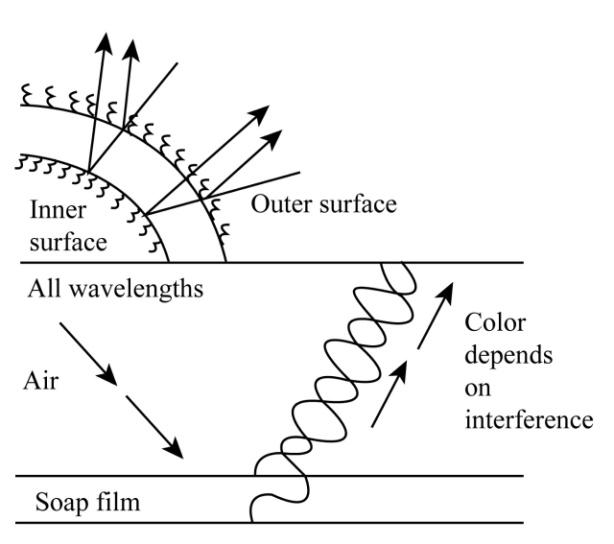
Some wavelengths will interfere destructively and other constructively, depending upon the extra distance travelled by a transmitted and reflected ray. This distance depends upon the angle of incident of light and thickness of the film. White light is made up of different colours, corresponding to specific wavelengths. As the thickness of the film changes, at an extra distance, the ray must be changed. Therefore the interference is constructive when the total extra distance matches a specific wavelength of light, and it is destructive when it is a half wavelength. So if white light shines on a bubble, the film reflects light of a specific colour and this colour changes with the film thickness. That means if a soap film is of uniform thickness, different colours are shown. This phenomenon is called interference.
Therefore, the correct option is (C).
Note:
A bubble can exist because the surface layer of a liquid (usual water) has a specific surface tension, which causes the coating to behave somewhat like an elastic sheet. If the distance is more between the water molecules causes a decrease in surface tension, enabling bubbles to form.
Complete step by step answer:
The bubble formed by a thin film of water and soap, and it has an outer and an inner surface. Each surface reflects an amount of light, and the waves of both reflections interact with each other, sometimes adding up and sometimes cancelling each other.
Some wavelengths will interfere destructively and other constructively, depending upon the extra distance travelled by a transmitted and reflected ray. This distance depends upon the angle of incident of light and thickness of the film. White light is made up of different colours, corresponding to specific wavelengths. As the thickness of the film changes, at an extra distance, the ray must be changed. Therefore the interference is constructive when the total extra distance matches a specific wavelength of light, and it is destructive when it is a half wavelength. So if white light shines on a bubble, the film reflects light of a specific colour and this colour changes with the film thickness. That means if a soap film is of uniform thickness, different colours are shown. This phenomenon is called interference.
Therefore, the correct option is (C).
Note:
A bubble can exist because the surface layer of a liquid (usual water) has a specific surface tension, which causes the coating to behave somewhat like an elastic sheet. If the distance is more between the water molecules causes a decrease in surface tension, enabling bubbles to form.
Recently Updated Pages
Master Class 12 Economics: Engaging Questions & Answers for Success

Master Class 12 English: Engaging Questions & Answers for Success
Master Class 12 Social Science: Engaging Questions & Answers for Success
Master Class 12 Maths: Engaging Questions & Answers for Success
Master Class 12 Physics: Engaging Questions & Answers for Success
Master Class 9 General Knowledge: Engaging Questions & Answers for Success
Trending doubts
Which are the Top 10 Largest Countries of the World?
Draw a labelled sketch of the human eye class 12 physics CBSE
Differentiate between homogeneous and heterogeneous class 12 chemistry CBSE
Why is the cell called the structural and functional class 12 biology CBSE
Draw ray diagrams each showing i myopic eye and ii class 12 physics CBSE
Which is the correct genotypic ratio of mendel dihybrid class 12 biology CBSE