




Smallest cell organelle which is called cell engine is:
(a) Ribosome
(b) Lysosome
(c) Vacuoles
(d) Endoplasmic reticulum
Answer
 Verified
589.5k+ views
Hint: They are minute particles consisting of RNA and associated proteins that function to synthesize proteins. They are needed for many cellular functions which mainly includes repairing damage or directing chemical processes.
Complete answer:
Ribosomes are the engines of cells as they make all the cell’s proteins, which carry out the cell’s functions. They occur as both free particles in prokaryotic and eukaryotic cells and as particles attached to the membranes of the endoplasmic reticulum in eukaryotic cells. Cells have many ribosomes, and the number mainly depends on how active a particular cell is in synthesizing proteins. The translation is the process through which the ribosome produces proteins.
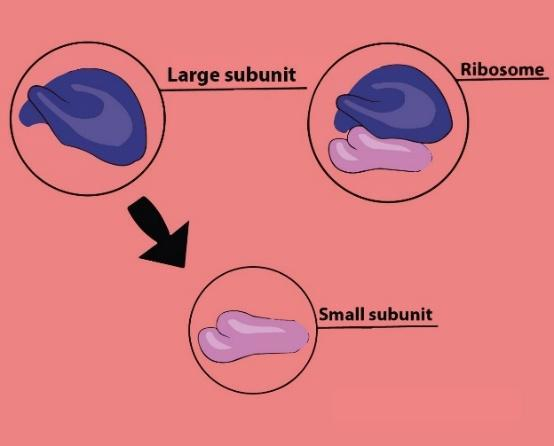
Within the ribosome, the rRNA molecules govern the catalytic steps of protein synthesis. The procedure includes stitching together amino acids to make a protein molecule. Therefore, rRNA is also called a ribozyme or catalytic RNA to reflect this function.
Additional information: Ribosomes are the sites at which information is carried in the form of genetic code and is converted into protein molecules. Each ribosome unit is composed of two subunits, a larger one and a smaller one, each of which has a characteristic shape. Ribosome subunits
are typically referred to in terms of their sedimentation rate, which is measured in Svedberg units (S), in a centrifugal field.
So, the correct answer is ‘(a) Ribosome’.<.b>
Note: Ribosomes act as catalysts in two extremely important biological processes called peptidyl transfer(peptidyl transferase is an enzyme that catalyzes the addition of an amino acid residue in order to grow the polypeptide chain in protein synthesis) and peptidyl hydrolysis.
Complete answer:
Ribosomes are the engines of cells as they make all the cell’s proteins, which carry out the cell’s functions. They occur as both free particles in prokaryotic and eukaryotic cells and as particles attached to the membranes of the endoplasmic reticulum in eukaryotic cells. Cells have many ribosomes, and the number mainly depends on how active a particular cell is in synthesizing proteins. The translation is the process through which the ribosome produces proteins.
Within the ribosome, the rRNA molecules govern the catalytic steps of protein synthesis. The procedure includes stitching together amino acids to make a protein molecule. Therefore, rRNA is also called a ribozyme or catalytic RNA to reflect this function.
Additional information: Ribosomes are the sites at which information is carried in the form of genetic code and is converted into protein molecules. Each ribosome unit is composed of two subunits, a larger one and a smaller one, each of which has a characteristic shape. Ribosome subunits
are typically referred to in terms of their sedimentation rate, which is measured in Svedberg units (S), in a centrifugal field.
So, the correct answer is ‘(a) Ribosome’.<.b>
Note: Ribosomes act as catalysts in two extremely important biological processes called peptidyl transfer(peptidyl transferase is an enzyme that catalyzes the addition of an amino acid residue in order to grow the polypeptide chain in protein synthesis) and peptidyl hydrolysis.
Recently Updated Pages
Master Class 11 Social Science: Engaging Questions & Answers for Success

Master Class 11 English: Engaging Questions & Answers for Success
Master Class 11 Maths: Engaging Questions & Answers for Success
Master Class 11 Chemistry: Engaging Questions & Answers for Success
Master Class 11 Biology: Engaging Questions & Answers for Success
Master Class 11 Physics: Engaging Questions & Answers for Success
Trending doubts
Differentiate between an exothermic and an endothermic class 11 chemistry CBSE
One Metric ton is equal to kg A 10000 B 1000 C 100 class 11 physics CBSE
Difference Between Prokaryotic Cells and Eukaryotic Cells
There are 720 permutations of the digits 1 2 3 4 5 class 11 maths CBSE
Draw a diagram of a plant cell and label at least eight class 11 biology CBSE
Two of the body parts which do not appear in MRI are class 11 biology CBSE