




Sketching/ Drawing/ Constructing the food chains depending upon various components (producers, consumers) present in surroundings.
Answer
 Verified
592.2k+ views
Hint: A food chain is a linear representation of the relationship between the organisms in terms of transfer of food and energy. It represents who eats whom. If any of the components of the food chain is absent, then the whole ecological system is disturbed.
Complete answer:
A food chain is a representation of the relationship between the animals in terms of who eats whom. Each and every organism is directly or indirectly dependent on each other and occupies a specific position or the trophic level in the food chain.
The components of the food chain:
Autotrophs or the producers- These organisms occupy the base or lowest position in the food chain. It consists of producers or the plants which are able to prepare their own food by using energy from the sun through photosynthesis. For example- plants, cyanobacteria etc.
Primary consumers- These are the animals which depend on the producers for food. The primary consumers are mainly the herbivores which feed on the producers. Example- Deer, rat, goat etc.
Secondary consumers- These are the animals which depend on the herbivores for food. They are the carnivores which feed on the flesh of the other animal. Example- Lion, tiger, etc.
Decomposers- These organisms occupy the highest position in the food chain. It feeds on the dead decaying organic matter.
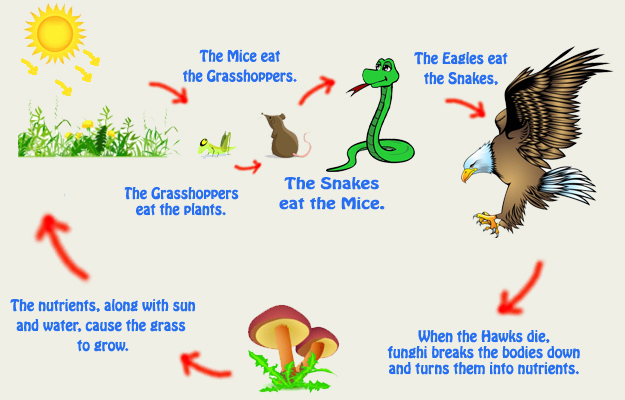
Here the plants are the autotrophs which produce food. The grasshopper is the primary consumer as it feeds on plants. The secondary consumers are mice which are being eaten by the snake and are further eaten by the hawk. The decomposer is the fungi which feed on the dead hawk.
Note: In terms of energy transfer, only 10% of the net energy transfers from one trophic level to another. The producers have the highest energy and the decomposers which occupy the highest level in the food chain have the lowest energy.
Complete answer:
A food chain is a representation of the relationship between the animals in terms of who eats whom. Each and every organism is directly or indirectly dependent on each other and occupies a specific position or the trophic level in the food chain.
The components of the food chain:
Autotrophs or the producers- These organisms occupy the base or lowest position in the food chain. It consists of producers or the plants which are able to prepare their own food by using energy from the sun through photosynthesis. For example- plants, cyanobacteria etc.
Primary consumers- These are the animals which depend on the producers for food. The primary consumers are mainly the herbivores which feed on the producers. Example- Deer, rat, goat etc.
Secondary consumers- These are the animals which depend on the herbivores for food. They are the carnivores which feed on the flesh of the other animal. Example- Lion, tiger, etc.
Decomposers- These organisms occupy the highest position in the food chain. It feeds on the dead decaying organic matter.
Here the plants are the autotrophs which produce food. The grasshopper is the primary consumer as it feeds on plants. The secondary consumers are mice which are being eaten by the snake and are further eaten by the hawk. The decomposer is the fungi which feed on the dead hawk.
Note: In terms of energy transfer, only 10% of the net energy transfers from one trophic level to another. The producers have the highest energy and the decomposers which occupy the highest level in the food chain have the lowest energy.
Recently Updated Pages
Master Class 12 Business Studies: Engaging Questions & Answers for Success

Master Class 12 Chemistry: Engaging Questions & Answers for Success
Master Class 12 Biology: Engaging Questions & Answers for Success
Class 12 Question and Answer - Your Ultimate Solutions Guide
Master Class 11 English: Engaging Questions & Answers for Success
Master Class 11 Social Science: Engaging Questions & Answers for Success
Trending doubts
Which are the Top 10 Largest Countries of the World?
Draw a labelled sketch of the human eye class 12 physics CBSE
Differentiate between homogeneous and heterogeneous class 12 chemistry CBSE
Why is the cell called the structural and functional class 12 biology CBSE
Draw ray diagrams each showing i myopic eye and ii class 12 physics CBSE
Which is the correct genotypic ratio of mendel dihybrid class 12 biology CBSE